
Variation
Adapting to the skillsets of Arsenal's new summer signings

I’m sure you are aware of the differences in how Gabriel Jesus and Kai Havertz interpret the CF role. The former has a preference for the left-hand side, and the latter’s tendency to drift to the right is rather conspicuous.
Obviously, there are additional nuances to consider, but the crucial conclusion in the context of this post is that they provide different qualities.
Meanwhile, Viktor Gyökeres prefers to stay on the last line, pinning CBs in the process and adding depth to the forward line via vertical runs. Basically, we have three different CFs.
Let’s now focus on the nominal RCM position. 23/24 Martin Ødegaard is the best Ødegaard we have seen. Stepping outside of the block, lots of touches on the ball, drifting laterally and dictating the tempo; his ability to find solutions and manipulate a block is brilliant. Eberechi Eze, on the other hand, wants to primarily dictate play between the opposition midfield and defensive line, operating in central spaces, whilst remaining close to the box. Again, two creative talents that aren’t remotely similar to each other.
This now brings me to one of the spurious Mikel Arteta narratives, who is supposedly a dictator and demands complete control over every aspect of play, thereby restricting individual freedom.
I want to emphasise ‘spurious’ because this rhetoric couldn’t be any further away from the truth.
Granted, our coach explicitly highlights the non-negotiables, which remain sacrosanct to him. But this is for the benefit of the team as a collective. If Arteta was a complete control freak, then you would expect Jesus, Havertz, and Gyökeres to be instructed to play the same way and likewise with Odegaard and Eze. But this doesn’t happen, which brings me to the diamond and a system that we have seen before under Arteta.
Have you noticed that since Eze’s inclusion at RCM, we have seen more instances of the nominal 3-4-3 diamond in play? I say nominal because there are always deviations from the specified shape or formation, and the opposition’s behaviours dictate these changes. If they are pressing high, then a different structure is required.
So, to be crystal clear, the context I’m referring to here is Arsenal being away from goal kicks, with the opposition not pressing as a unit and essentially remaining within a compact block. Take a look below for some examples against Fulham and Newcastle.
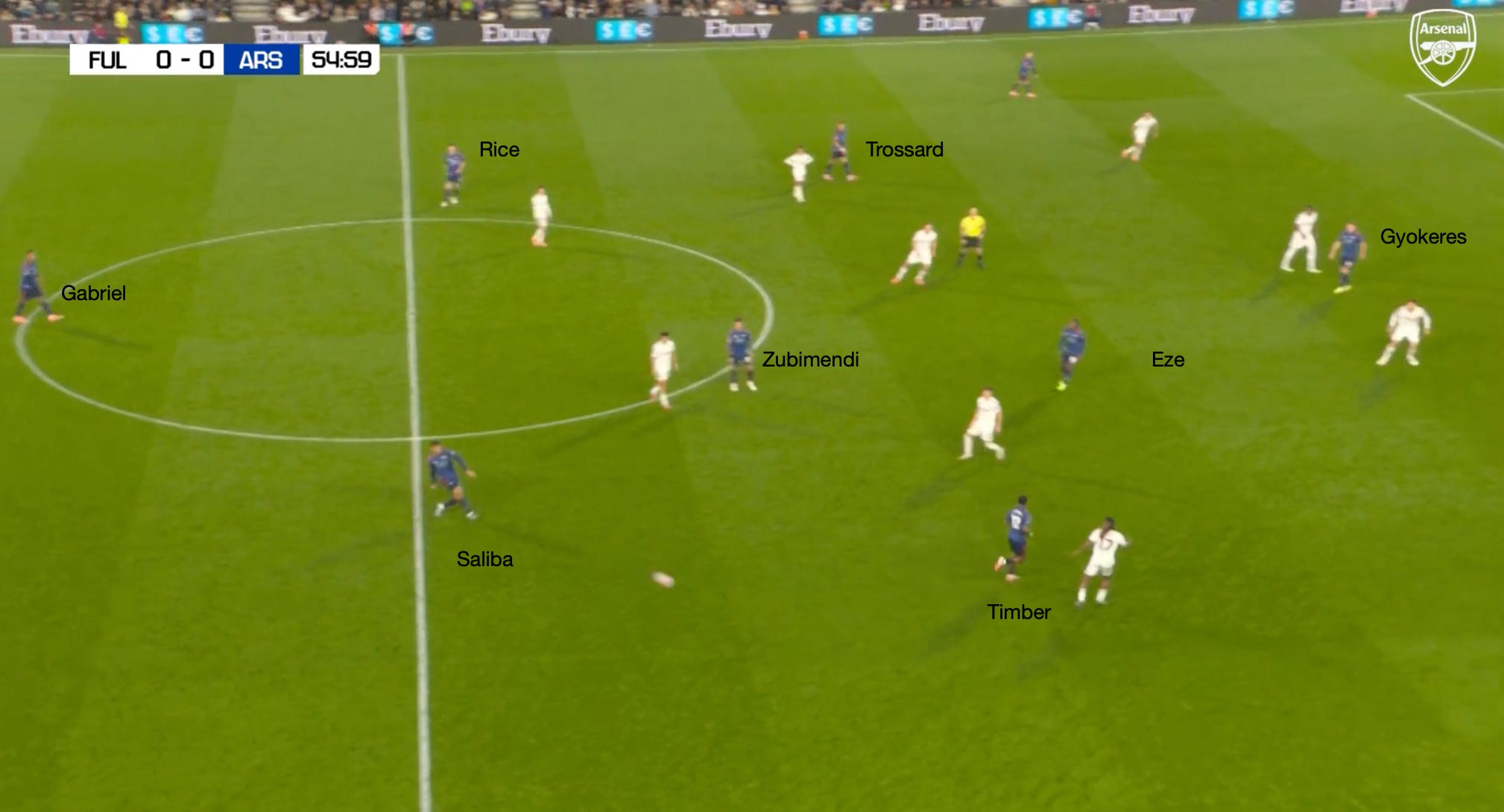
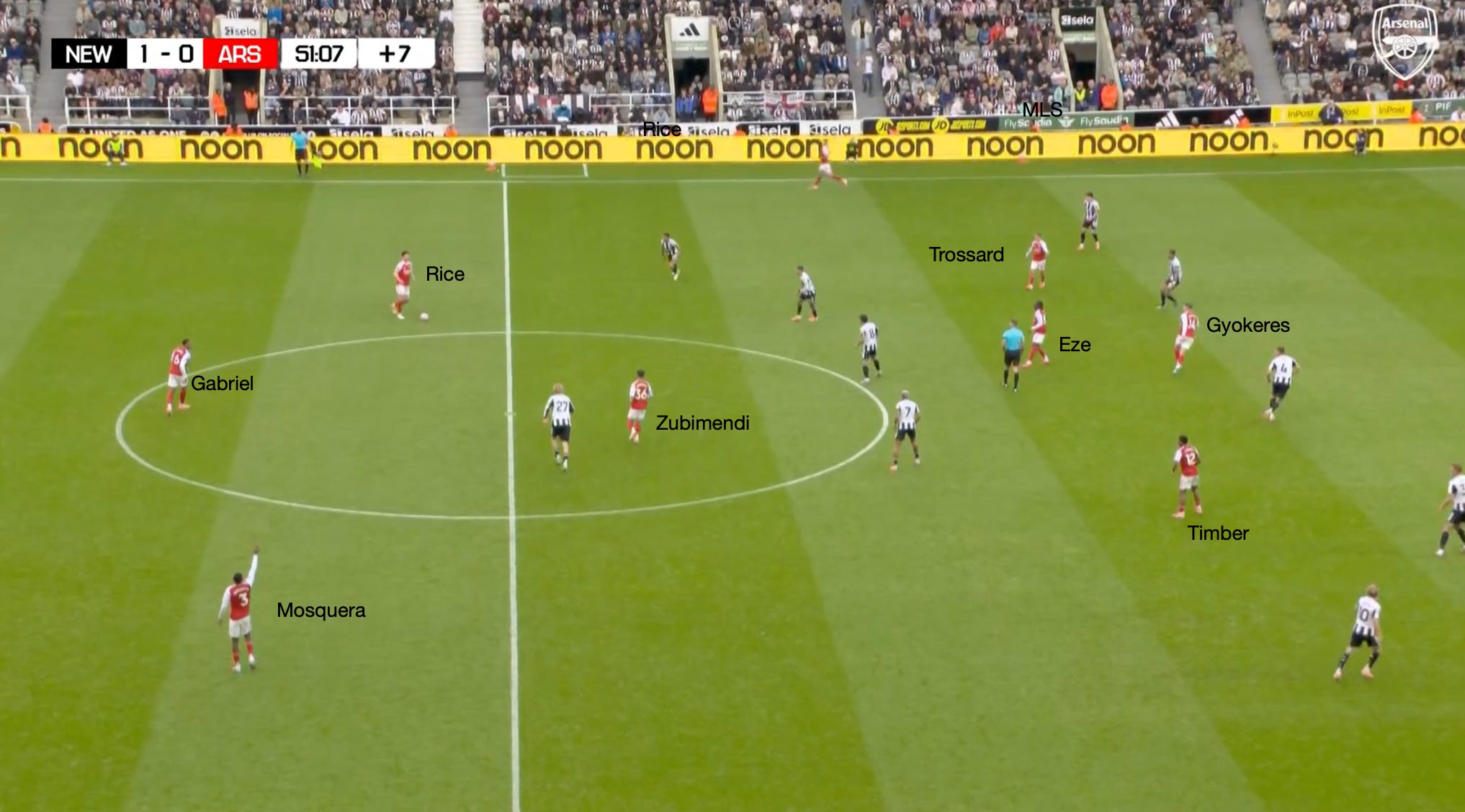
This shape was rather discernible after half-time against Fulham, but it was only used situationally against Newcastle, as The Magpies placed profound emphasis on pressing high and man-to-man whenever opportunities arose.
Atletico Madrid, on the other hand, didn’t press and sat in a nominal 4-4-2 block. Tactical homogeneity! For those who don’t understand this reference, check out my ‘Combating Tactical Homogeneity’ post.
Let’s take a look at our diamond and the primary intentions.
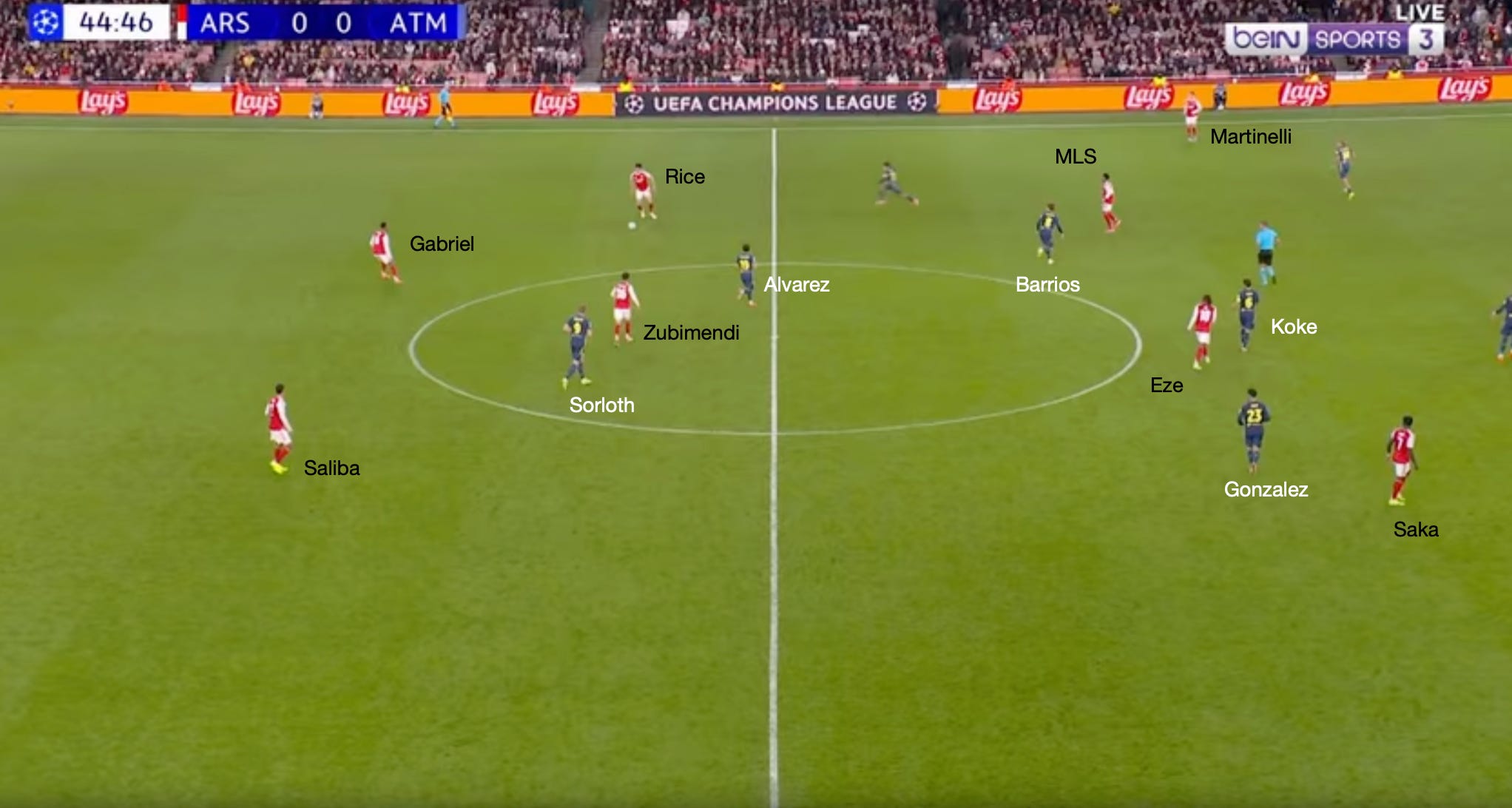
The back three provide excellent coverage against Atletico’s front two (Alexander Sørloth and Julián Alvarez), with clear numerical superiority established. Our front three (not shown in the picture, barring Gabriel Martinelli) offer depth and width against the back four.
A back three and front three are common practices, but what’s different is the midfield construction. As shown in the visual above, there is a clear number 10 in Eze at the tip of the diamond, with two players on the outside (Bukayo Saka and Myles Lewis Skelly) and Martin Zubimendi positioned as the nominal 6. Saka wasn’t always initially stationed within the half space (it was predominantly Jurrien Timber), and Declan Rice didn’t always take up the wide LCB position, but these rotations were crucial in gaps appearing within the Atletico Madrid block.
A key benefit of this shape is that you can overwhelm the midfield pivot (Koke and Pablo Barrios) with three players between the lines (3v2); in fact, it becomes a 4v2 if one of the pivot players (Koke or Barrios) jumps to Zubimendi.
Naturally, this forces the opposition wingers to come inside to deny those on the outside of the diamond from finding space. The ripple effect this creates is that accessing the wingers and isolating them 1v1 becomes easier, as we saw against Fulham, with Timber constantly dragging LW Alex Iwobi infield, which enabled Saka to fix Ryan Sessegnon 1v1. The same principles were on show against Atletico Madrid, with Timber pulling Nicolás González inside to allow Saka to attack the LB, Dávid Hancko, and Starboy, unsurprisingly, caused absolute carnage.
Let’s now dive into the concept of ‘abandoning’.
Whilst Timber attacking the inside channel was key to opening up space for Saka, this exact movement didn’t always occur. Both Timber and Lewis Skelly, on the opposite side, would move in and out, from high to low. Why? Basically, it was to make it harder for the wingers to track them. You then have Eze in a central position, with our CF pinning the two CBs.
In layman’s terms, the half spaces in advanced spaces were occasionally left abandoned. They were open for a reason, which was to allow the wingers to move into these spaces by abandoning width and arriving in behind the last line, via diagonal movements.
These runs are difficult to contain if the execution of the delivery and timing of the run and touch are on point (remember Ben White to Saka against Liverpool last season at the Emirates?).
The FB is initially facing the touchline, but then must quickly shift, adjust and change direction. In the meantime, the winger has already arrived with a dynamic advantage. Jürgen Klopp’s Liverpool were masters of this in recent history.
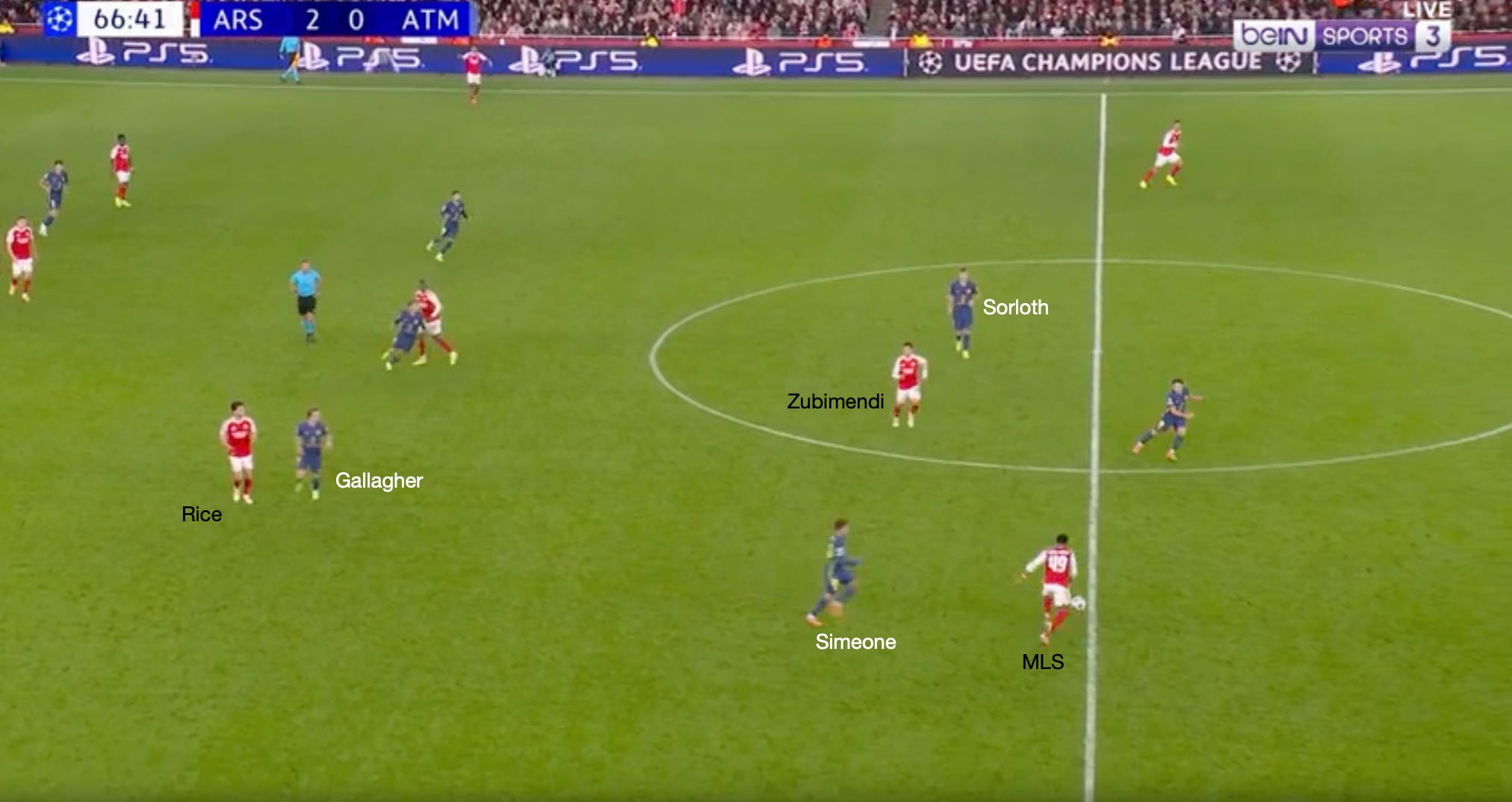
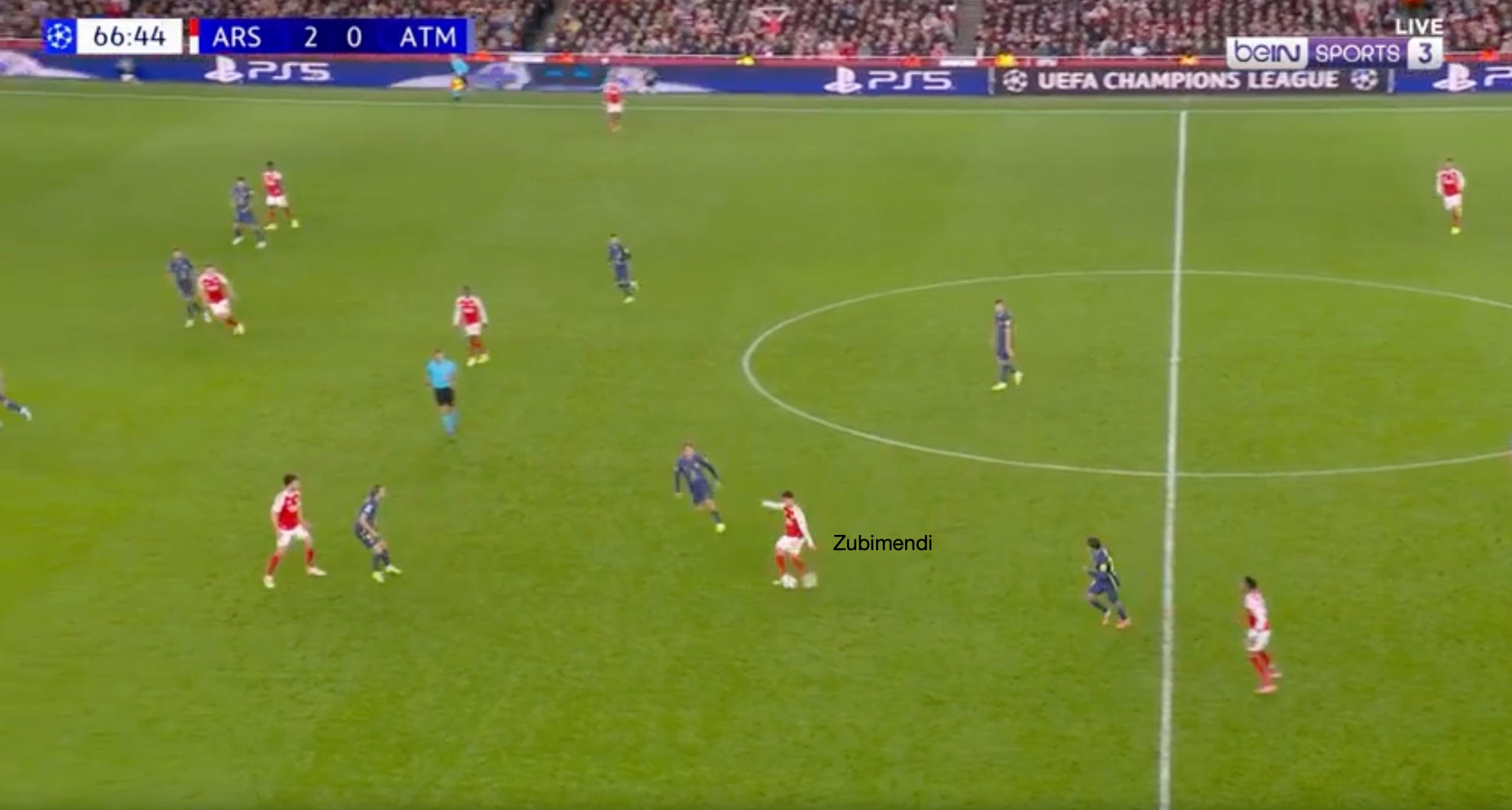
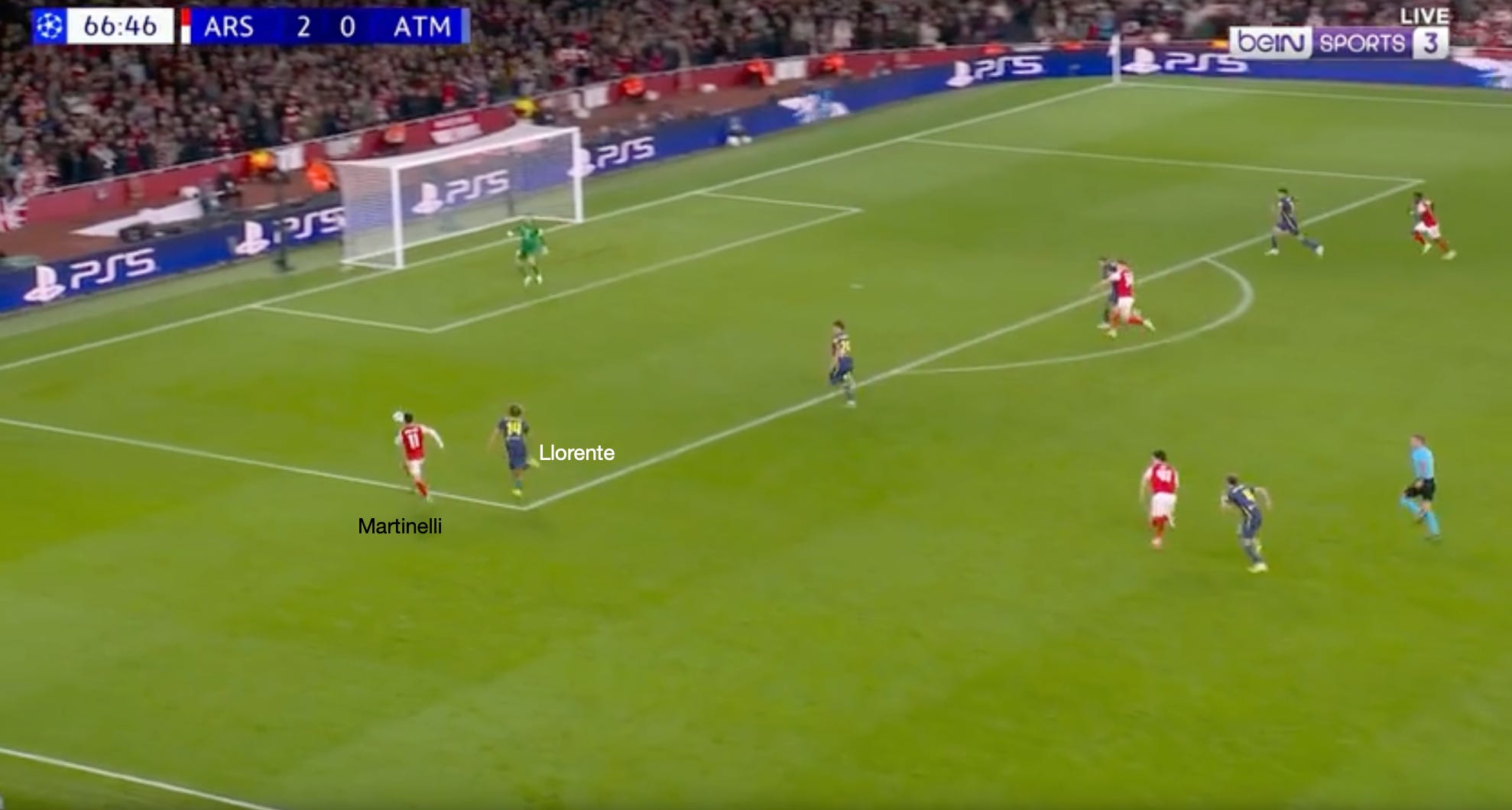
Have a look below to see all of this in action on our left-hand side, in the build-up to the third goal of the night. Within Atletico Madrid’s nominal 4-4-2, as Lewis Skelly, occupying the wide LCB role in this situation, receives the ball, he provokes pressure from the winger (Giuliano Simeone) and notice how Rice, who is on the outside of the diamond, is pinning the nearside pivot midfielder (Conor Gallagher), which means that our winger (Martinelli) is isolated 1v1 against FB, Marcos Llorente. Lewis Skelly delivers a lovely right-footed pass into Zubimendi, who is free due to Sørloth failing to mark him. The Spaniard then executes a beautiful left-footed ball over the top for Martinelli to latch onto, who has abandoned width and crosses to Eze. The ball eventually finds its way to Gyökeres, who converts.
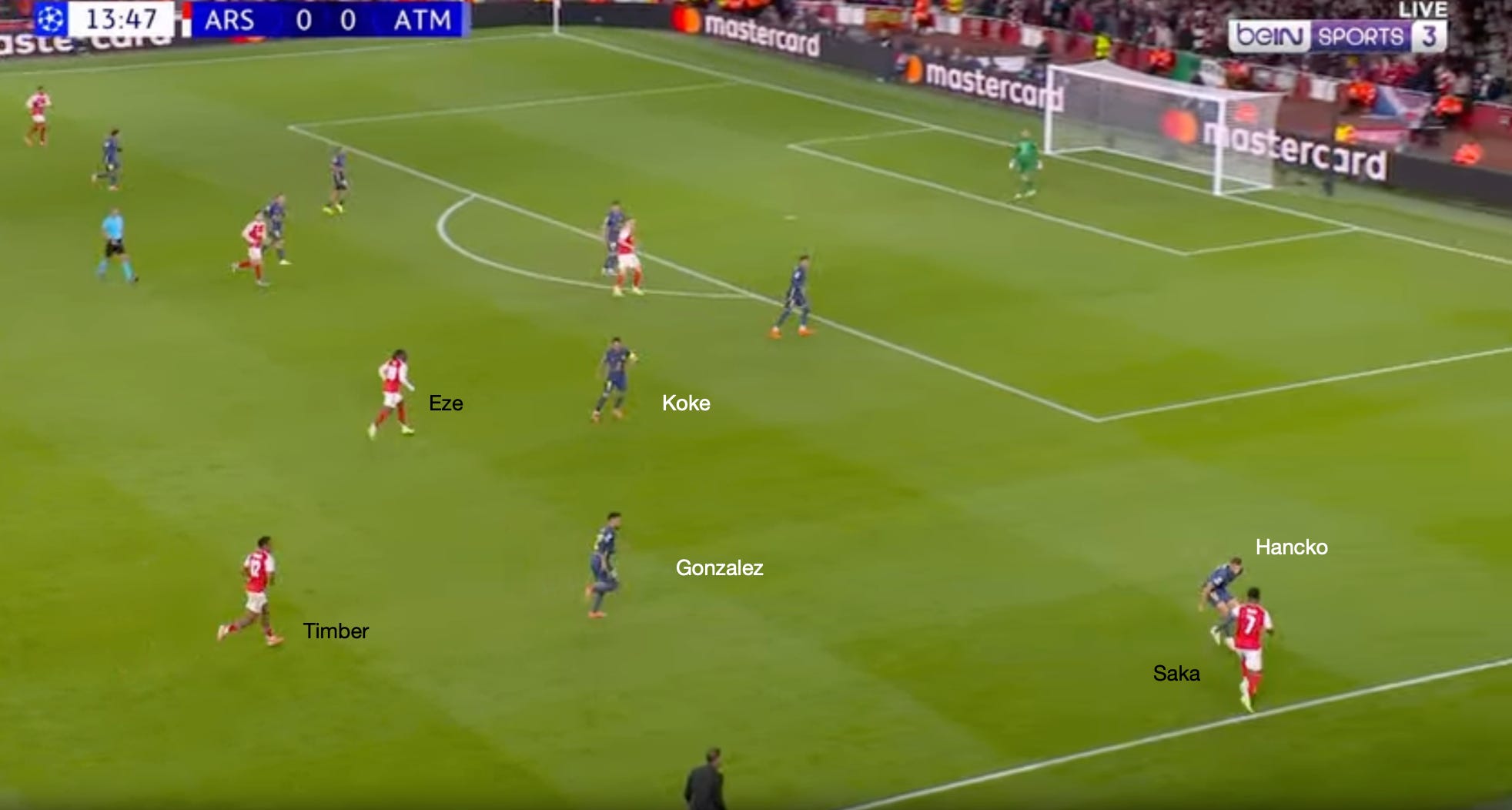
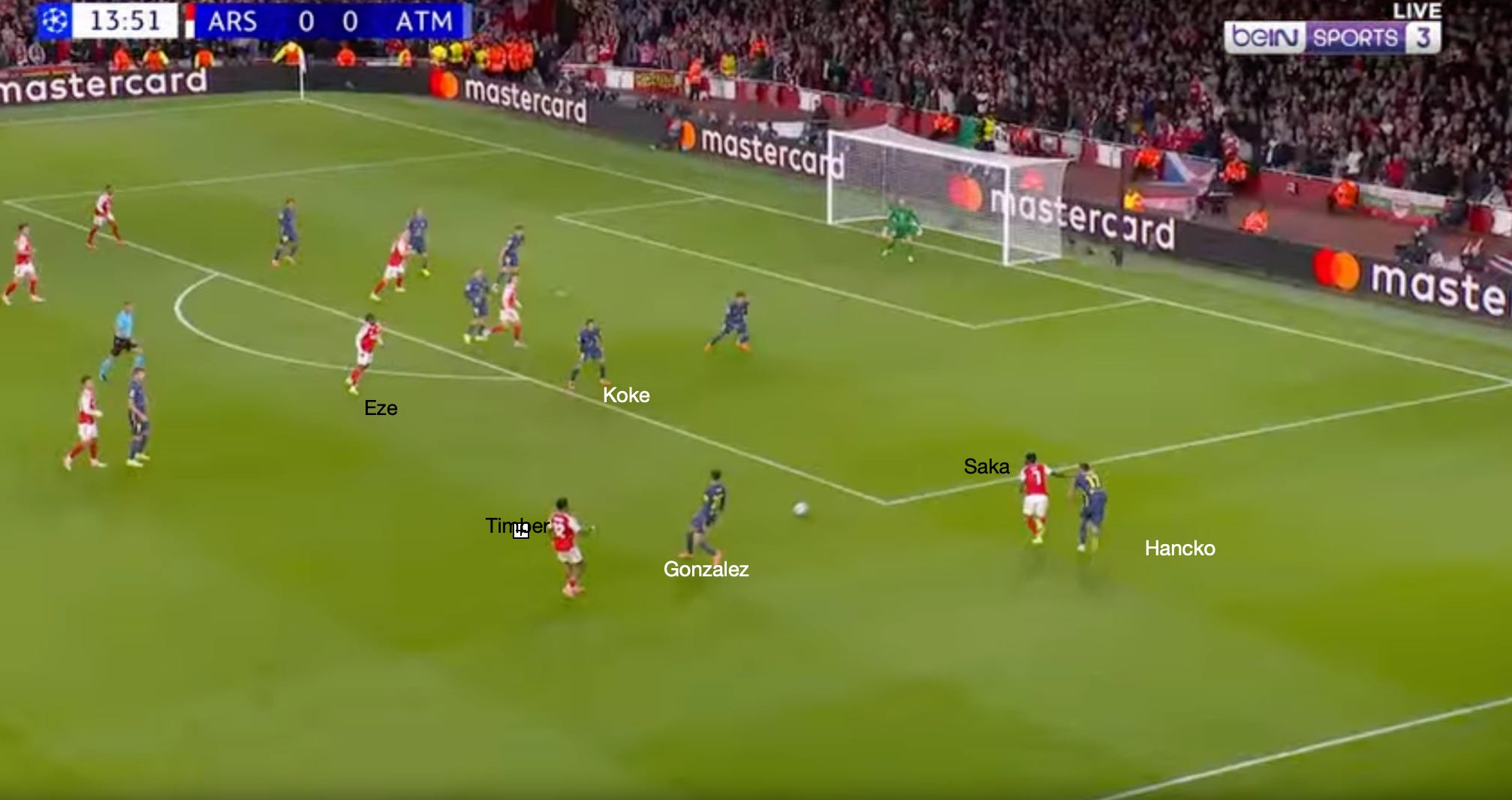
Take a look at another example of this below, with Saka abandoning width and attacking the empty half space thanks to Timber’s deeper position, which attracts the opposition winger (González), thereby preventing the formation of a double team (2v1 vs Saka). This is further compounded by Eze’s central position, which drags the nearside pivot midfielder (Koke) away from the right-hand side.
Last but not least, have a look at this lovely clipped ball in behind from Eze to Saka, who drifts inside (abandons width) and forces a top save from Jan Oblak.
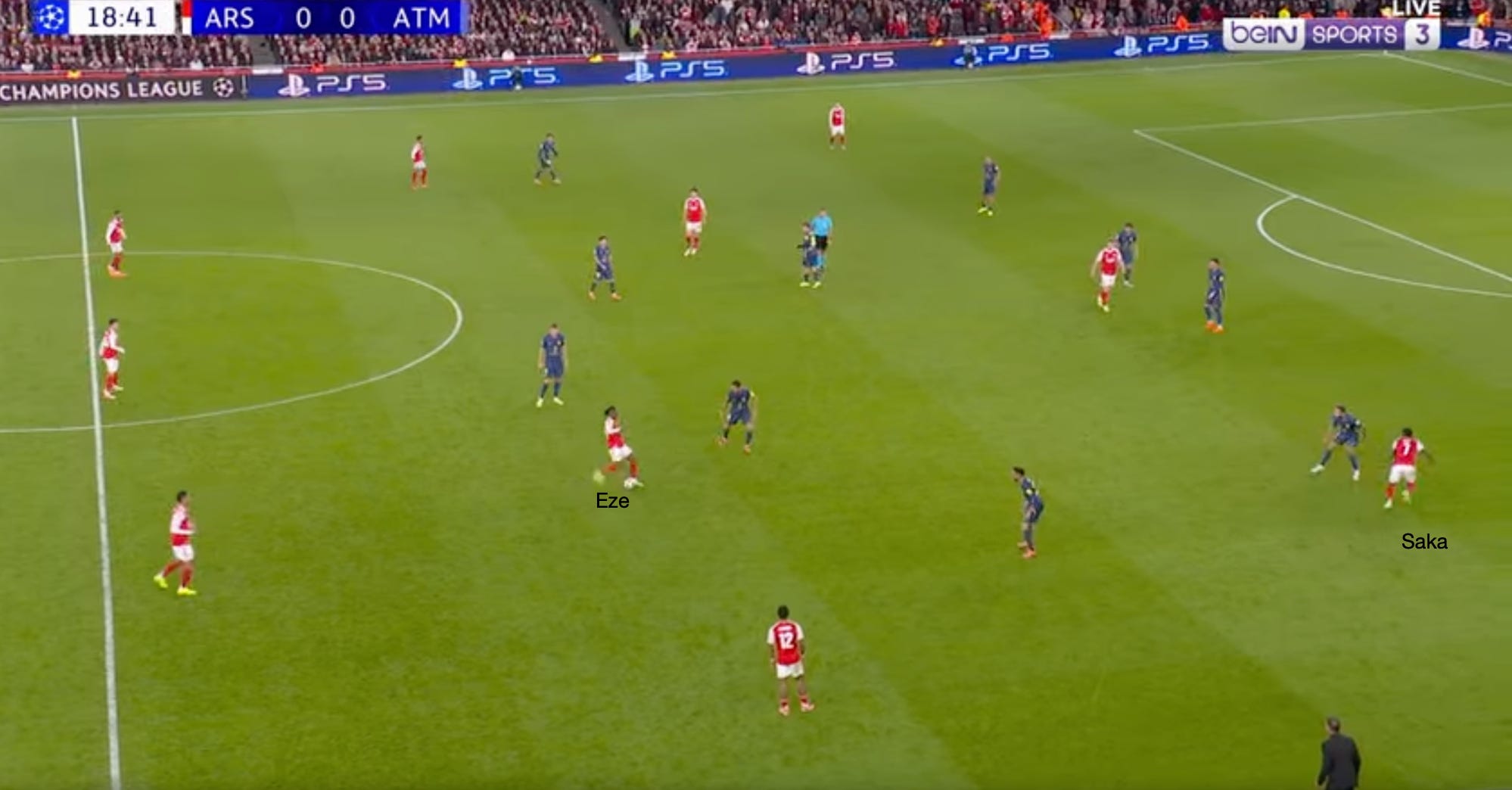
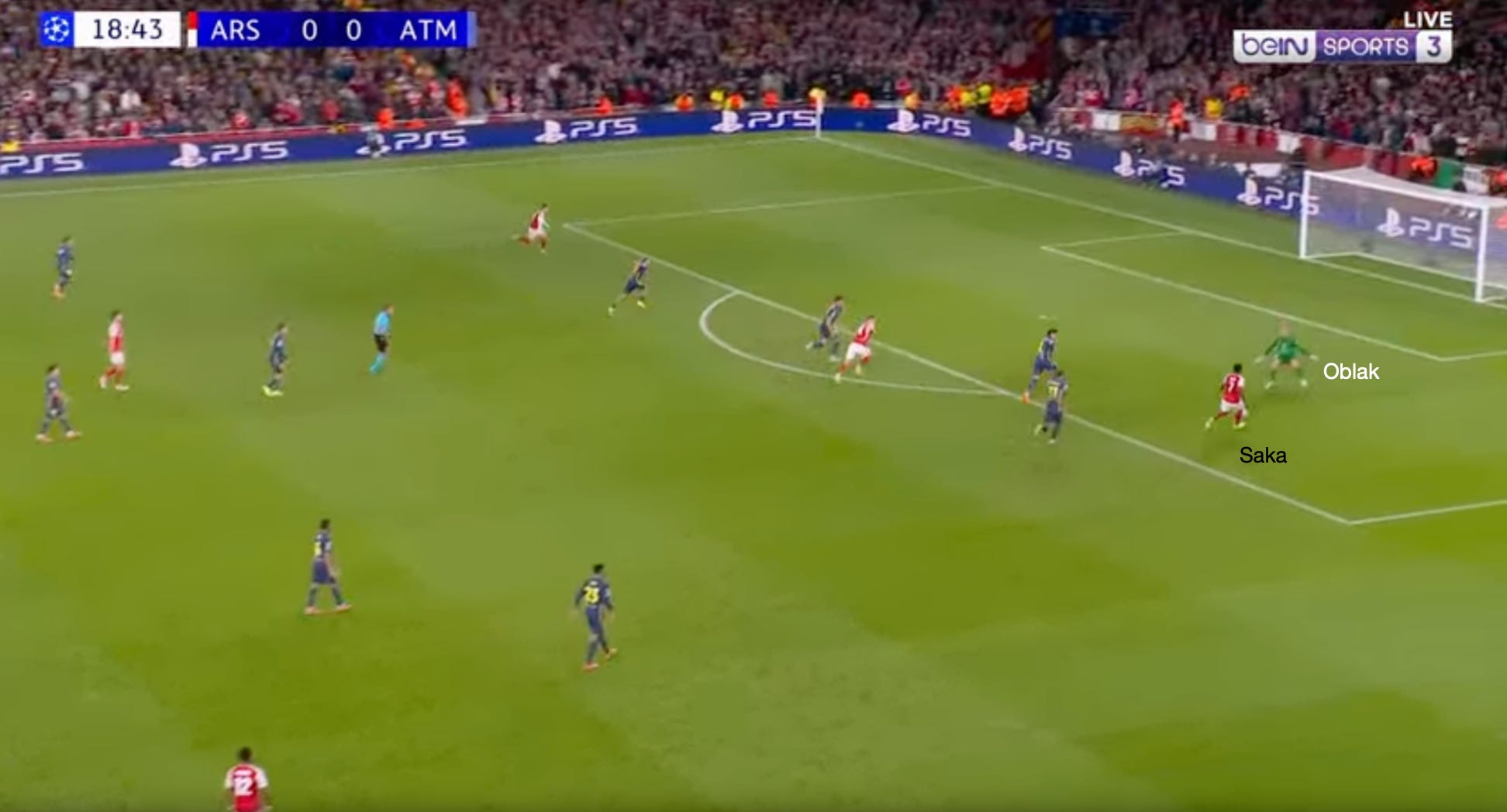
Let’s bring everything back to the first few paragraphs of this post, as I don’t want to dive into the other specifics of the diamond, apart from the fact that the mean and standard deviation of open play pass reception points, courtesy of Thomas Tarantino, quite clearly shows this structure on display yesterday.
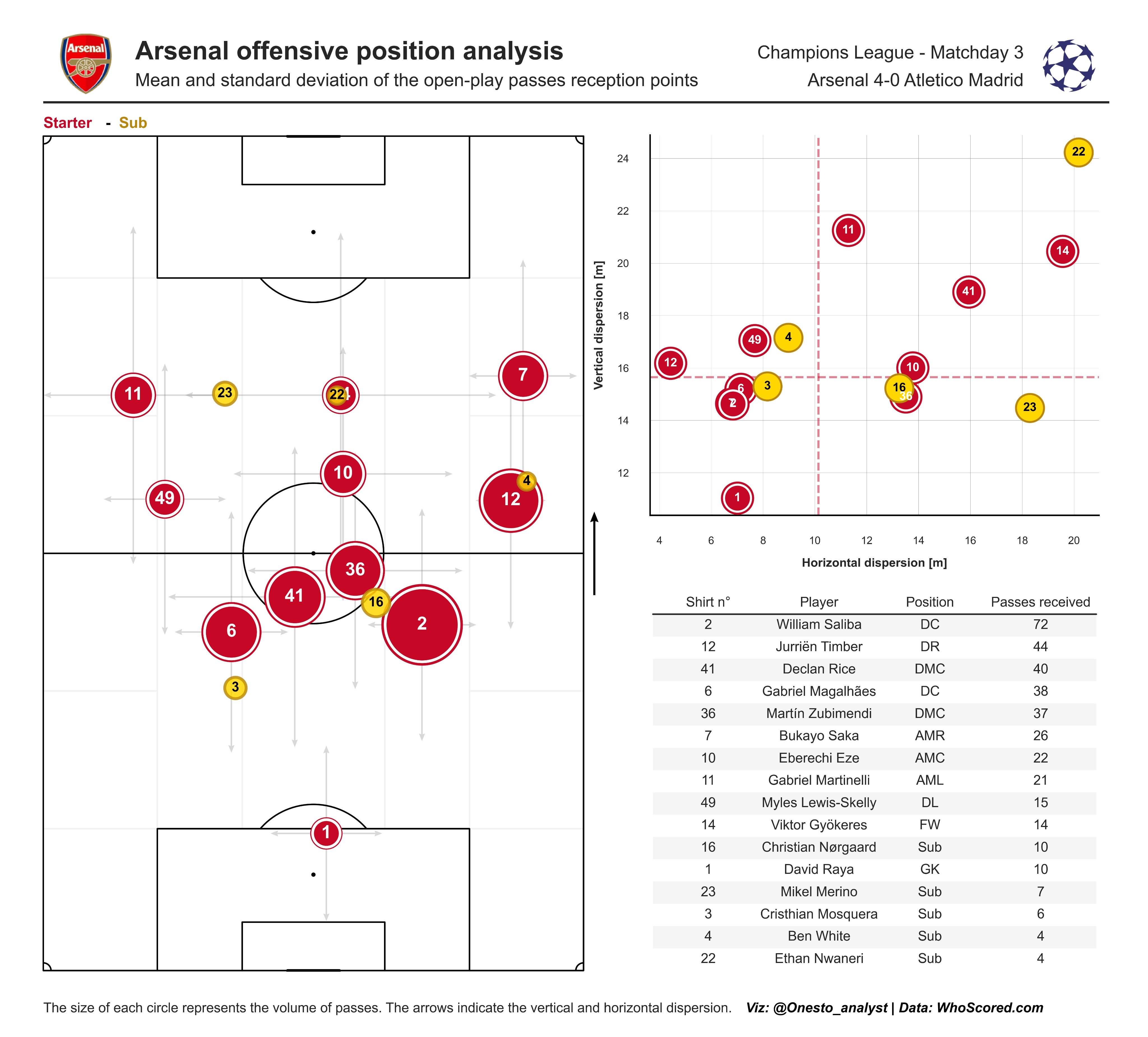
Eze and Gyokeres are being utilised in a way that suits their skillset. The former is at his best when close to zone 14 and in a position to get shots on goal. Think back to some of his memorable moments in a Palace shirt; for example, goals against Aston Villa and Man City in the FA Cup. Our third goal leads to Eze finding himself in the position we want him to occupy inside the final third.
Personally, I want to see more of Eze as our nominal LW as the angles are favourable for a right-footer cutting inside. But we are most certainly trying to create an environment in which he can flourish on the right.
And finally, when it comes to Gyokeres, this is not a player who is at his best in deeper positions. This is a striker who wants to stretch the back line with incessant runs on the shoulder, and with Eze predominantly at the tip of the diamond, we are allowing the big man to stay upfield.
Cool, look forward to more 🔴⚪️
Ended too soon. Great analysis buddy