
The false 9 threat
Liverpool's usage of PSG principles denied Arsenal from controlling proceedings after the break

This was Declan Rice’s post-match comments on the first half against Bayern Munich, providing insight into the spells where Arsenal were pinned deeper and near their own goal:
“When they [Bayern] drop you deep, it’s so hard to pick up references across the pitch. It’s so hard to get up to a man because they are just rotating constantly, so it’s about staying zonal and waiting for the opportunity to pounce.”
This is what happened in the second half against Liverpool, primarily: Arsenal defending zonally, despite it not being the intention. We always want to press.
I was at the game, seated in the lower tier, where the compromise made for the exposure to a more boisterous atmosphere is a restricted view. It’s super tough to visualise what’s really happening in terms of the finer details. I always accept this trade-off because, firstly, I’m a fan first and foremost, so I don’t care about the details on first viewing, and I prioritise being within proximity to the noisiest sections of the ground. Secondly, I rewatch the games anyway, which I’ve done for seven years now.
In the ground, I was wondering why we couldn’t get near them after the interval. It was so strange. My intuitive feeling was that Florian Wirtz’s false 9 shift was the pre-eminent driver. My rewatch confirmed to me that I wasn’t too far away from the truth.
Essentially, the second half was reminiscent of PSG’s opening 20 minutes at the Emirates in the Champions semi-final first leg, where Ousmane Dembélé’s interpretation of the false 9 role, alongside the fluid trio of Vitinha, João Neves and Fabián Ruiz stepping inside and outside the block simultaneously, prevented us from being able to press them. This was further compounded by their two dynamic, free-flowing full-backs, Achraf Hakimi and Nuno Mendes.
On Thursday, it was Ryan Gravenberch, Alexis Mac Allister, Dominik Szoboszlai and Wirtz making it difficult for us to identify man-to-man (M2M) references and lock on. The warning signs were there in the first half. You can see this in action below.
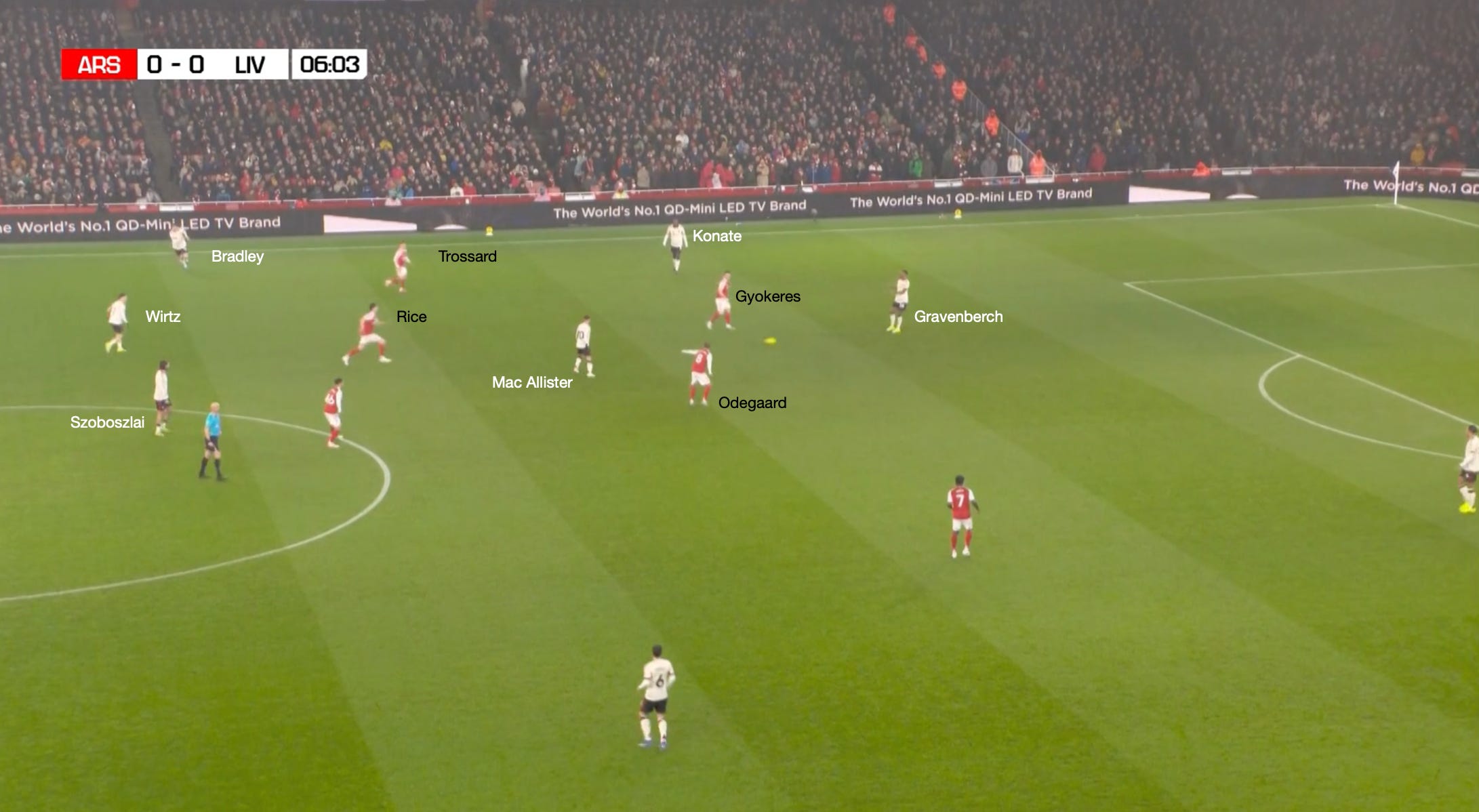
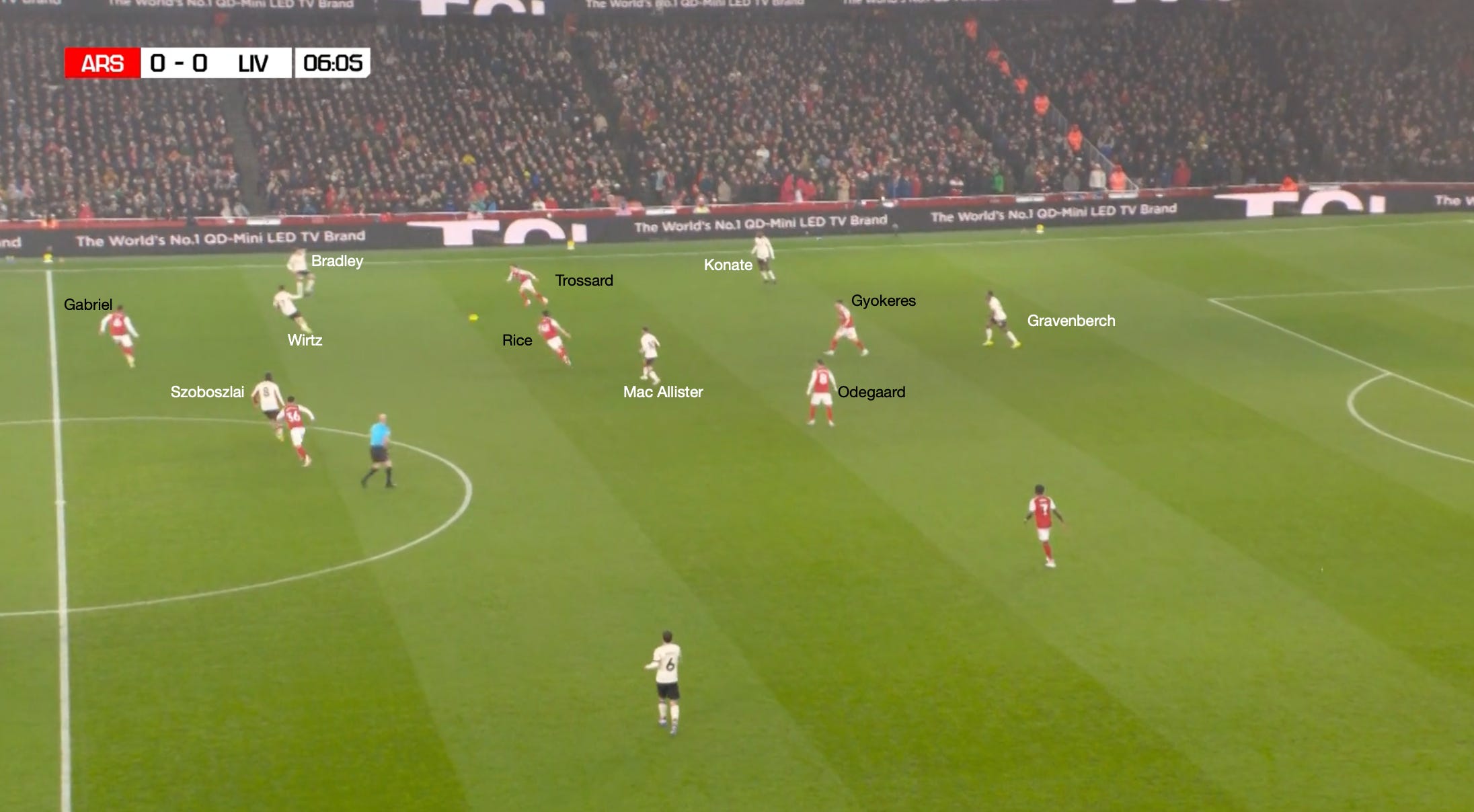
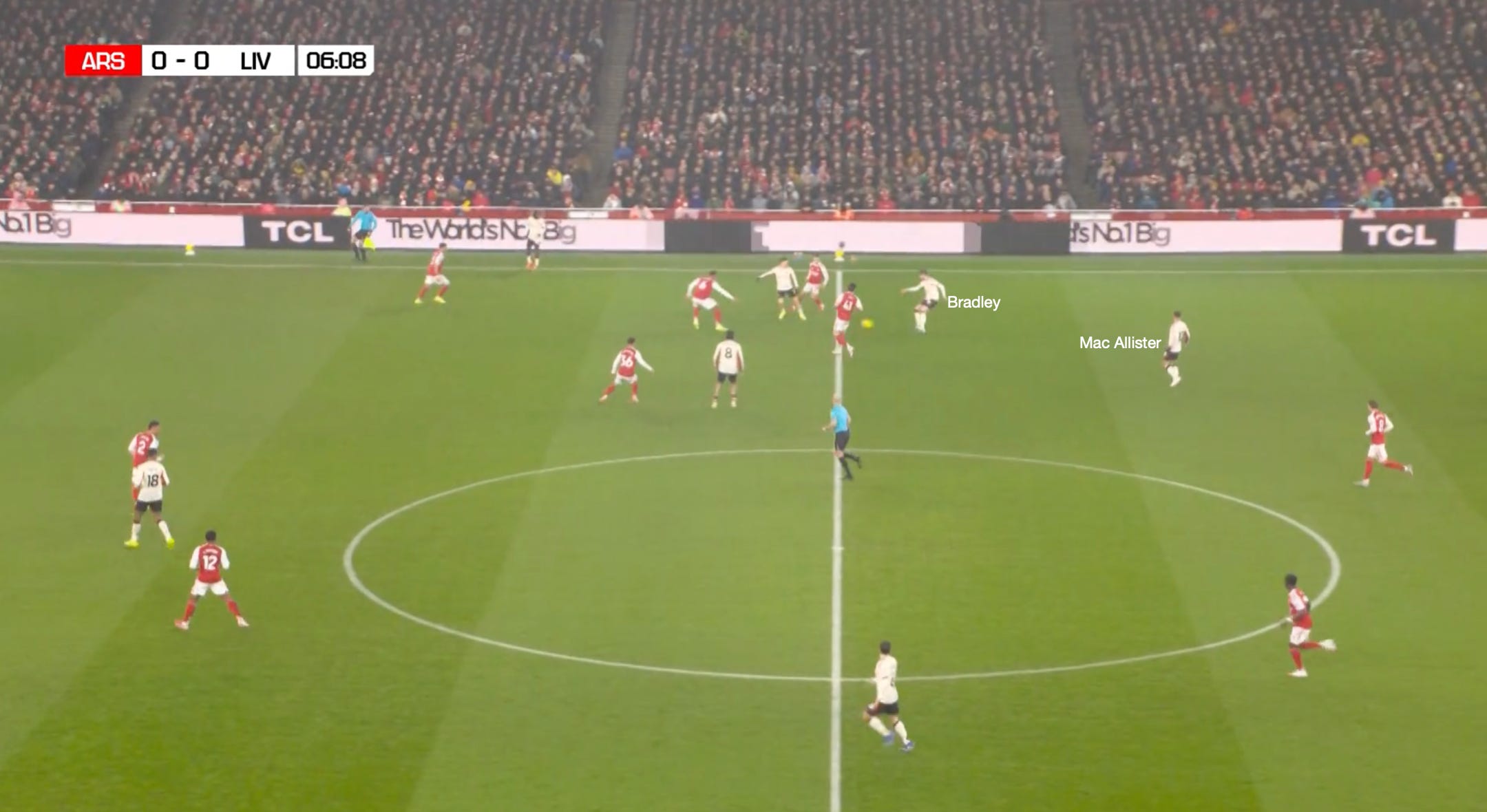
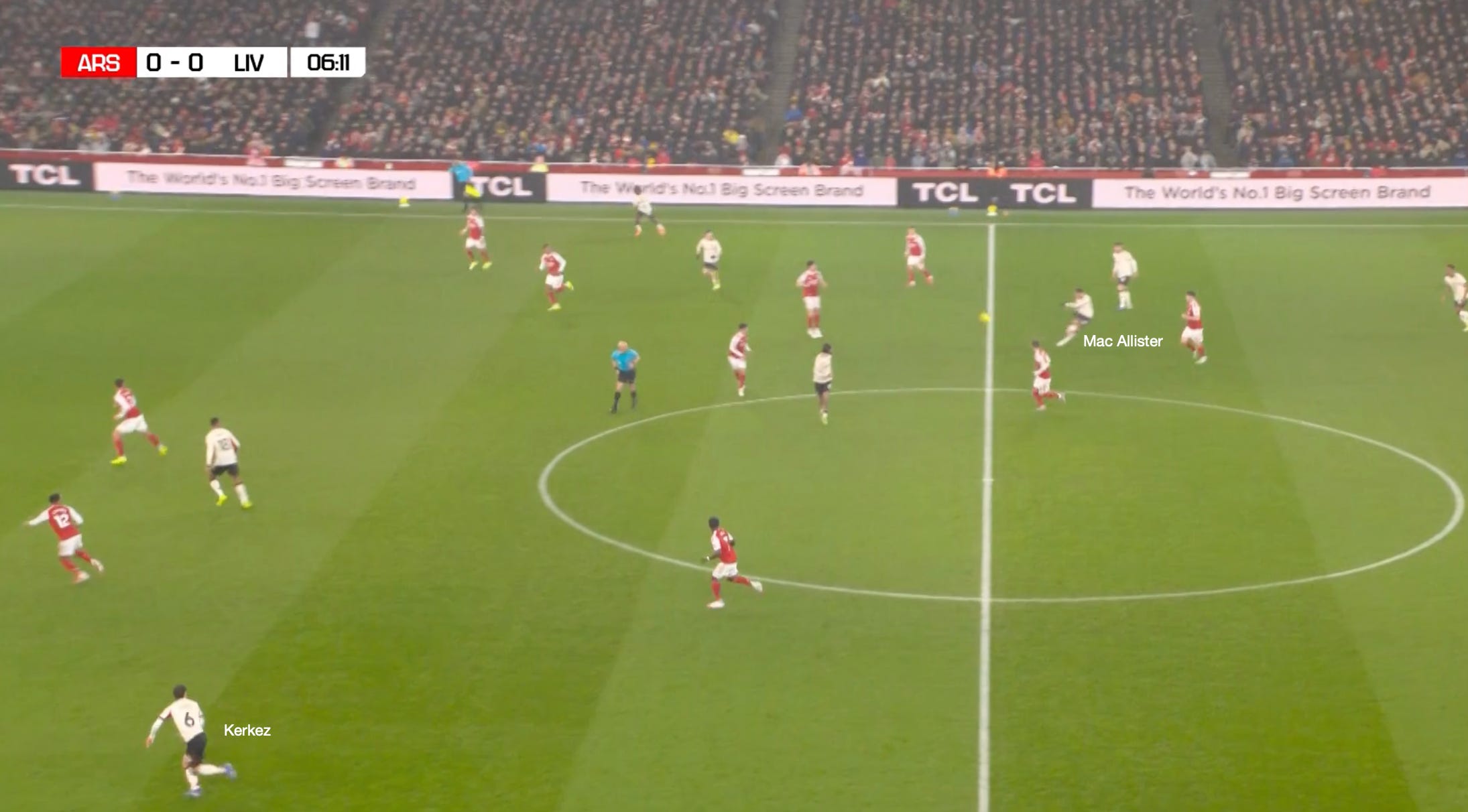
Gravenberch steps into the backline, splitting Virgil van Dijk and Ibrahima Konaté. Viktor Gyökeres isn’t aggressive enough in his pressure, angling from Konaté to Gravenberch, with the Liverpool midfielder playing the pass into Mac Allister, who could then easily find Konaté as the line of pass is on because Gyökeres starts the press; however, he recognises that Leandro Trossard is ready to jump and abandon his man, Conor Bradley.
Now, this all stems from the numerical overload Liverpool established through our left-hand side. Rice is hesitant to jump to Mac Allister because of Wirtz dropping deep, inside the pocket. And further back, Gabriel Magalhães can’t jump to Wirtz because he’s wary of the run Jeremie Frimpong (who is marked by Piero Hincapié) could make through the space vacated, attacking it diagonally. You also have the potential ripple effect of Hincapié jumping to Bradley to back up the pressure being applied by Trossard on Konate; this would then leave big Gabriel 2v1 against Frimpong and Wirtz.
In layman’s terms, Liverpool have the spare man, and they exploit it here, following Rice eventually jumping to Mac Allister, with the latter finding Bradley, and now they are out. Soon after some tidy short combinations between Liverpool players on this side, Mac Allister receives the ball and delivers a huge switch of play to Milos Kerkez on the far side.
See below for another warning sign from the first half, in the build-up to Bradley hitting the crossbar, following confusion between William Saliba and David Raya. Again, the two Liverpool centre-backs (CBs) are wide, either side of Alisson Becker, who delivers the pass into Mac Allister, and he bounces it to Konaté. You have the same idea where Gyökeres initiates the press to stop Konaté from receiving the ball, and so the line of pass back to the Liverpool defender is on via the midfield player inside the block.
This time, it’s Rice, more out of frustration, who jumps to Konaté, which is the wrong move, as the overload centrally can now be fully exploited by Liverpool, since Gravenberch becomes the free man. Why? Because Trossard is on Bradley, big Gabriel on false 9, Wirtz dropping in, and Hincapié is marking Frimpong. Liverpool work it well around our pressure with their additional man, before Bradley is in a promising scenario to play Frimpong in and eventually Liverpool’s full back has the chance to open the scoring.
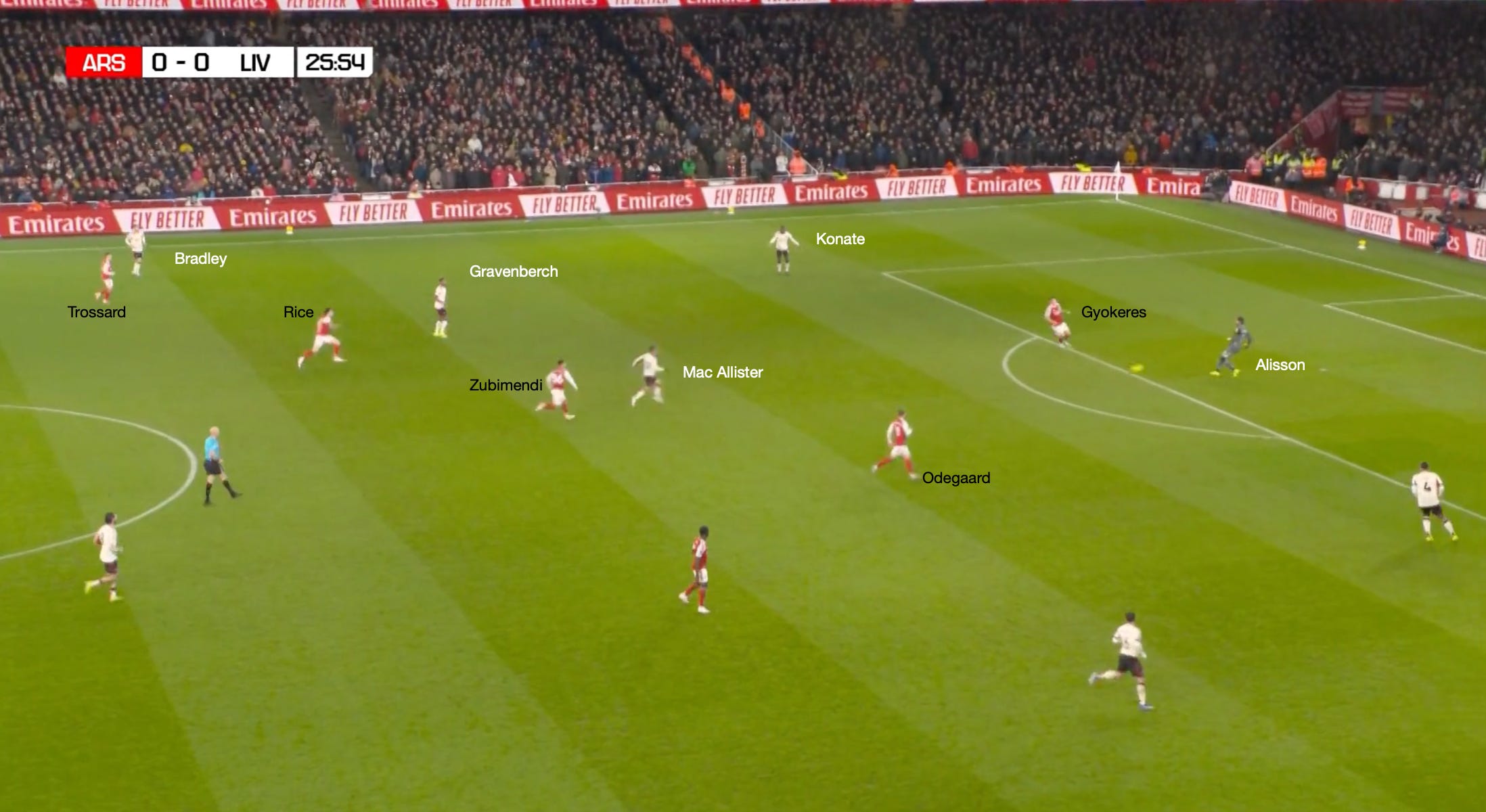
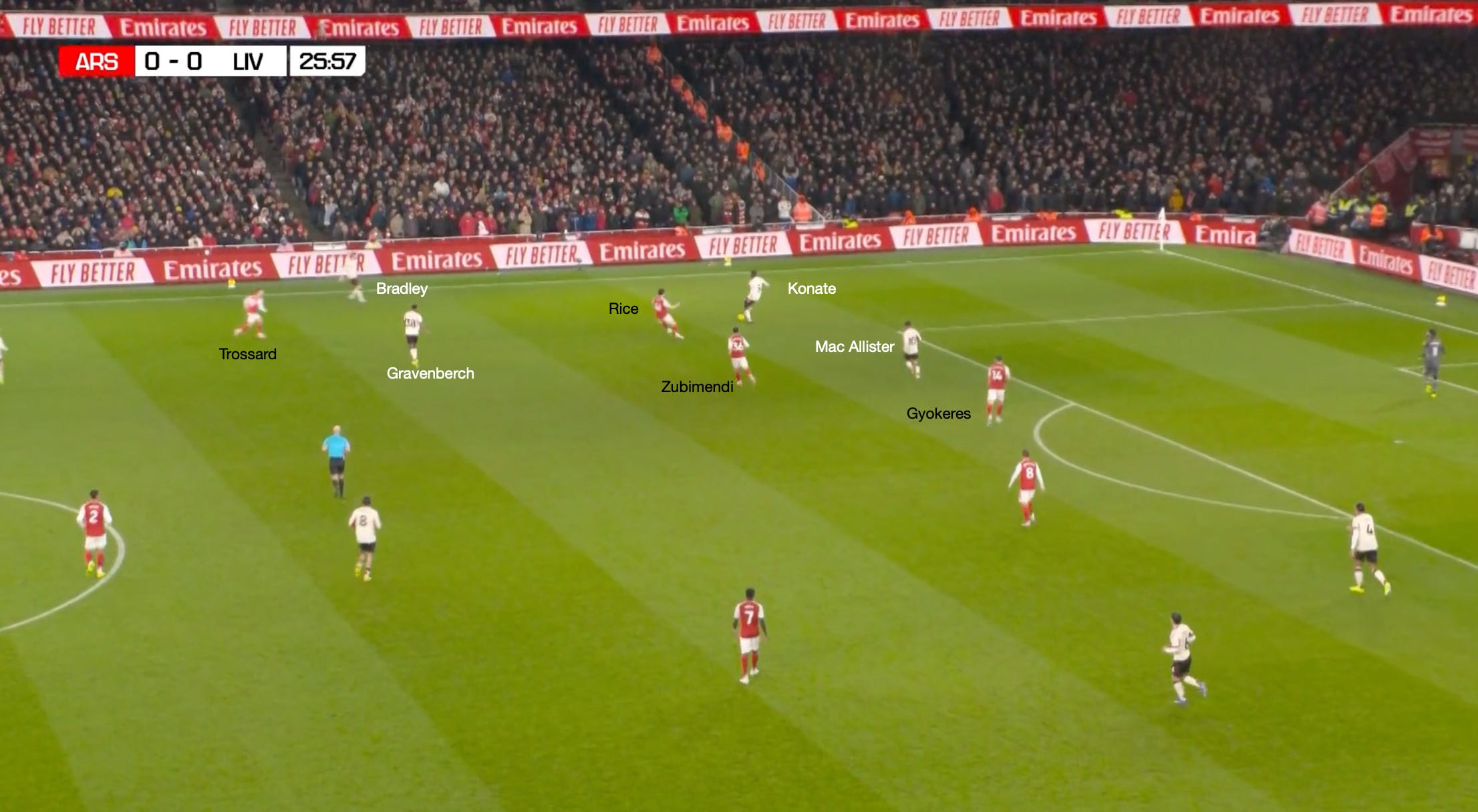
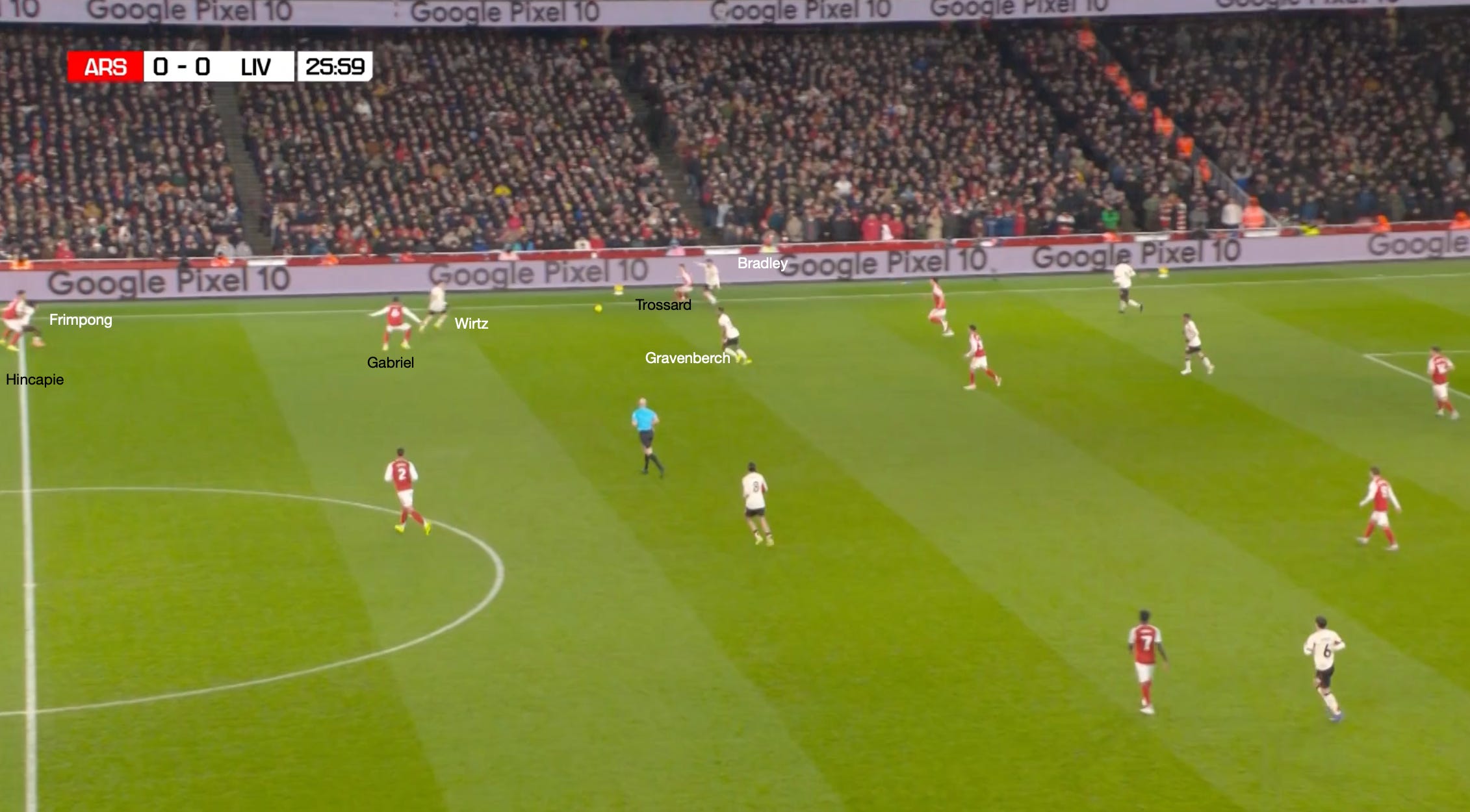
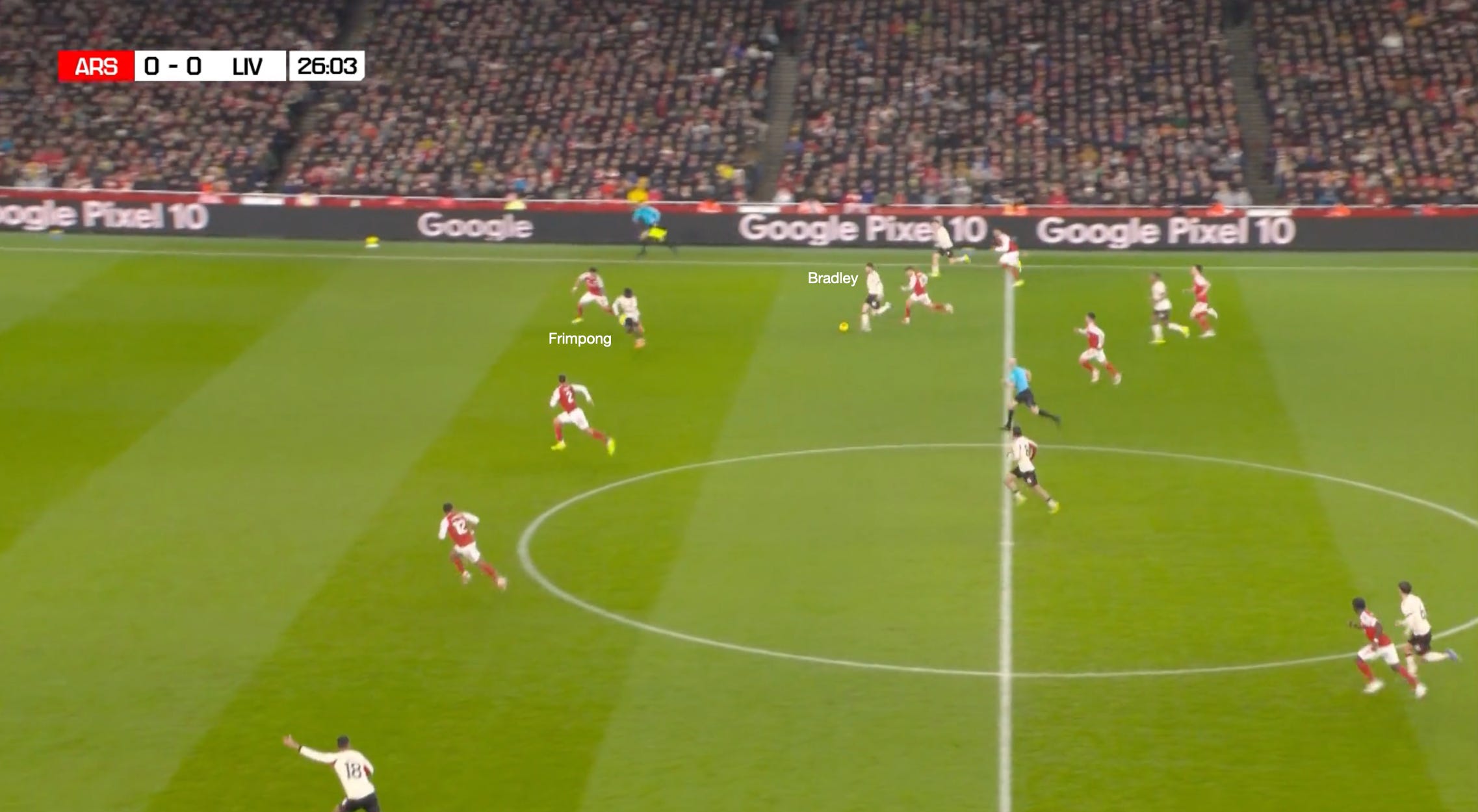
These overloads on our left-hand side were far more prevalent in the second half. The slight tweak Liverpool made was that they pressed harder when we were building out from the back. Wirtz and Szoboszlai were far more aggressive on the trio of Saliba, big Gabriel and Martin Zubimendi. Both of the Arsenal CBs were predominantly positioned on either side of Zubimendi. And in the first half, they were able to carry the ball into the space created by those ahead, especially from Jurrien Timber and Hincapie, who were pinning the Liverpool wingers. This space, however, wasn’t regularly open as the game progressed because of the work done by Wirtz and Szoboszlai. Being under pressure isn’t anything new; in fact, we want to play against pressing teams since this leaves open spaces further ahead. However, our technical level was way below the required standards, and with Liverpool’s higher propensity to loose balls, this allowed them to get their foot on the ball. And when they did, we couldn’t get out because of the midfield overloads that remained present when we were defending deeper.
See below to see this in action and how eliminating the initial line of pass is crucial.
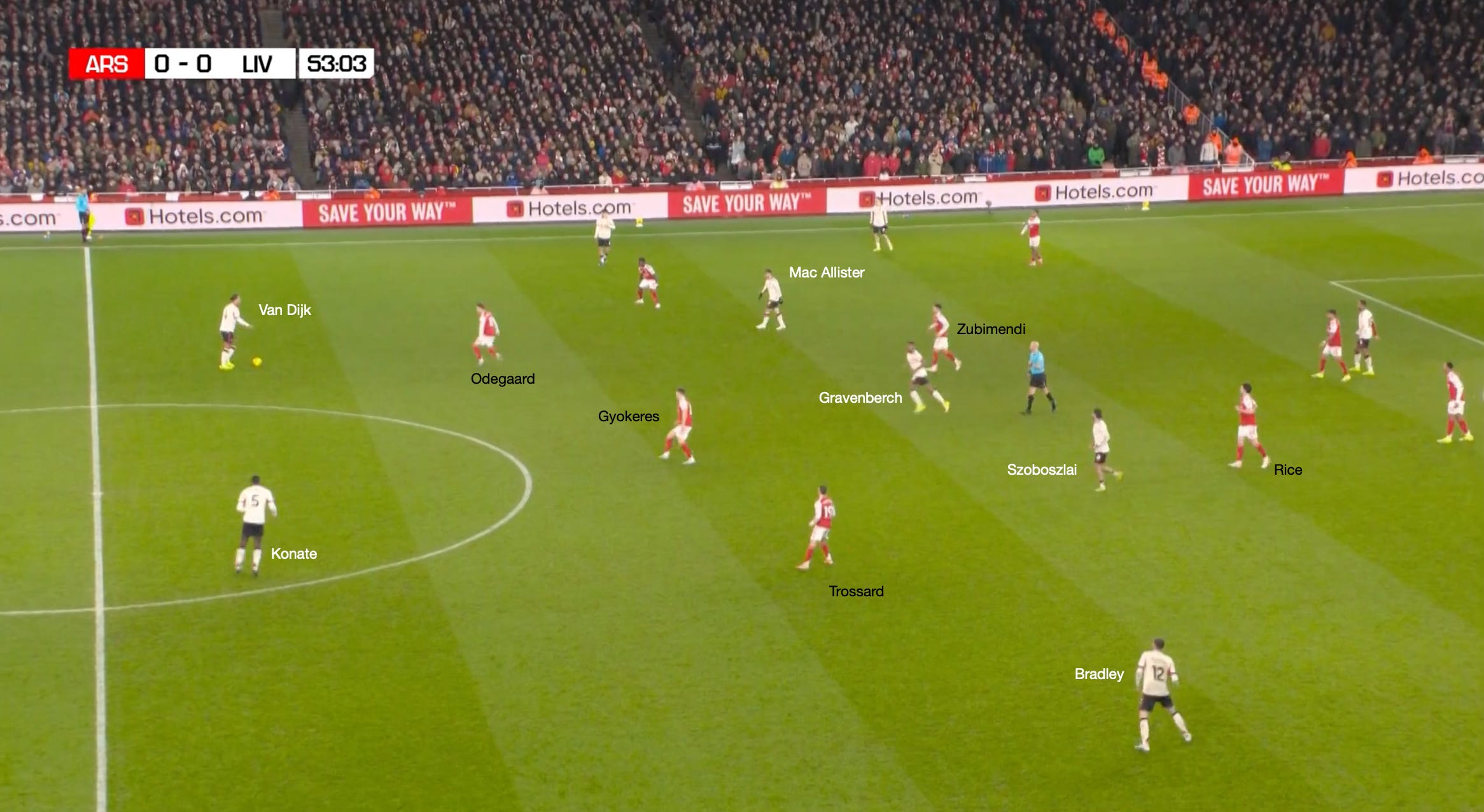
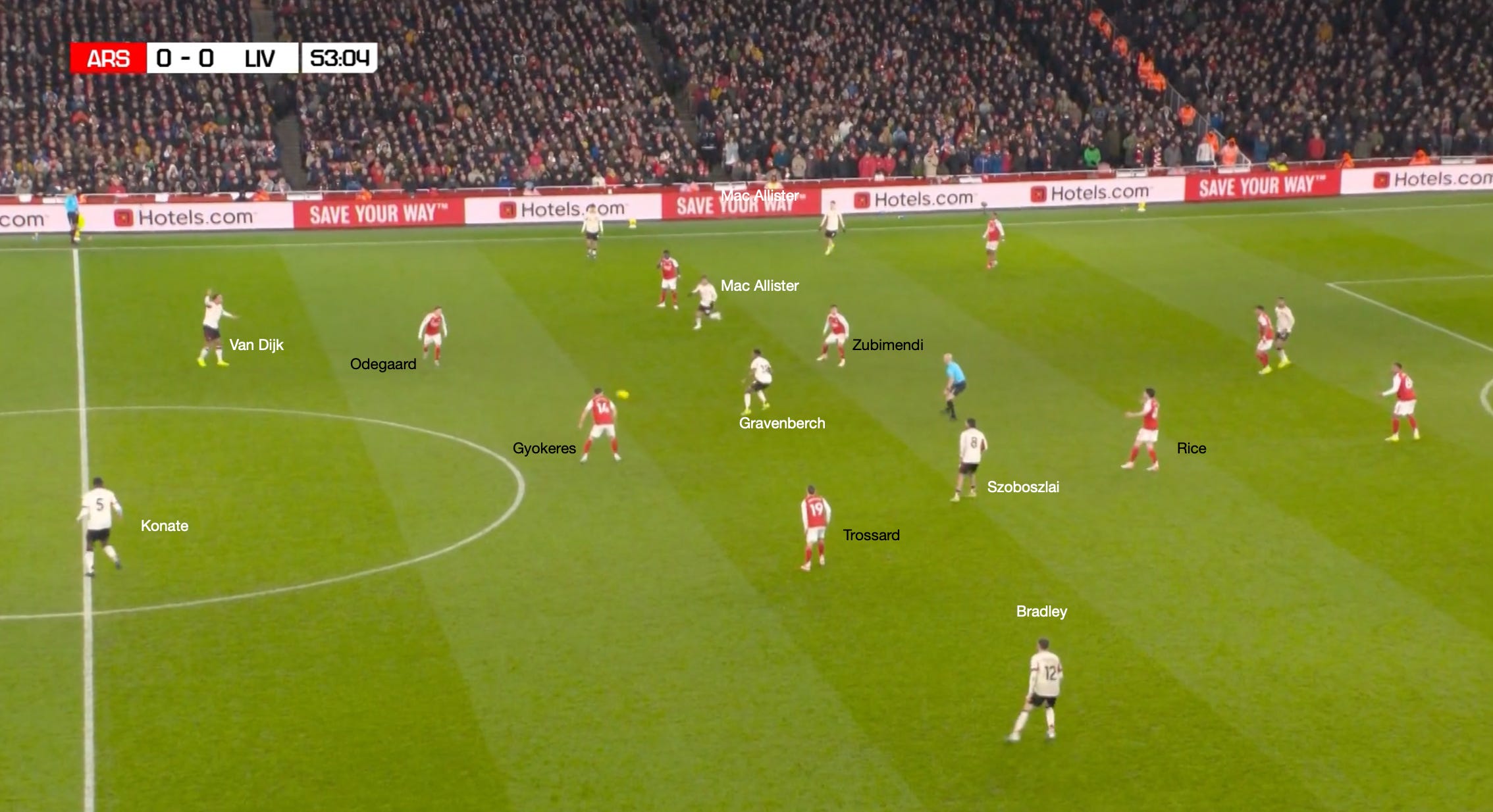
The line of pass from either Van Dijk or Konate to the first midfield receiver wasn’t frequently cut off. Neither Gyökeres nor Martin Ødegaard were consistent in this aspect, especially the former. When one jumps, the other marks the midfield receiver in a pendulum-like manner. Failure to do this means that teams dropping their midfielders deeper to overload central areas can gain joy. You can see from above that as Ødegaard gets closer to Van Dijk, Gyökeres must stop the entry pass into Gravenberch. He doesnt, which means that Gravenberch can get onto the ball, turn and face play. If Rice or Zubimendi jump, they then leave their designated markers free in the half spaces (Szoboszlai and Mac Allister).
The same occurs below, where Wirtz is pinning Zubimendi in midfield, thereby freeing up Mac Allister to receive freely from Van Dijk. Saliba couldn’t follow the dropping Wirtz all the way in because that would allow Cody Gakpo to attack the space vacated diagonally.
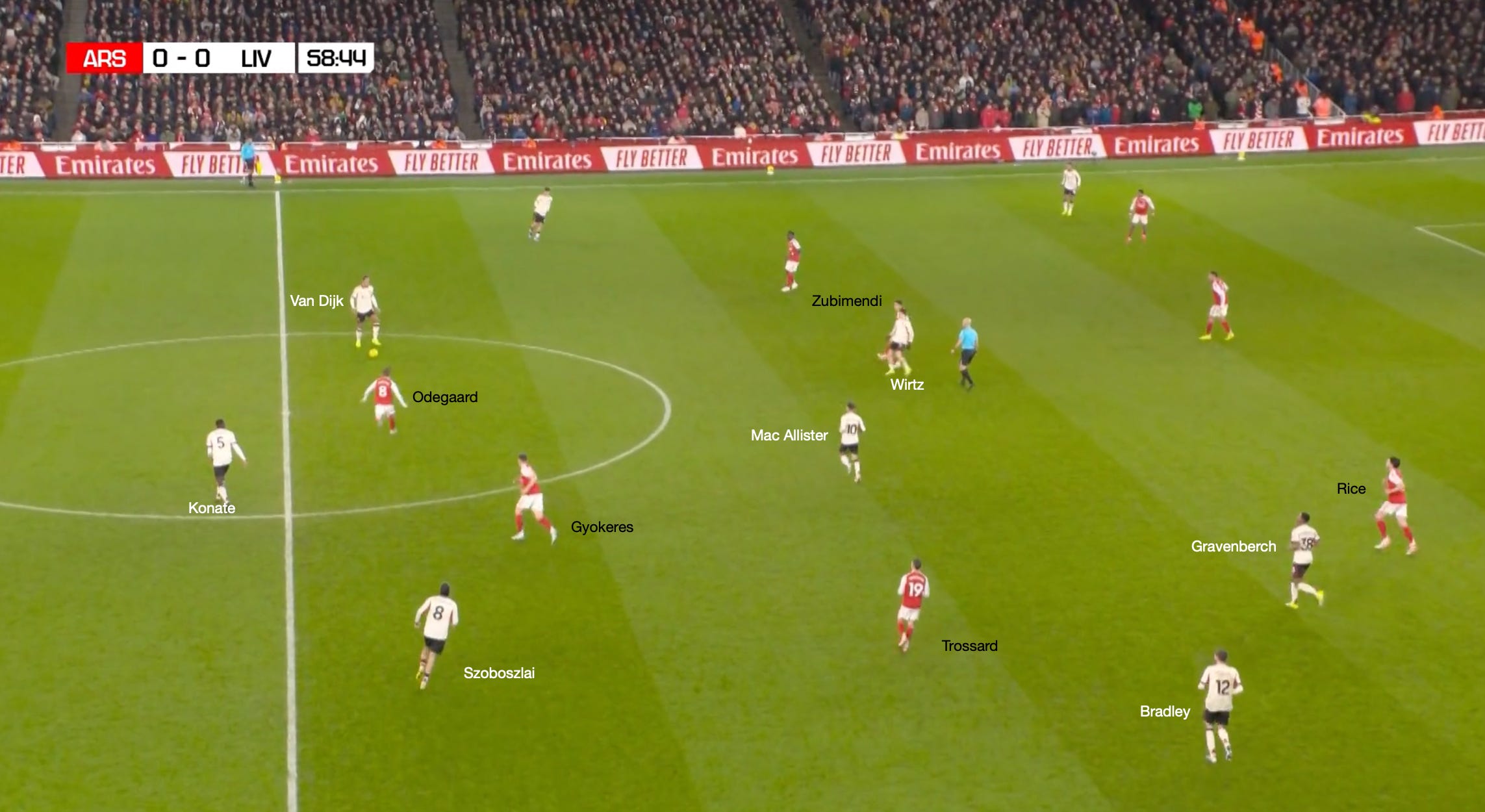
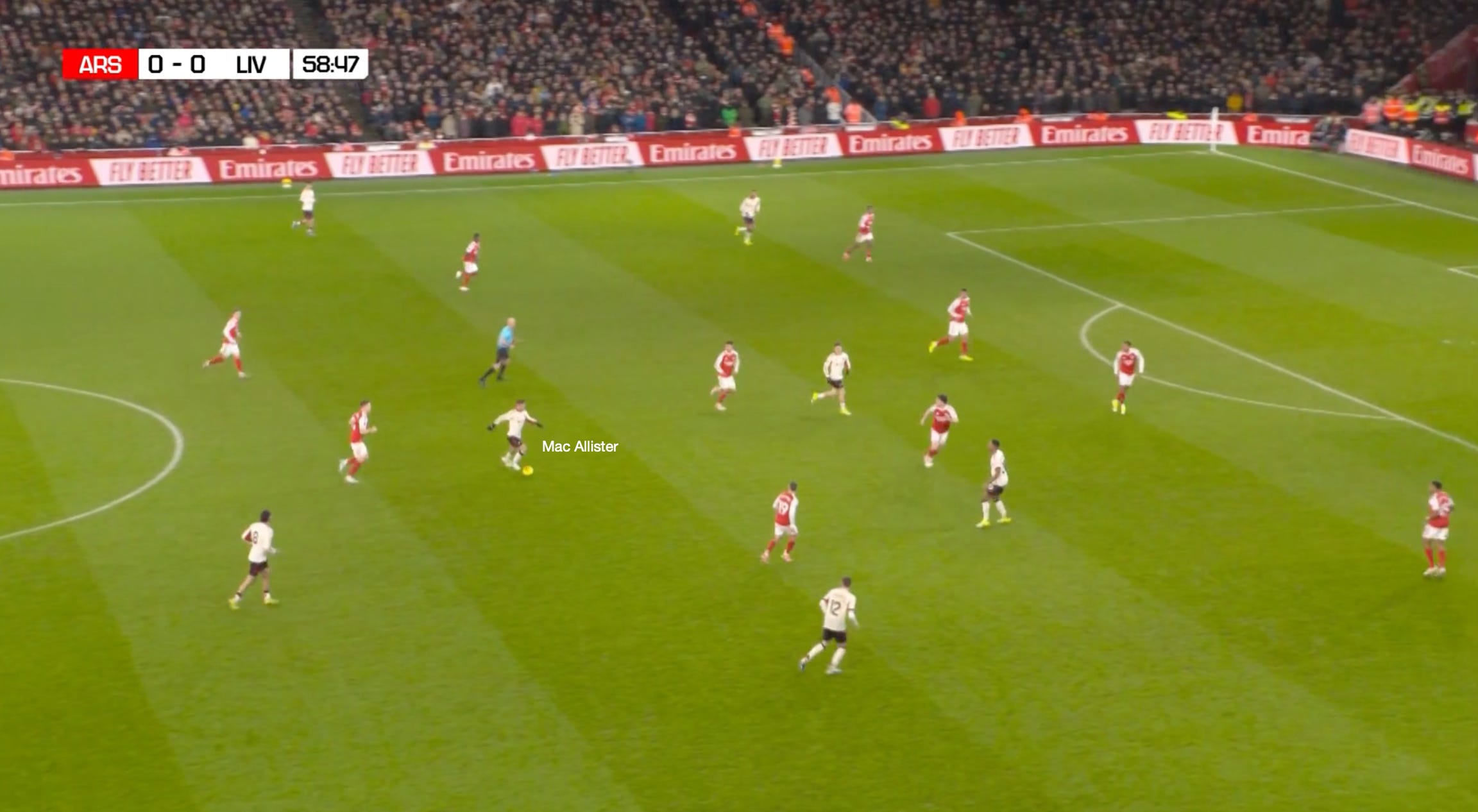
Here’s a final example shown below where the same pattern emerges. Neither Gabriel Jesus nor Ødegaard deny the entry pass into Mac Allister, and Rice can’t jump because of Szoboszlai. However, the general hesitancy displayed by our players, as Rice shows here, allowed Liverpool players, like Szoboszlai here, to get on the ball anyway. Notice Wirtz again in the left half space, with big Gabriel unsure to follow because of the run Frimpong could make in behind.
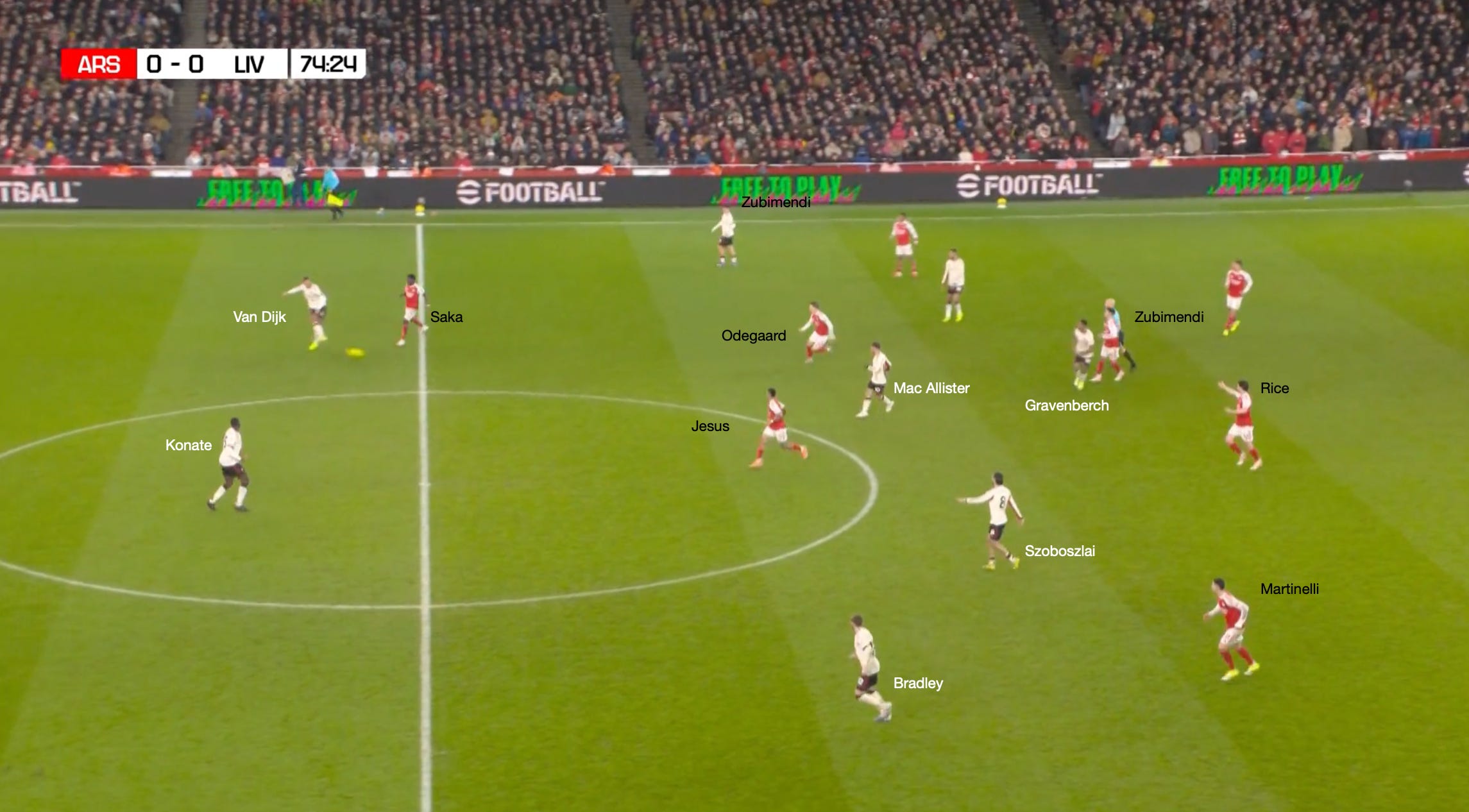
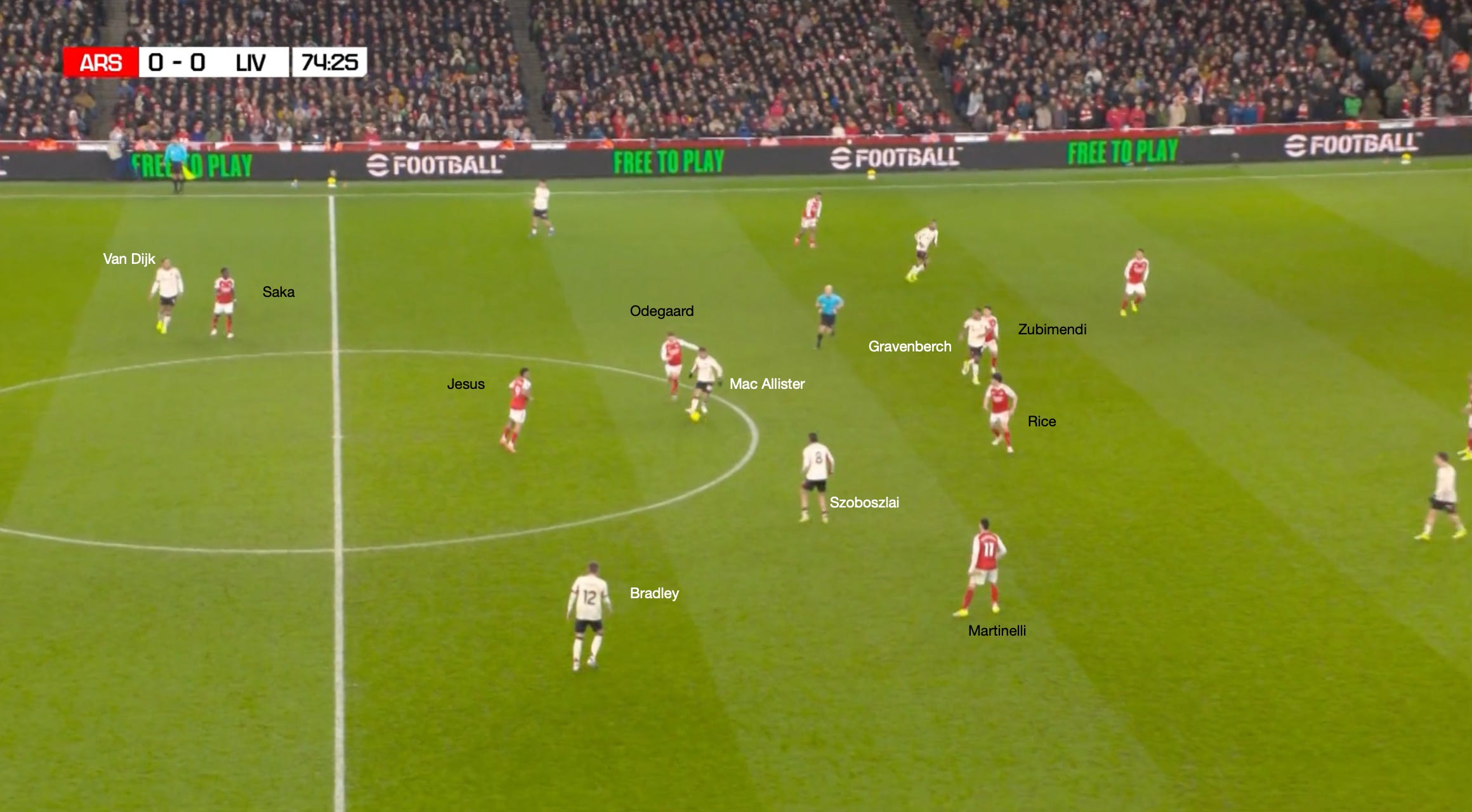
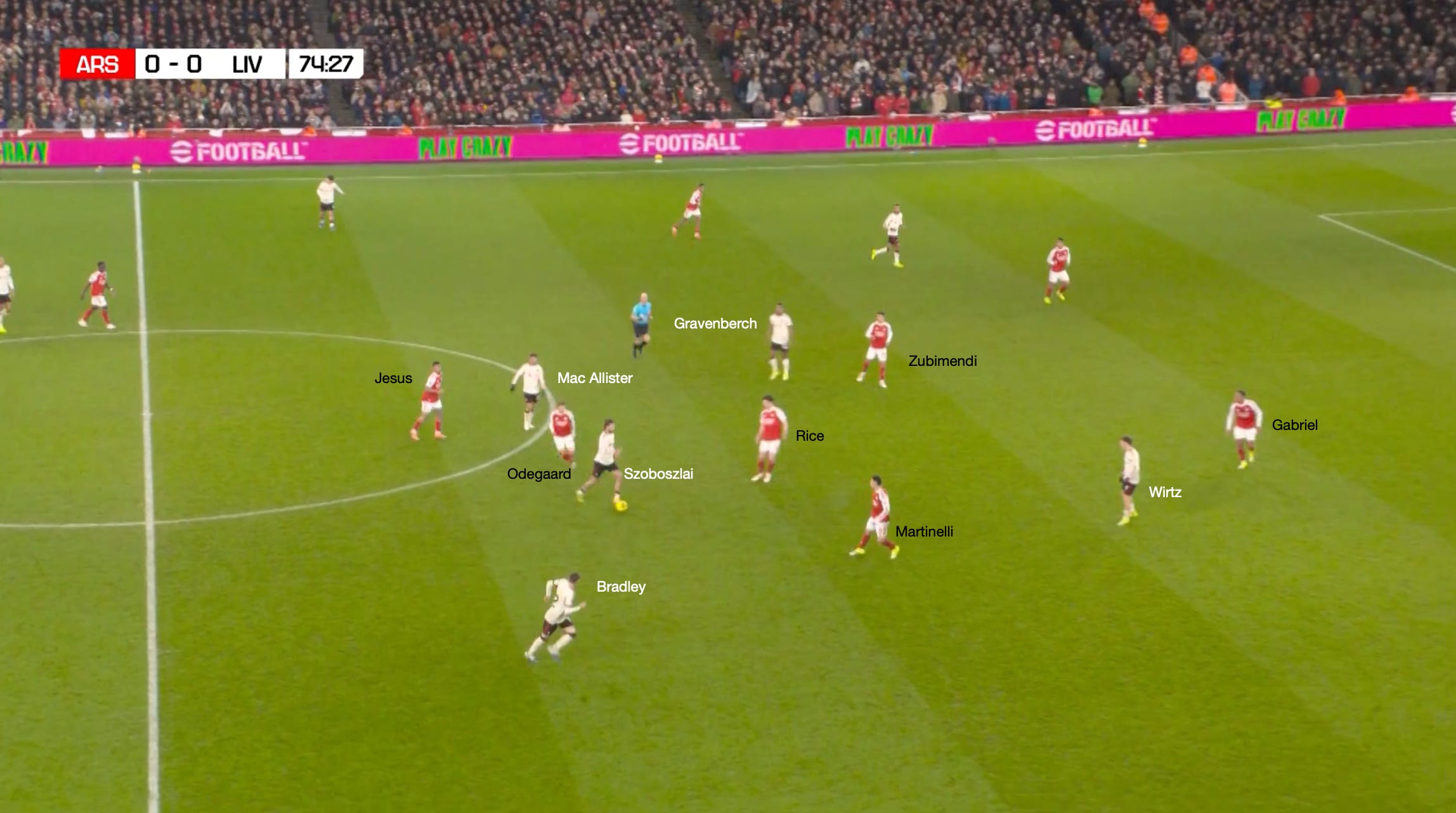
Liverpool players were always on the move. Moving in relation to each other and overloading our left. Aston Villa provided us with similar issues in terms of central overloads in both games. The most recent encounter at the Emirates saw Morgan Rogers drop really deep, away from big Gabriel and near Amadou Onana, creating a 2v1 against Mikel Merino. We found this difficult to counter in the first half.
How could we have denied Liverpool from controlling large portions of the second half? We needed to do the following:
Be better on the ball under pressure
Be better with loose balls
When defending deeper within a settled block, we needed to eliminate the line of pass from the backline into the midfield reciever, which requires discipline
Once ‘3’ is executed, we can then start pressing more aggressively from the front, so that passes could be forced back to Alisson. Once the ball goes back to the goalkeeper, we can then press confidently and in M2M fashion because the distances between Liverpool teammates lengthen
Love this, such an eye for detail!