

To say yesterday’s three points were vital is an understatement. It was a massive day and weekend of Barclays.
As a cluster of games, Newcastle away, West Ham at home, Fulham away and Crystal Palace at home saw us pick up just three points in the 23/24 campaign and two points in 24/25; these encounters have been our kryptonite in the past, severely denting title aspirations.
A complete contrast to this season, however, as we’ve managed to collect maximum points, at a time when our rivals are experiencing severe turbulence. This was the group of fixtures where I challenged this Arsenal team to become the protagonists of this race, and here we are. Still a long way to go, of course!
Right, now let’s focus our attention back to Crystal Palace and on a more micro level.
Oliver Glasner is a superb coach. I can guarantee you that his team will create further havoc against the traditional top six. It’s a unit built for the big encounters, as we have previously witnessed in their FA Cup triumph against Manchester City and their successive victories in the league and Community Shield against Liverpool.
They’re dangerous as underdogs because of their sound defensive structure, which is complemented by their forwards, who are potent in transition. Statistically, as per Opta Analyst, they rank 17th in the Premier League for average possession (42.4%), but have generated the most xG in the division.
Unsurprisingly, Mikel Arteta post-match stressed just how difficult it is to manufacture clear-cut chances against Crystal Palace, before highlighting the importance of exploring other avenues that can yield positive returns, which we do so regularly with the frowned-upon dead ball.
And by the way, in the context of Arsenal, consistently scoring via set pieces is extremely sustainable. But I’ll save that discussion for another day.
The purpose of this post is to focus on our intentions against Crystal Palace’s defensive structure and how the ideas presented made logical sense, despite the lack of open play creation by the book.
So, to be specific, I’m talking about Arsenal’s behaviour in possession, away from goal kicks and with Crystal Palace stationed in their settled nominal 5-4-1 block.
To begin with, let's take a look at our first line of build-up, which features a back three yet again, consisting of William Saliba, Gabriel Magalhães and Riccardo Calafiori, who provide excellent coverage to circulate possession around Jean-Philippe Mateta. This is very standard stuff.
Now, what occurs further ahead is where the interest lies!
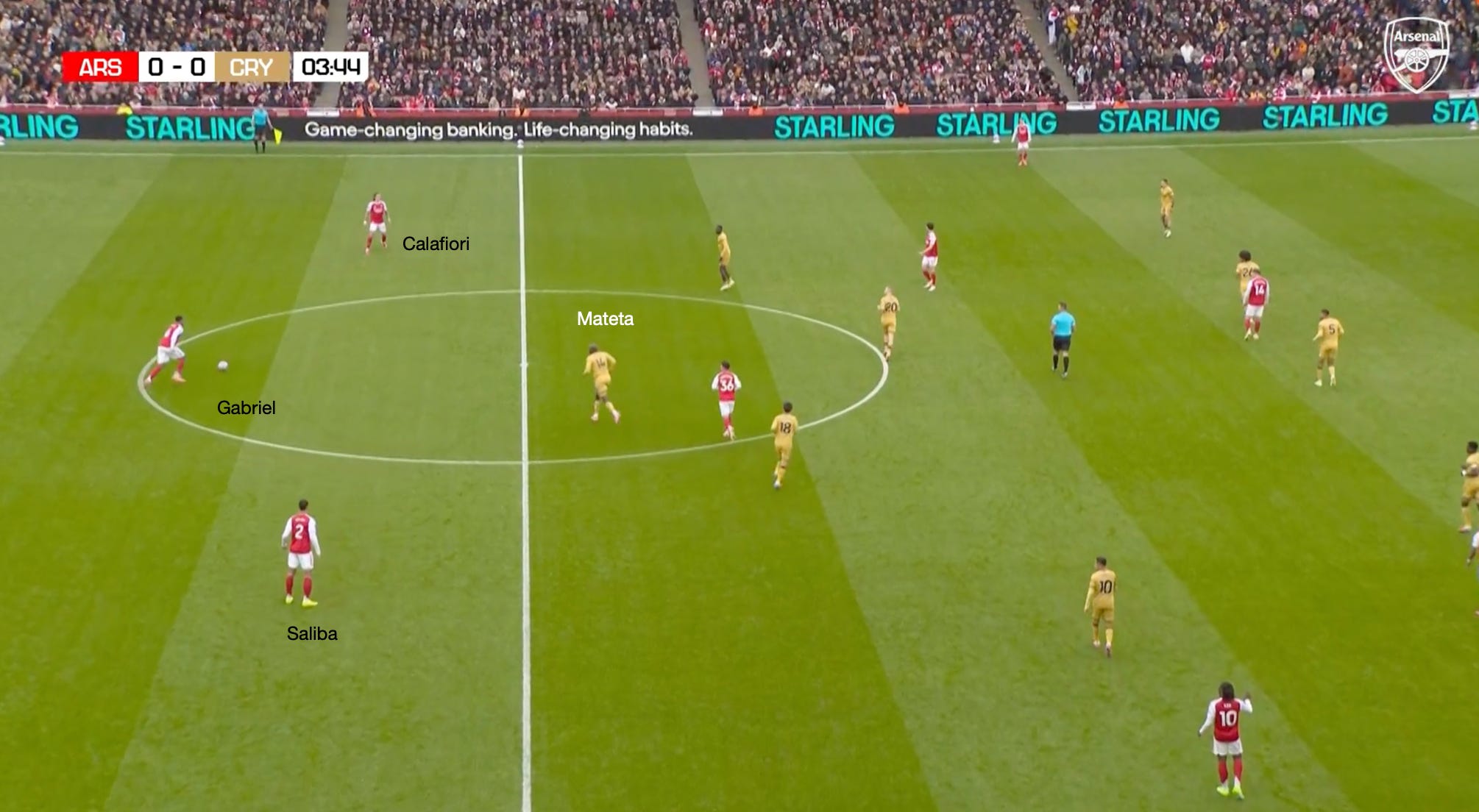
Quickly going back to my ‘Combating tactical homogeneity’ and ‘Variation’ posts, you will notice that against back four systems, to pin the entire backline, a very effective way to do so is by utilising two touchline players (our wingers), who fix the FB’s and a CF stationed in between the two CBs.
There are obviously additional nuances that one must consider in relation to the opponent, which we saw against West Ham, Fulham and Atletico Madrid, for example, and I’ve explained that in greater detail previously. But essentially, three players restrict the entire back four from freely stepping out.
A back five, on the other hand, offers new challenges and therefore provokes you to find different solutions.
Again, to keep things simple, as that’s always my aim, a back five has the benefit of an additional defender; that player is the central centre back (CCB), who is positioned in between the two wide central defenders.
The CCB primarily covers the jumps that the wide central defenders may make.
The reason why the wide central defenders may jump out is that a 5-4-1 block can be overloaded by a nominal 4-3-3. In reference to our game yesterday, we started with a midfield trio of Declan Rice, Martin Zubimendi and Eberechi Eze, which offers numerical superiority against the double pivot of Daichi Kamada and Adam Wharton.
To combat the dangers of this overload, one of the wide central defenders, positioned in the half spaces, will step out and engage; that’s a benefit of the back five. The jumps from these wide defenders can restrict the spaces between the defensive and midfield lines.
Basically, you then have two choices. You either deny the wide central defenders from stepping out by pinning them, which opens up space between the lines, or you provoke them to step out and exploit the spaces behind the backline. We attempted to do both.
Let me first explain option one.
As I’ve said already, against back four systems, only three players are required to fix the entire backline.
A back five, however, can’t easily be fixed by three players because remember, they have an extra man, which gives license to the wide central defenders to jump out! So you need another player to perform a ‘pinning role’.
Naturally, with us being a right-sided team, we consistently looked to pin their LCB, Marc Guéhi. It doesn’t matter who takes up the role; the salient point is that someone should, more often than not, do it.
Have a look at the visuals below, which showcase these ideas in action.
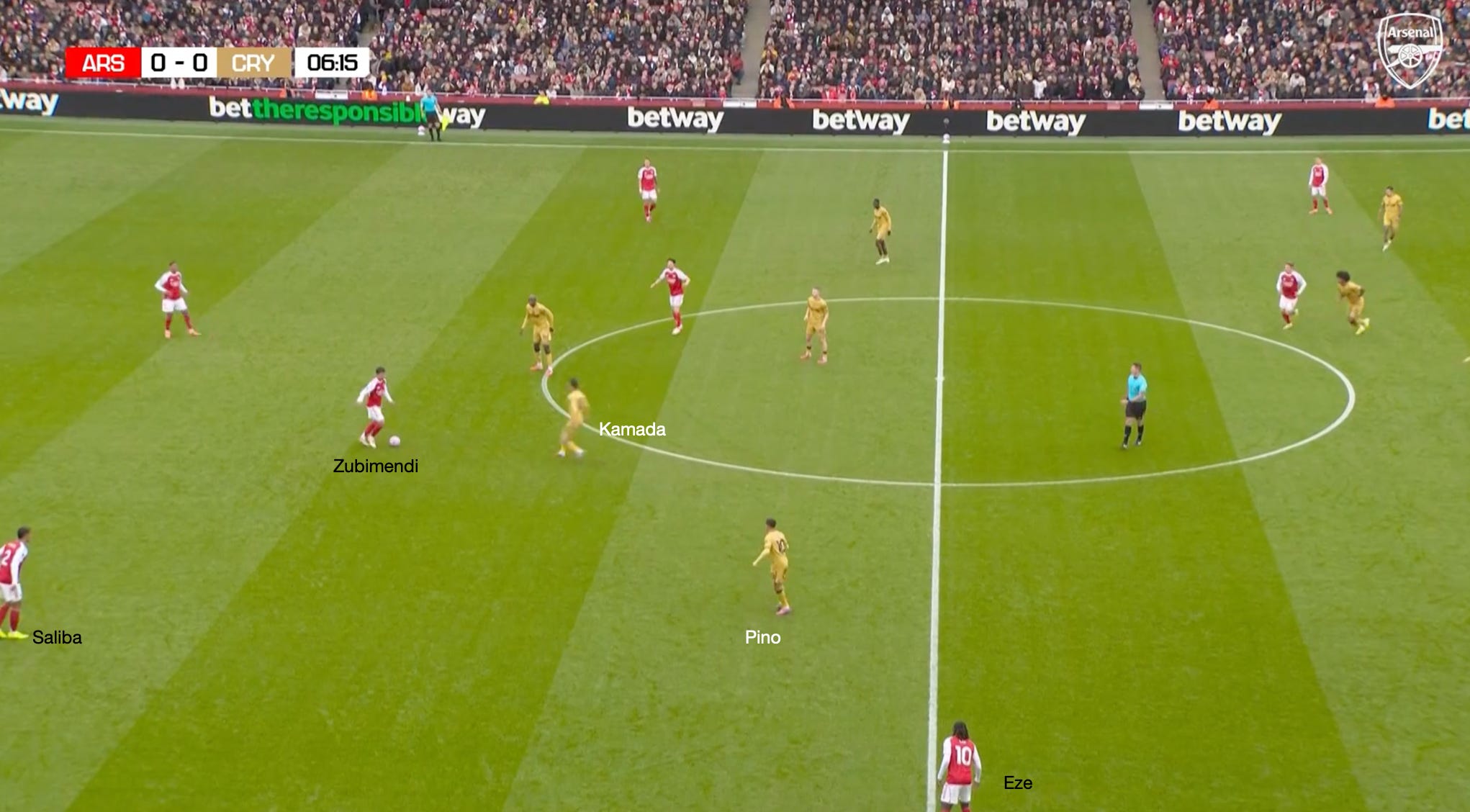
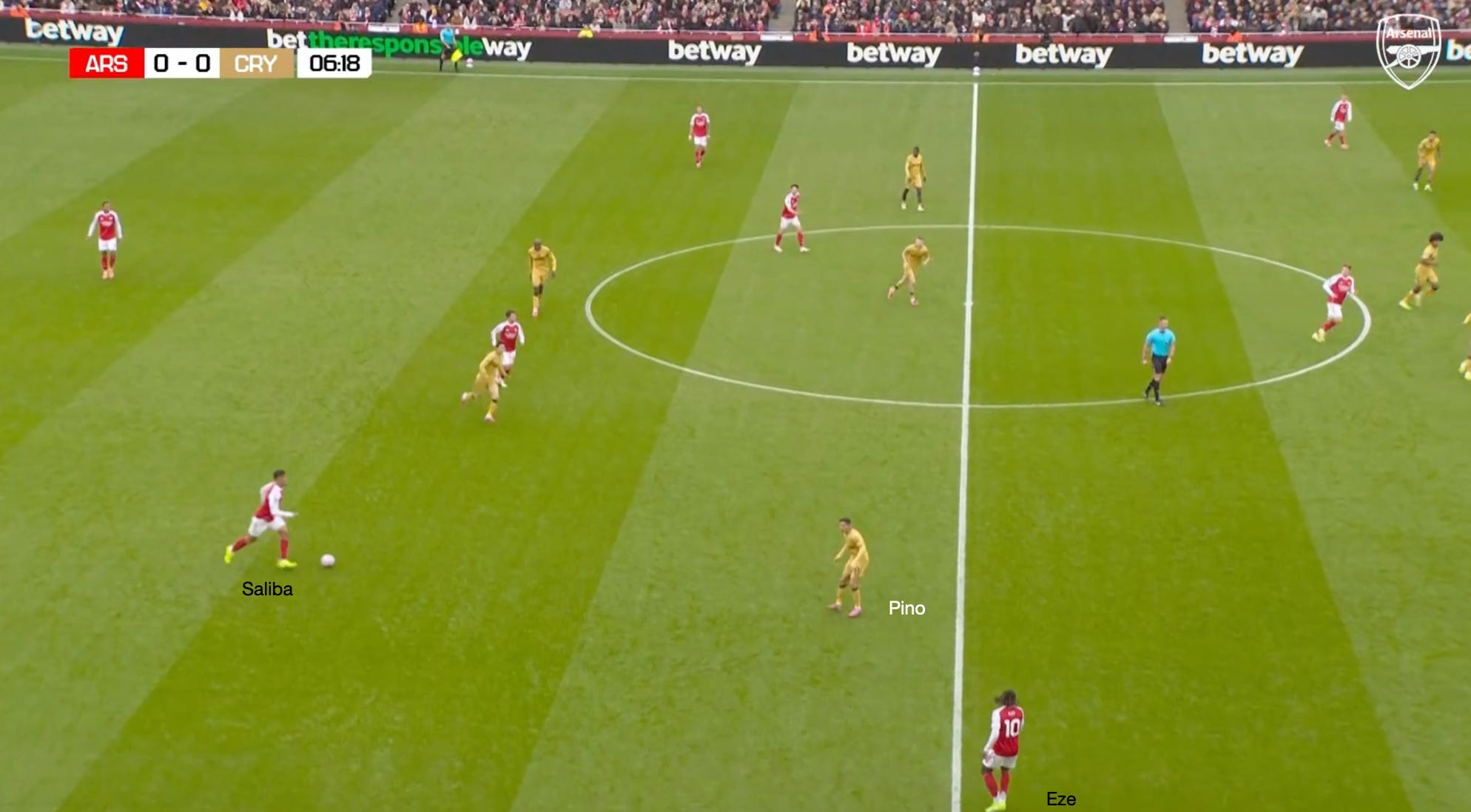
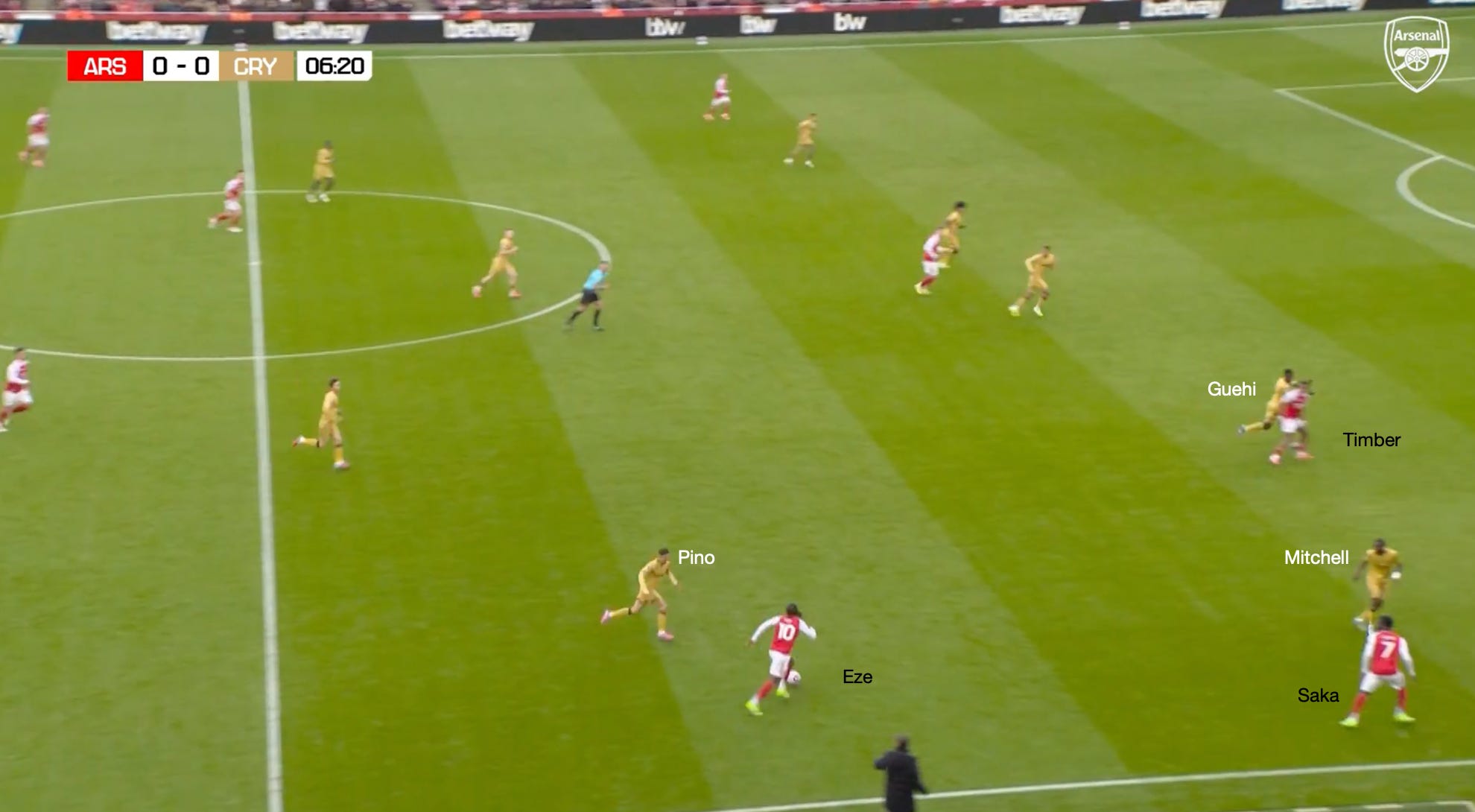
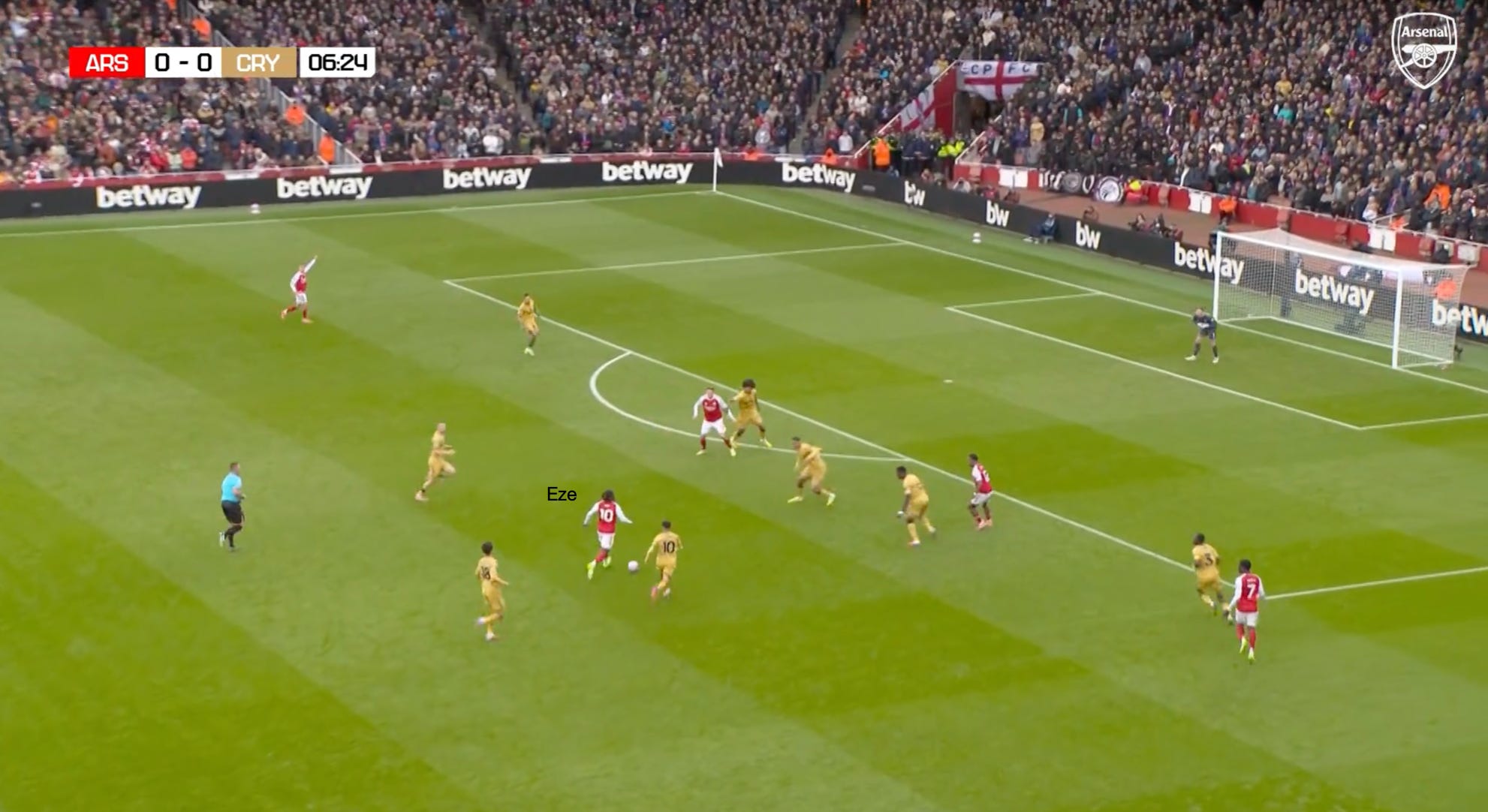
The key is to entice Kamada to jump onto Zubimendi, as it allows us to exploit the space he has vacated.
As Yeremy Pino jumps to Saliba, this is a typical trigger for someone (Eze in this scenario) to step outside the block and receive the ball; as he will have time and space to execute the next action, since other opposition players are occupied. In the above sequence, you can see Bukayo Saka shielding left wingback Tyrick Mitchell, Guéhi is being pinned by Jurrien Timber, whilst Kamada has jumped to Zubimendi. After receiving the ball from Saliba, Eze is now free to attack the centre, and what looks like an extremely promising scenario is eventually wasted by Eze not adding that precise final touch.
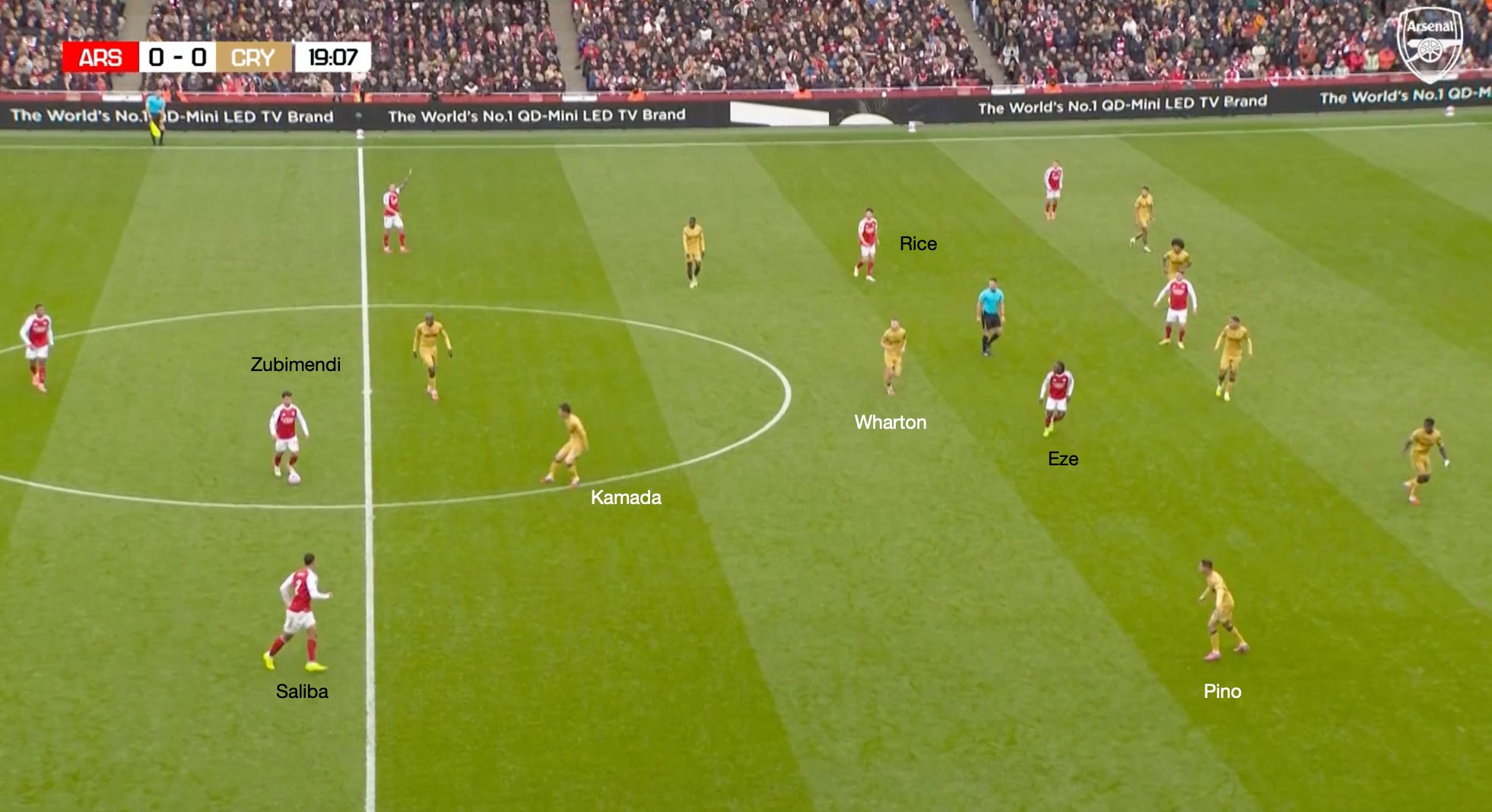
Take a look below to see another example of these principles in action, but Eze this time remains central and near Rice, to overload Wharton and notice Guéhi being pinned by Saka. Eze again fails to make the correct decision in the final third.
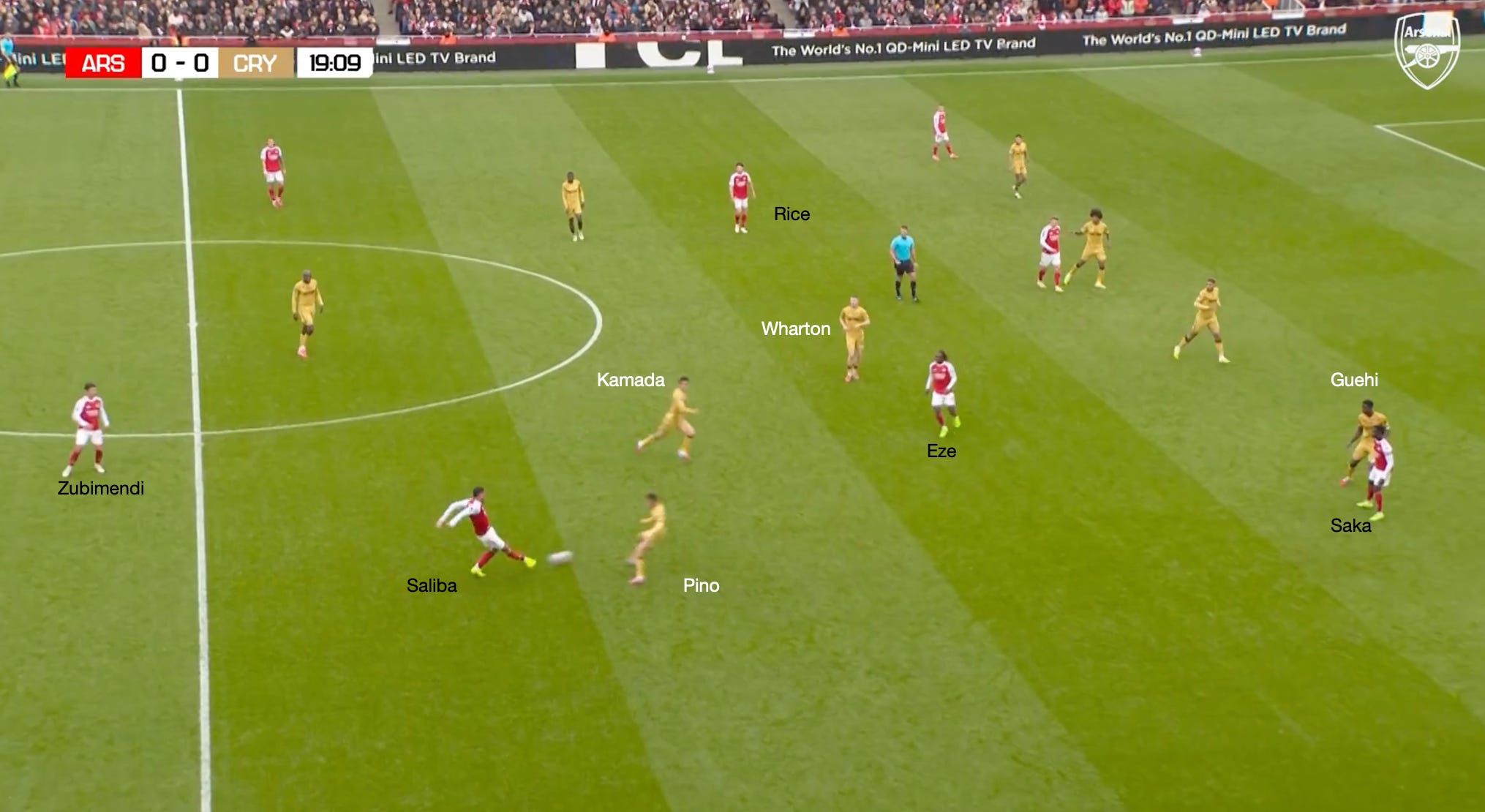
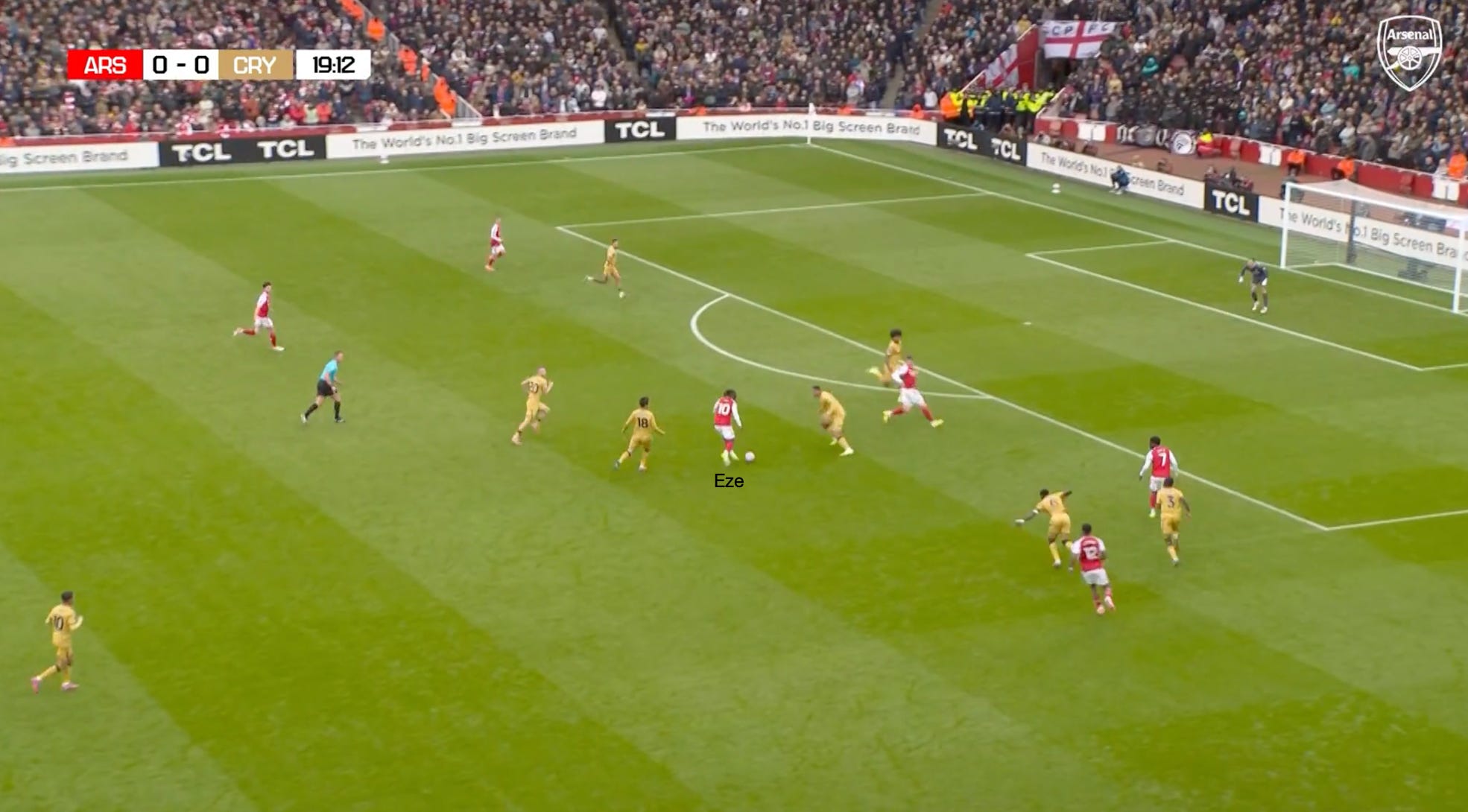
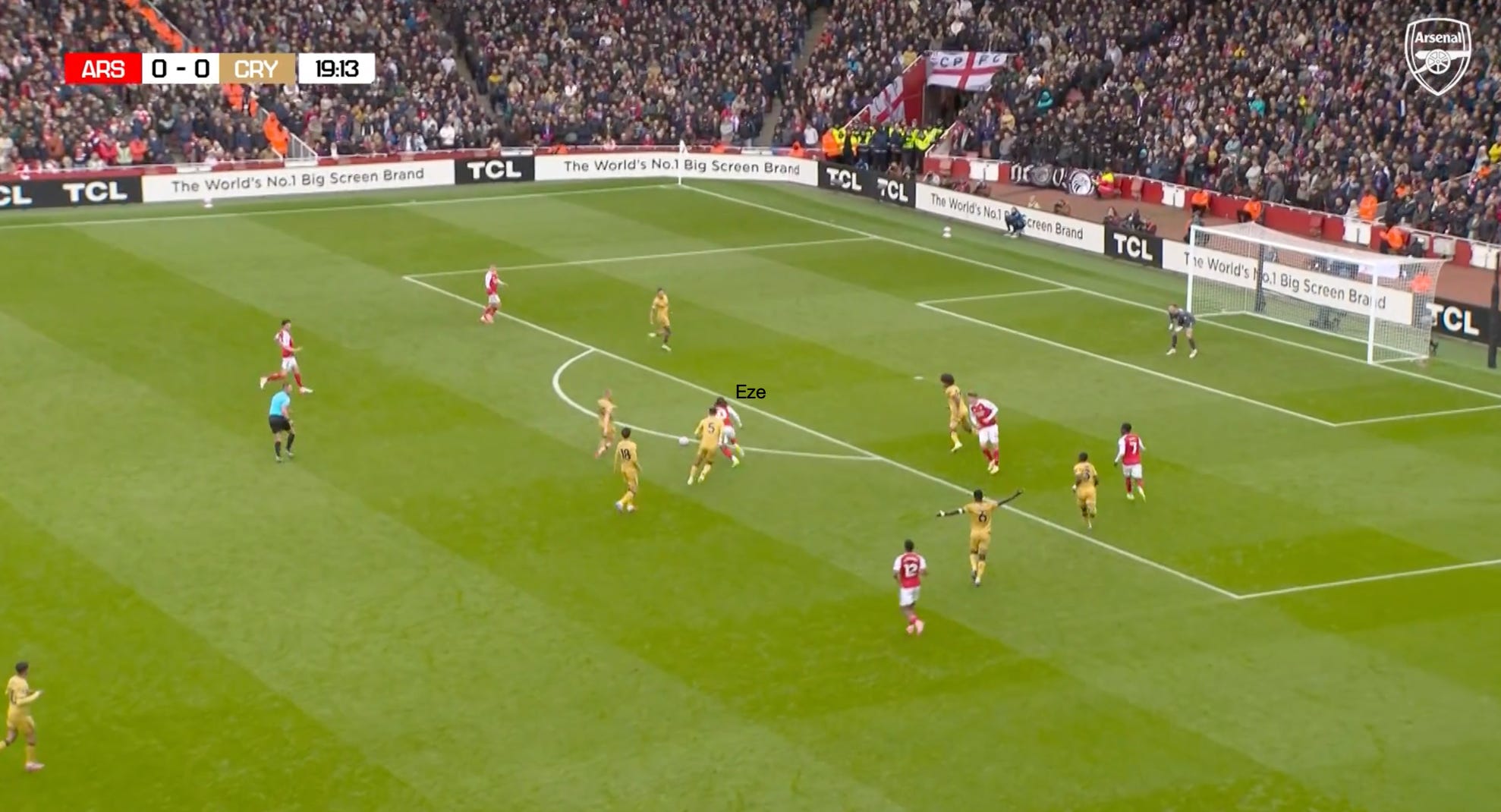
And here’s another, but this time it’s Viktor Gyökeres messing up the opportunity, as he fails to find Timber.
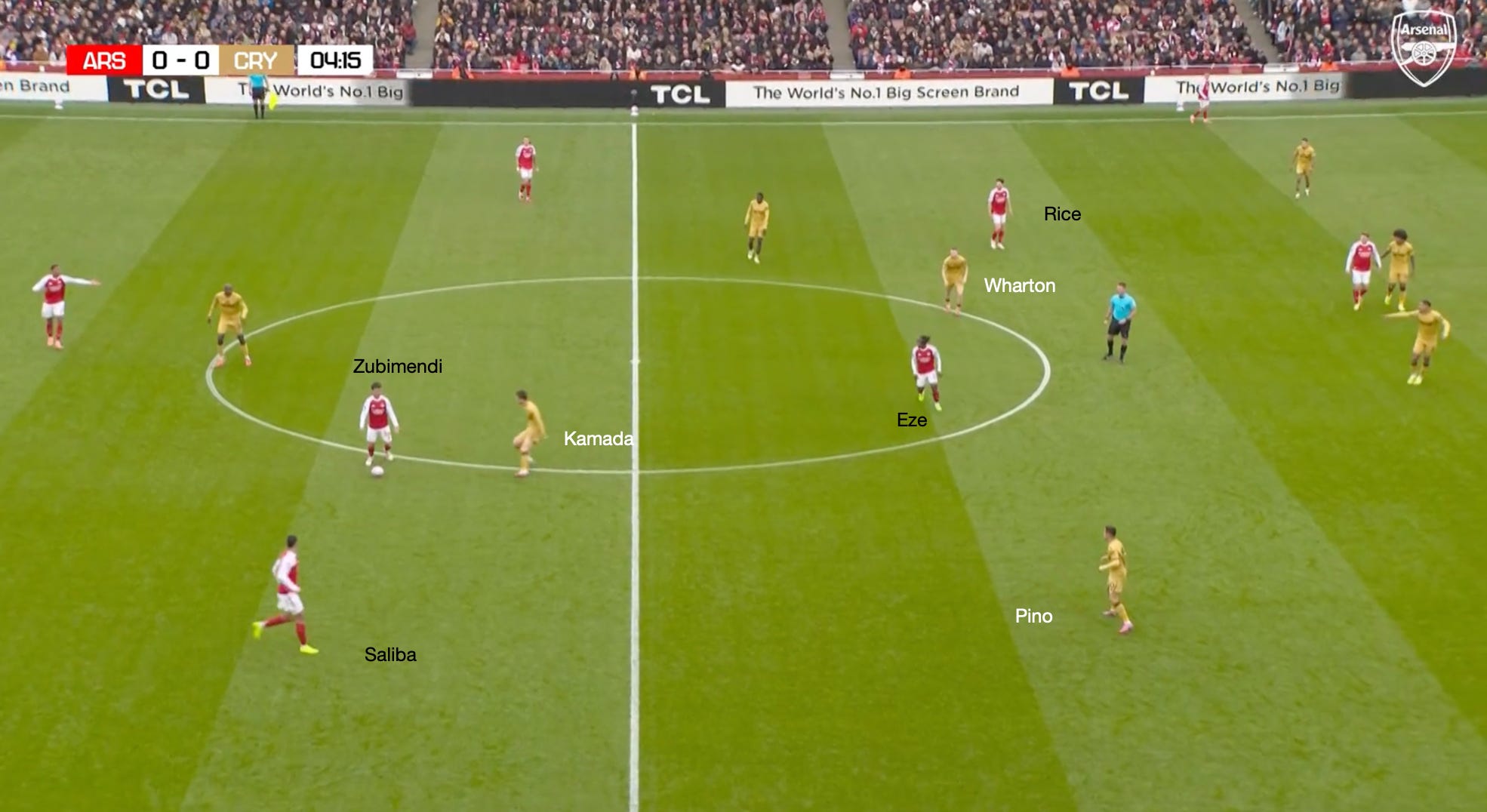
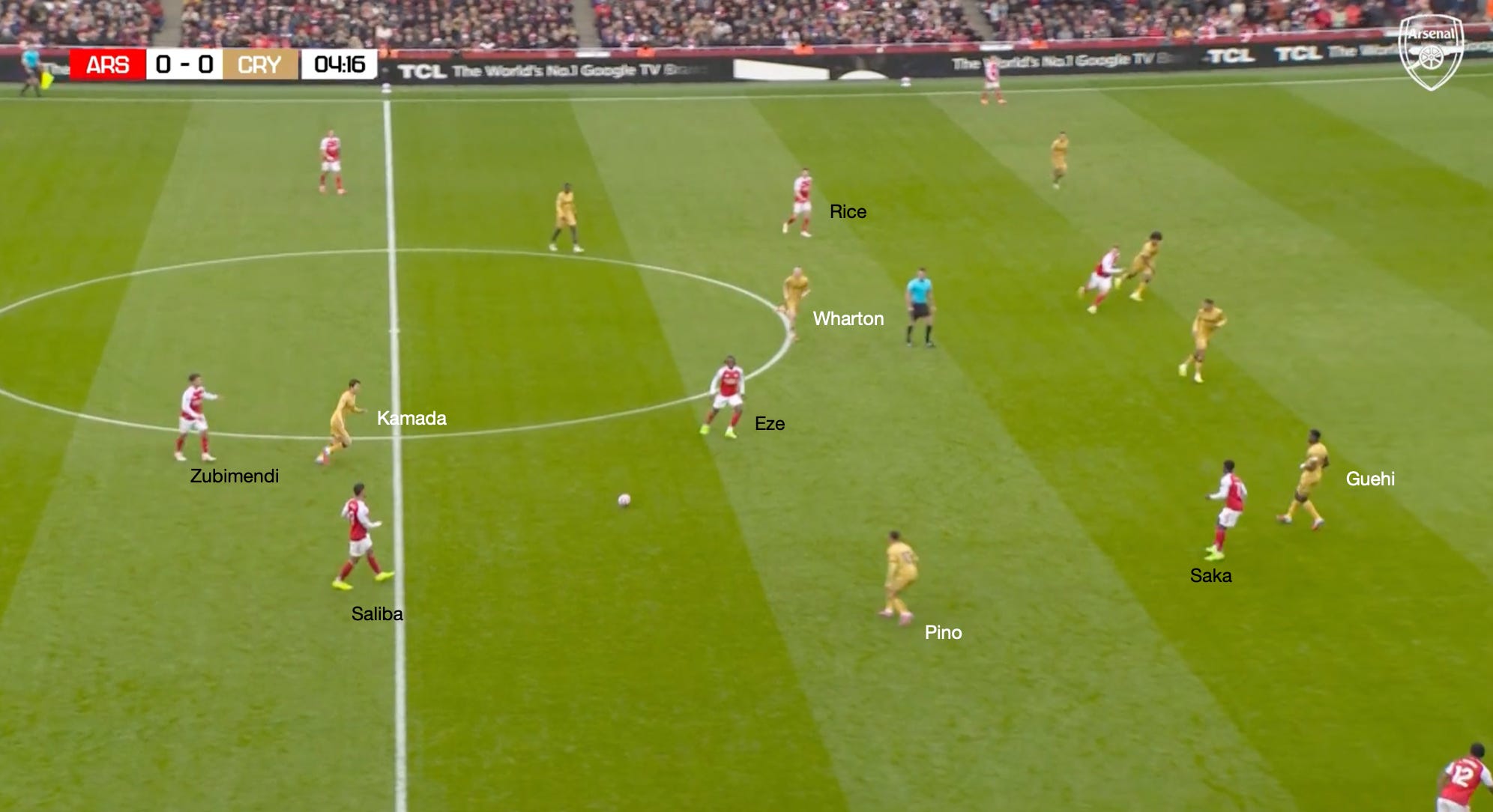
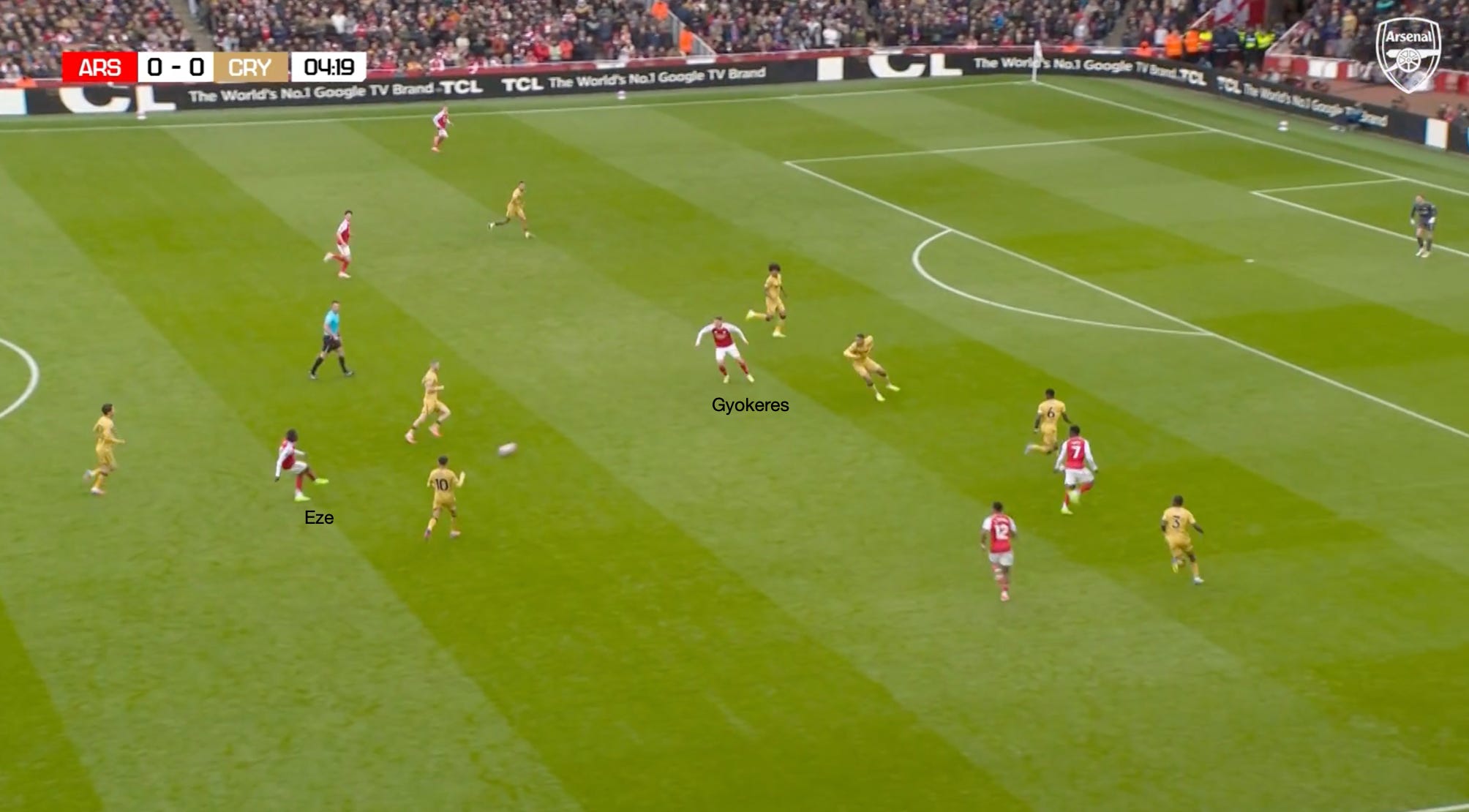
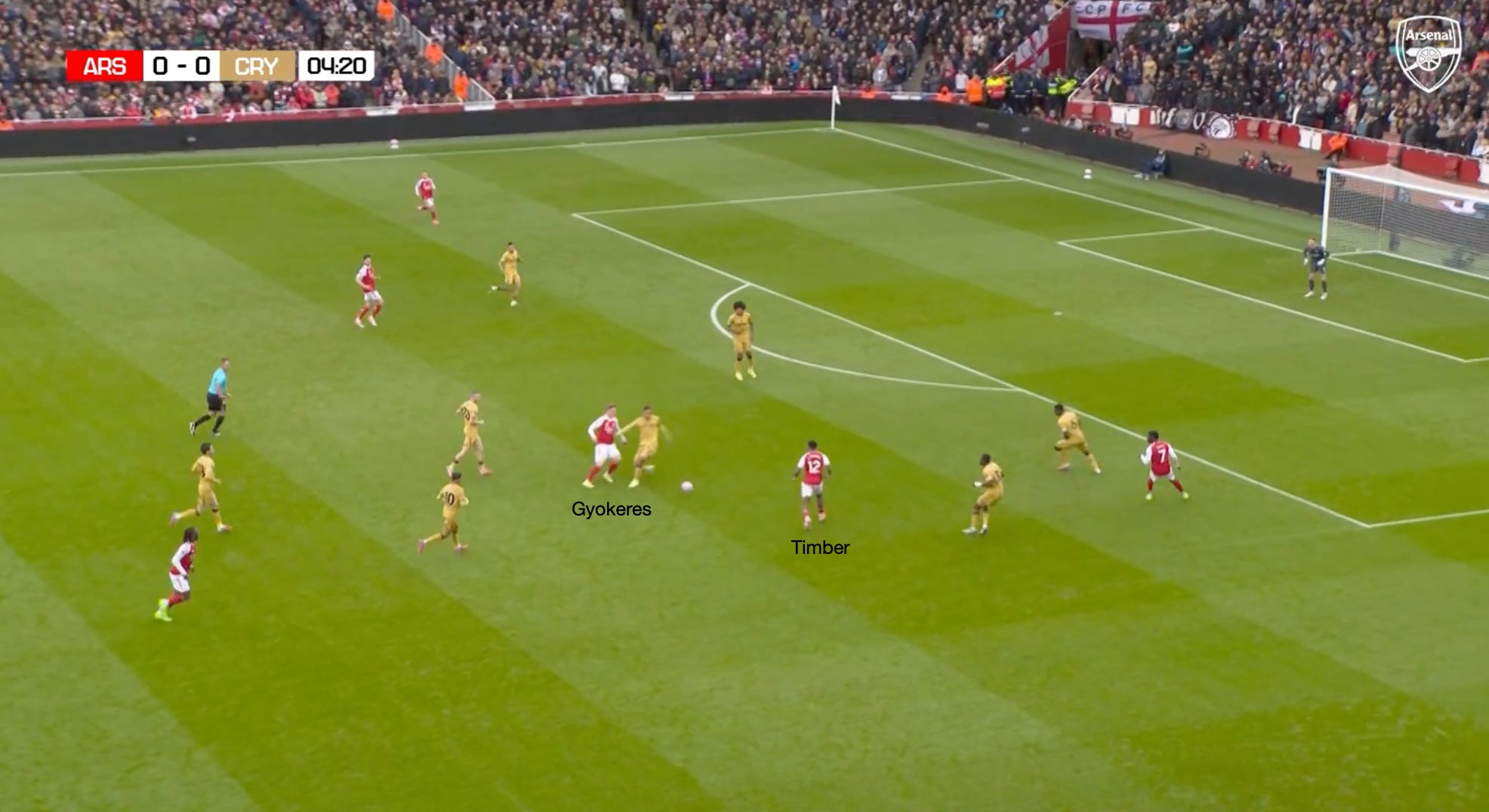
This happened on many occasions, where the methodology was rational, but wastefulness in key areas denied the maximisation of these principles.
Now let’s look at option two, which is provoking jumps from the wide central defenders and responding with direct play.
Do you remember Gabriel Martinelli’s goal against Crystal Palace at Selhurst Park from last season? If you do, then you will recall a peach of a long ball by big Gabriel for Leandro Trossard to latch onto, who then delivers a cross for Gabriel Jesus, and eventually, Martinelli converts the situation.
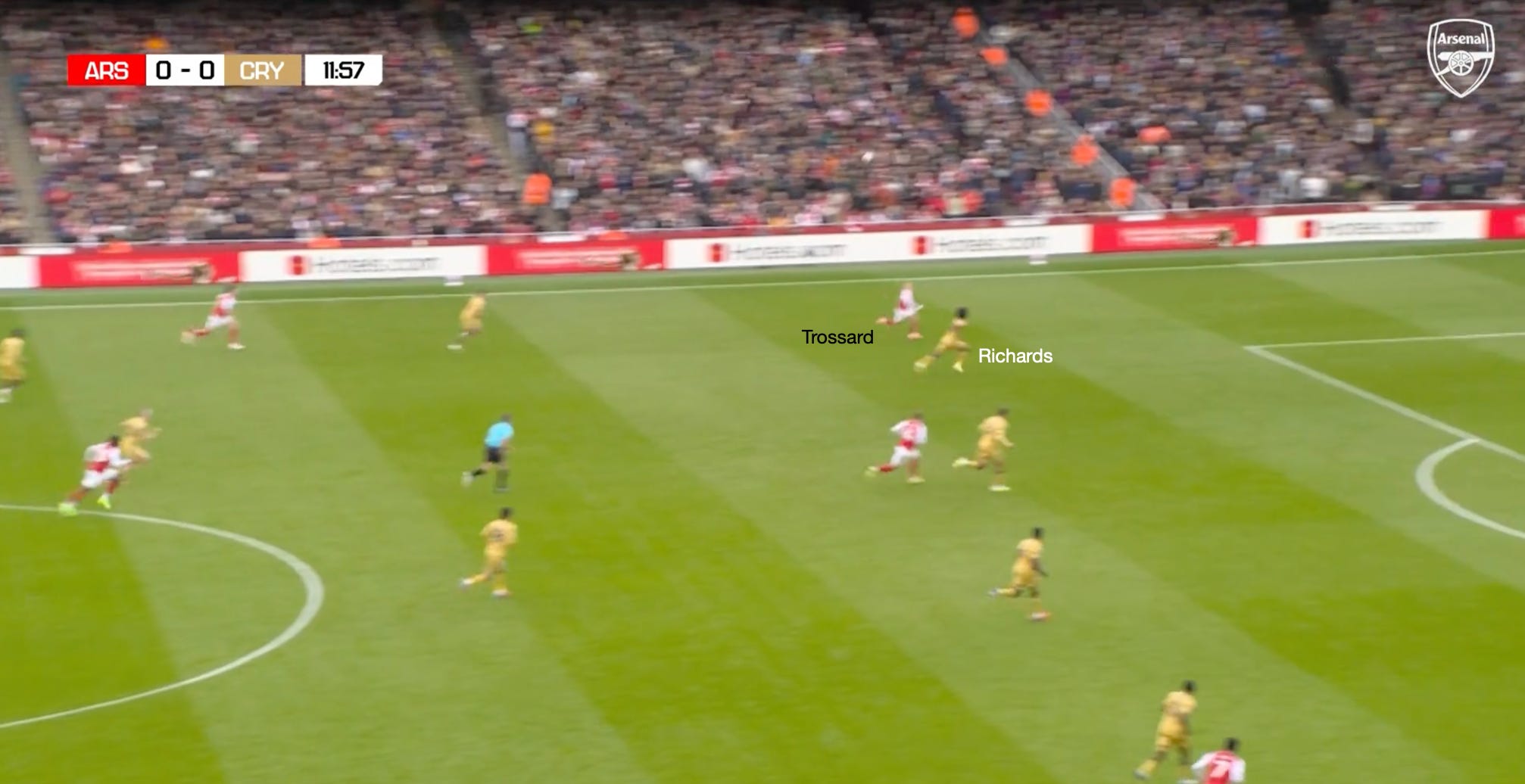
The long ball comes from the wide RCB, Maxence Lacroix, stepping out and following Rice, which in turn creates an opportunity for Trossard to abandon width and attack the open space via a dynamic out-to-in run.
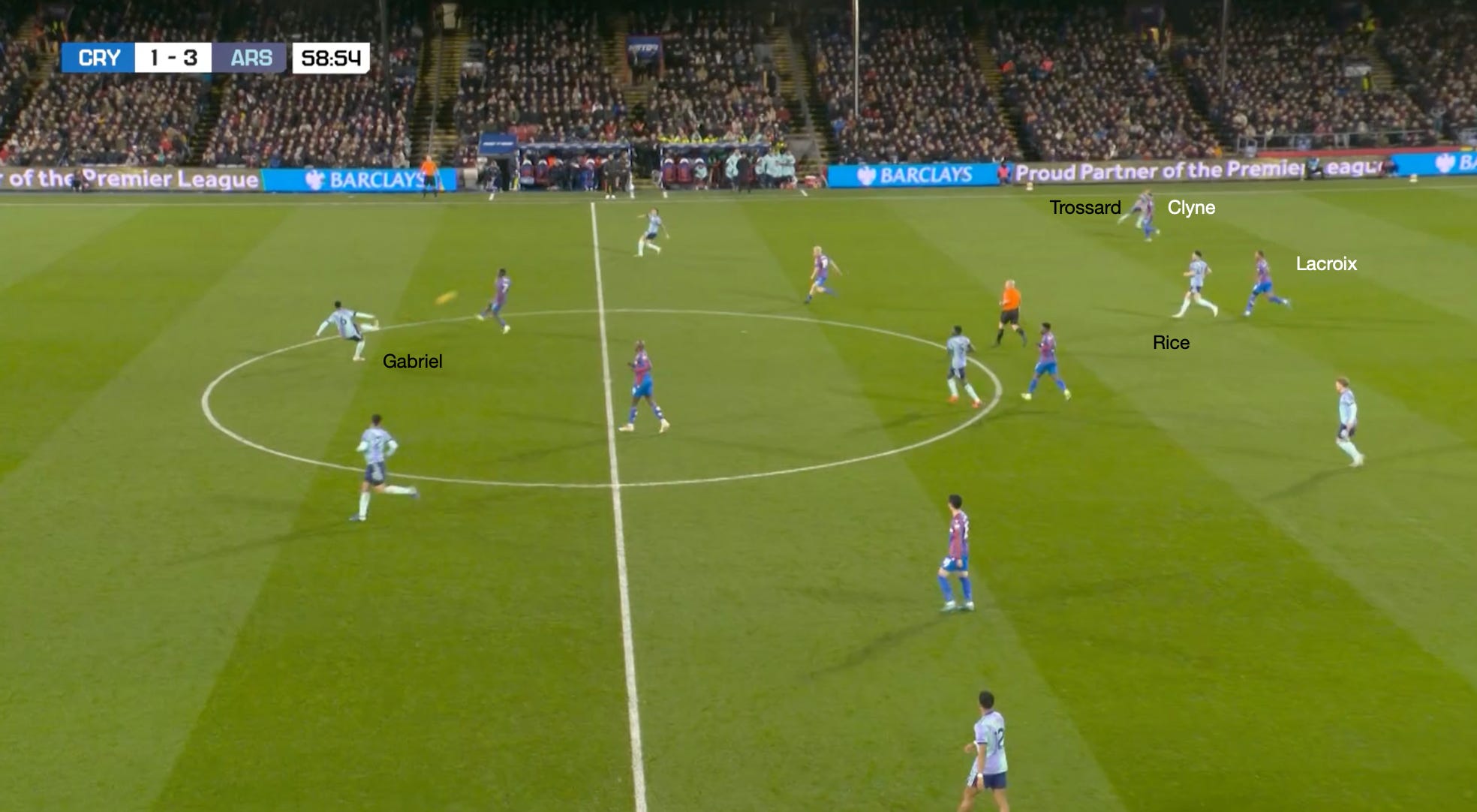
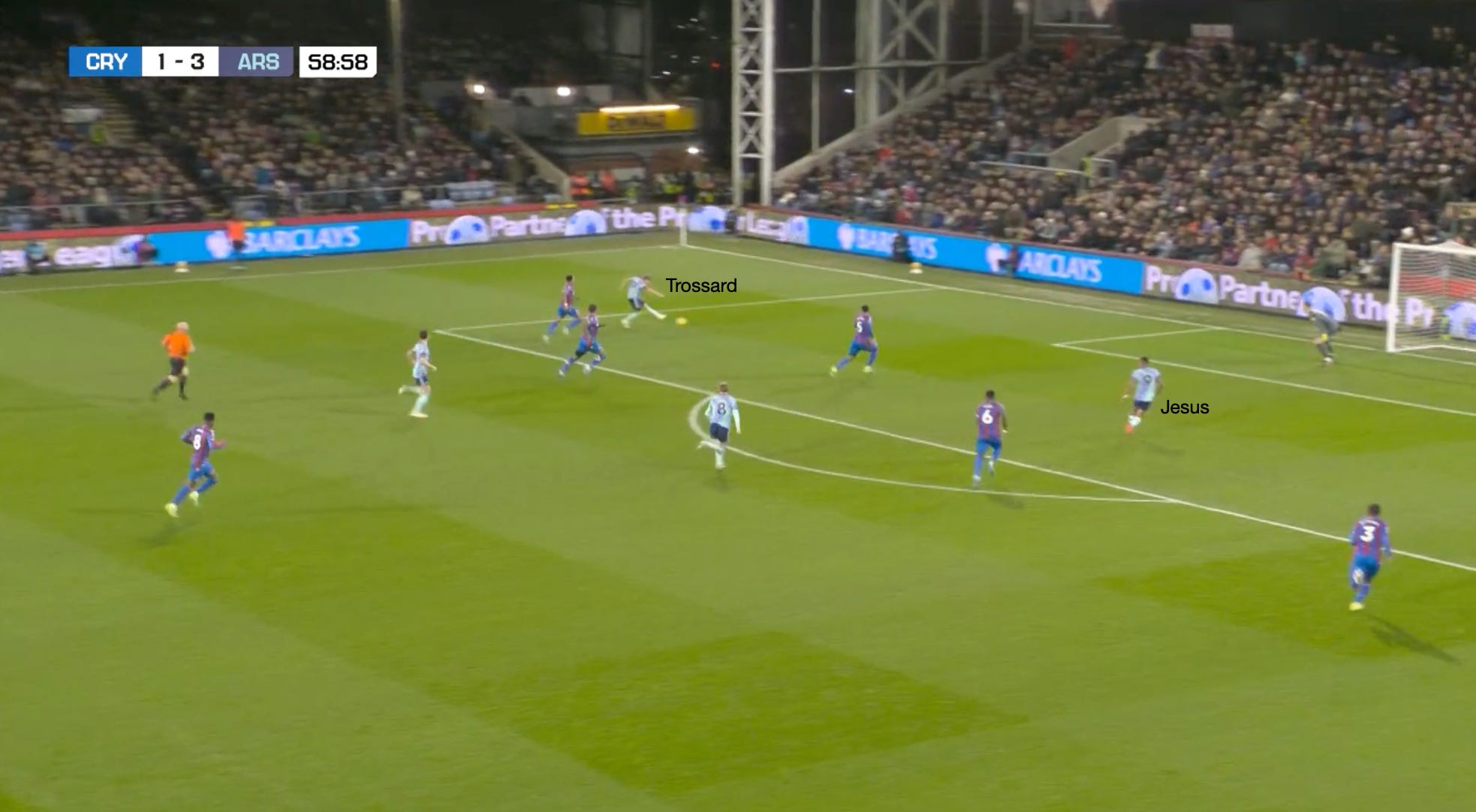
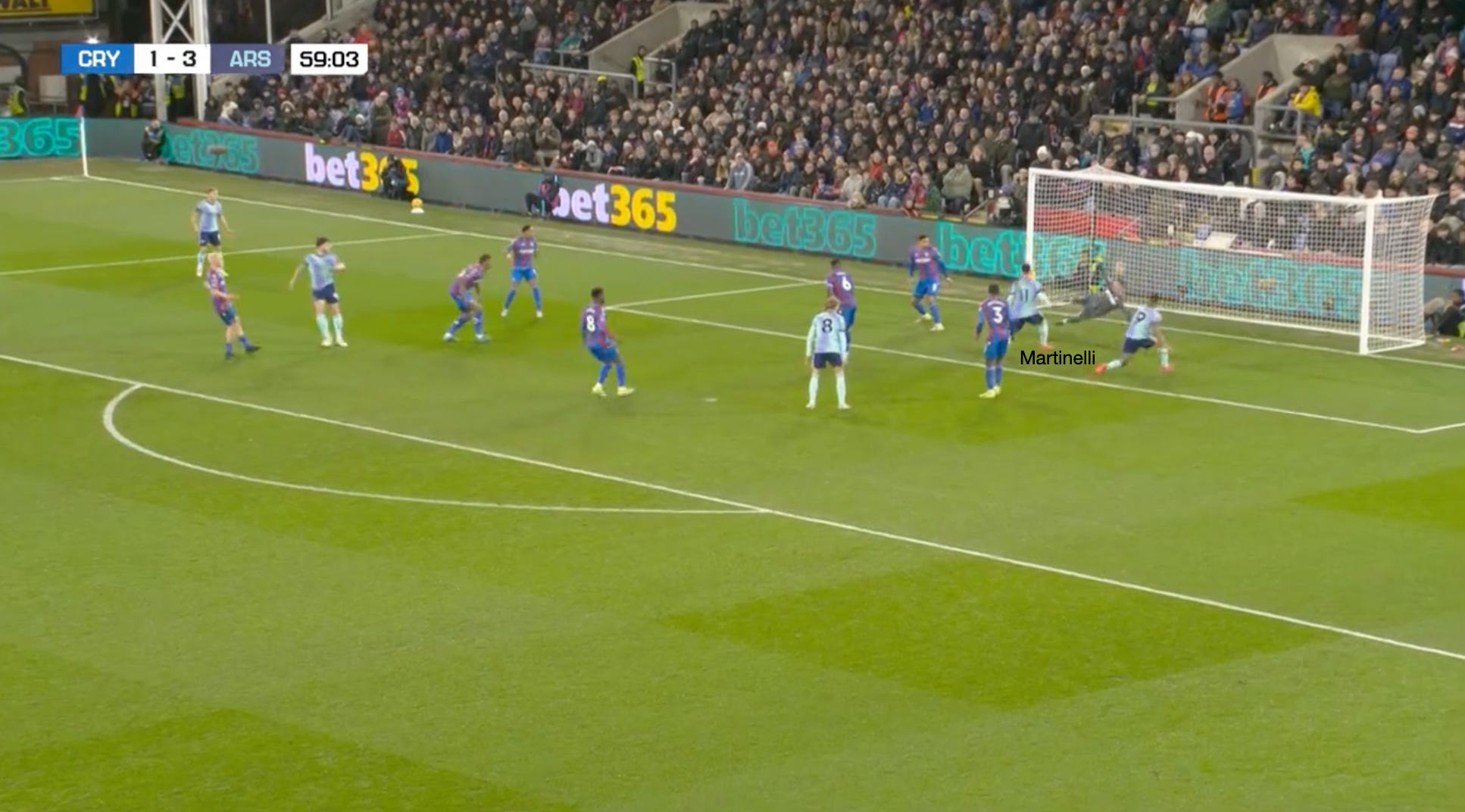
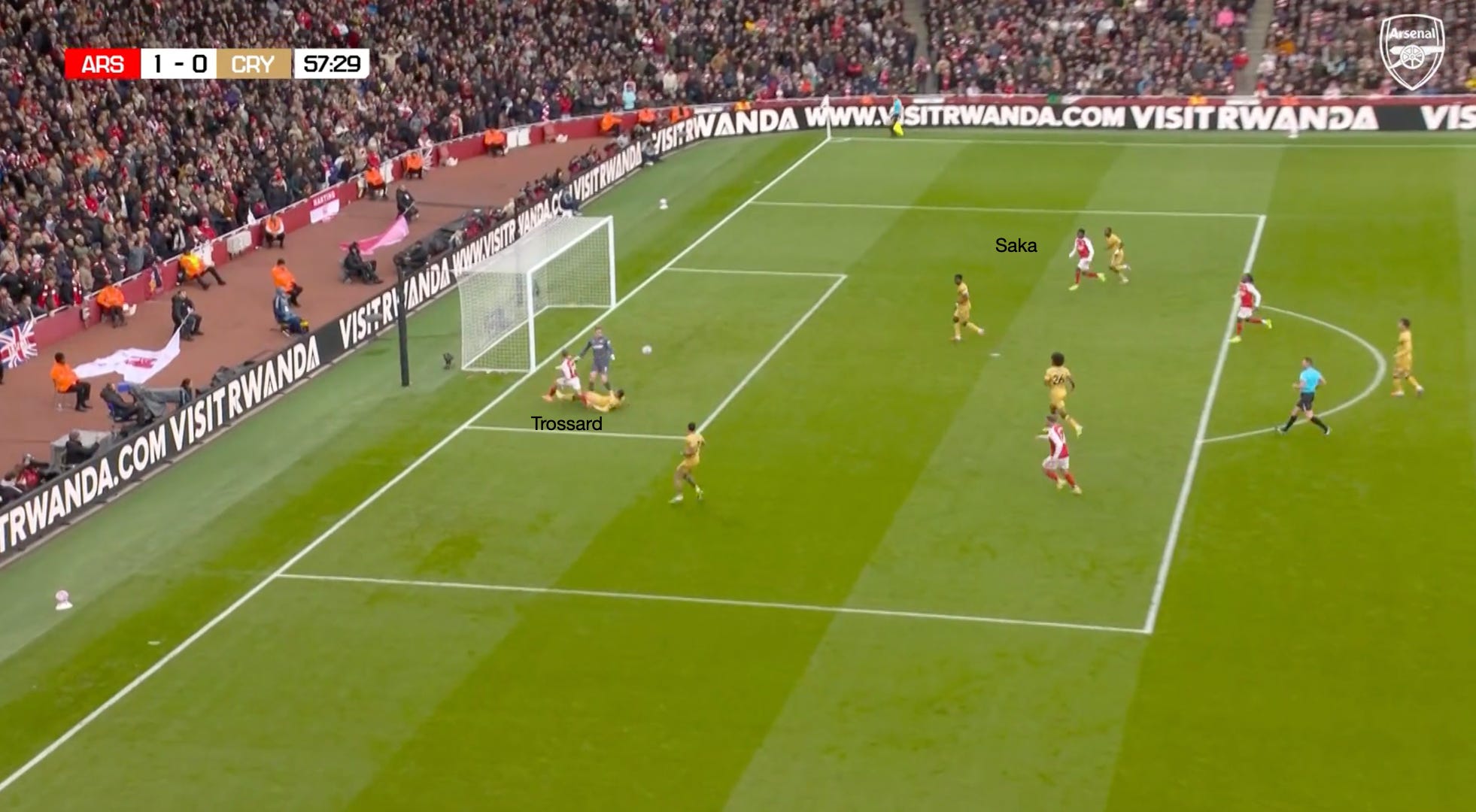
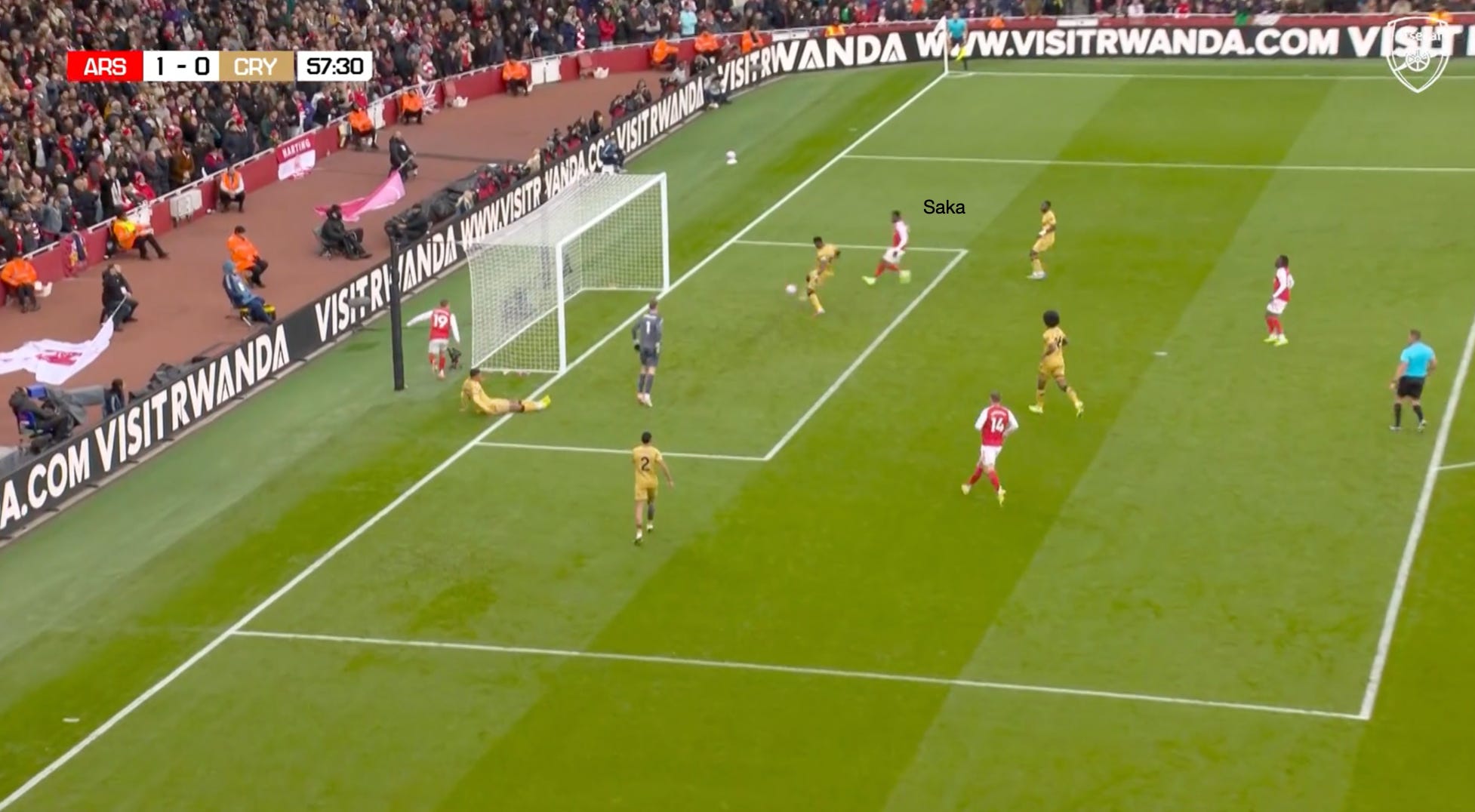
Now let’s look at yesterday. You can see from below Gyökeres provoking Chris Richards to step out, which, as I’ve already stated, is the trigger for the ball in behind. Trossard arrives dynamically behind the backline following a tremendous pass over the top by big Gabriel, and Saka would have had a tap-in if he’s on his toes!
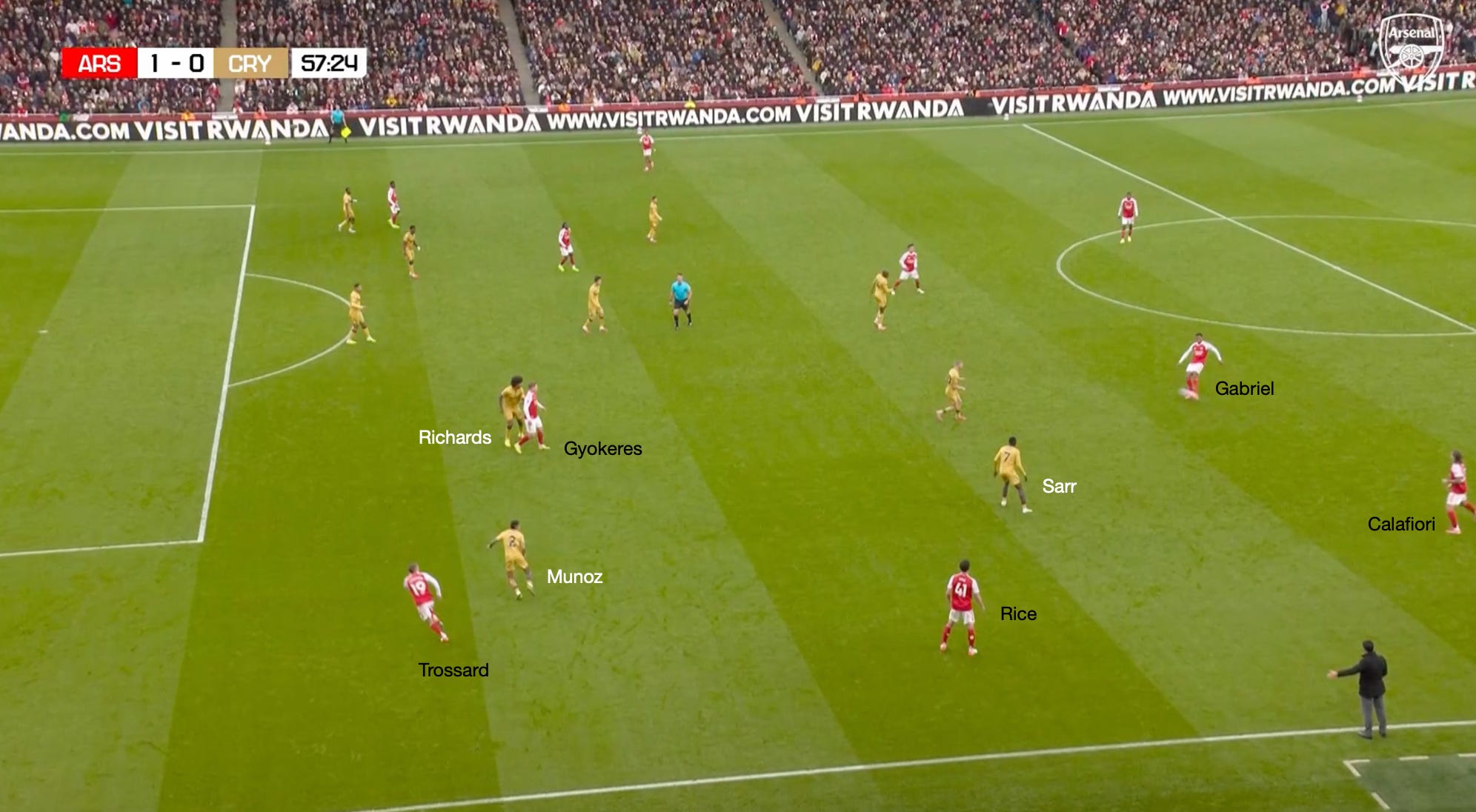
Also notice Ismaïla Sarr’s positioning, who is ready to press wide LCB, Calafiori, which is the signal for Rice to move outside the block. Similar to what is happening on the right, as I’ve previously documented.
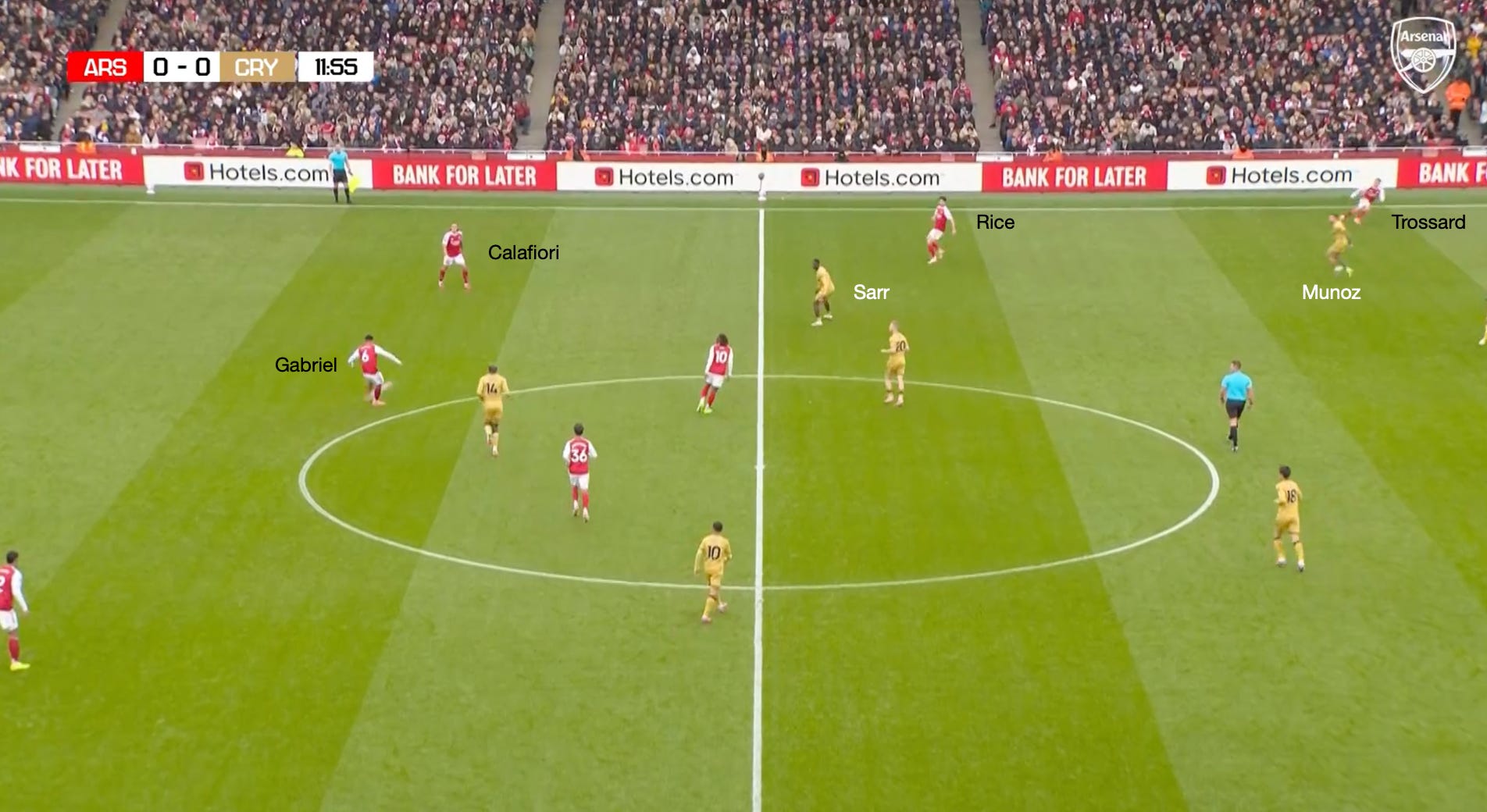
Here’s another example, but this time it’s the right wingback Daniel Muñoz jumping towards Rice, who yet again drifts wide to potentially receive the ball, as Sarr is ready to lock onto Calafiori. Pressure provoked, and then it’s about delivering the pass in behind for the winger to meet.
Naturally, when you look at the numbers and see Arsenal fashion just 0.9xG over the entire 90 minutes, as per Scott Willis, it leads you to the narrative of us being void of ideas.
Courtesy of the book Thinking, Fast and Slow, by Daniel Kahneman, this is the anchoring effect in full flow, where pieces of data, which are easily consumable, can send you down a false path, in my opinion.
Both things can be true; Crystal Palace defended superbly to limit Arsenal’s threat, but at the same time, we had a clear approach, and what let us down was the final execution, alongside other discernible factors such as the speed of our play, which could have been accelerated in many moments.
My final point I will leave you with is that you should expect to see similar behaviours against back-five mid-block systems. What I’ve highlighted in this piece isn’t exclusive to just Crystal Palace. Let’s hope for more refined end product next time round, though!
This is a brilliant piece of tactical analysis. Your ability to turn complex ideas into easily digestible ones is truly remarkable
Excellent once again Rohan. I love the clarity in explaining the two approaches we utilized yesterday. It was a game of limited chances hand I think we had a fair result.