
Arsenal optimism
A sucker punch in the dying embers at the Stadium of Light shouldn't dampen our spirits

The North East of England has seen us exposed to what I like to call the ‘loose ball game’. Both Sunderland and Newcastle have provoked battles of this nature, and it’s not easy to consistently dictate proceedings.
So, what is the loose ball game? Essentially, it’s a type of contest that is extremely demanding from a physical standpoint, and the Premier League has become inundated with teams that advocate for this approach.
Anyways, back to the specifics of the loose ball game.
Let’s assume you have ‘Team A’ who are up against ‘Team B’, with the former in possession of the ball at a goal kick.
Team A intends to play through the lines, and Team B responds by pressing man-to-man, thereby creating a match-up that’s duel-heavy; 1v1 battles spread across the entire pitch, intending to shorten the attacking sequences (number of passes) of Team A. This triggers Team A to go long, as keeping the ball regularly on the ground is an arduous task in this environment.
A long ball results in at least one physical exchange, which is commonly referred to as the first ball. This first exchange will likely lead to another exchange, known as the second ball. But the exchanges may or may not stop there. This continues to occur until either Team A or Team B is in control of the ball, hence why I refer to this as the loose ball game, as whoever picks up that final ball is then in a position to start an attack.
Let’s assume Team B wins the loose ball in this scenario and is now in control of the ball. But let’s say they intend to play a direct type of game, with Team A also without the ball, wanting to press high. This results in another long ball being hit, but this time from Team B, and, as a result, it leads to further physical exchanges. What we have here is another situation of the loose ball game in full flow.
To further compound this, Team B at any indirect set piece, even if it’s inside their own half and near their goal, is going long with the goalkeeper. And then you have both teams utilising very direct long throw-ins, thereby generating even more physical exchanges.
What I’m basically saying is that if you have to face a ‘Team B’ type side, it naturally produces an incredibly physical game. It’s all about being able to collect the loose ball because only then can you control the tie.
You may have guessed that Team A is Arsenal and Team B is Sunderland.
Sunderland pressed us high and man-to-man at goal kicks; in fact, they always wanted to press us when we had the ball in our own third, which forced long balls on numerous occasions via David Raya.
Take a look at the situation below as an example where you can see Sunderland centre half Dan Ballard following our right attacking midfielder, Eberechi Eze, all the way in. This should give you an idea of just how aggressive Sunderland were in advanced areas.
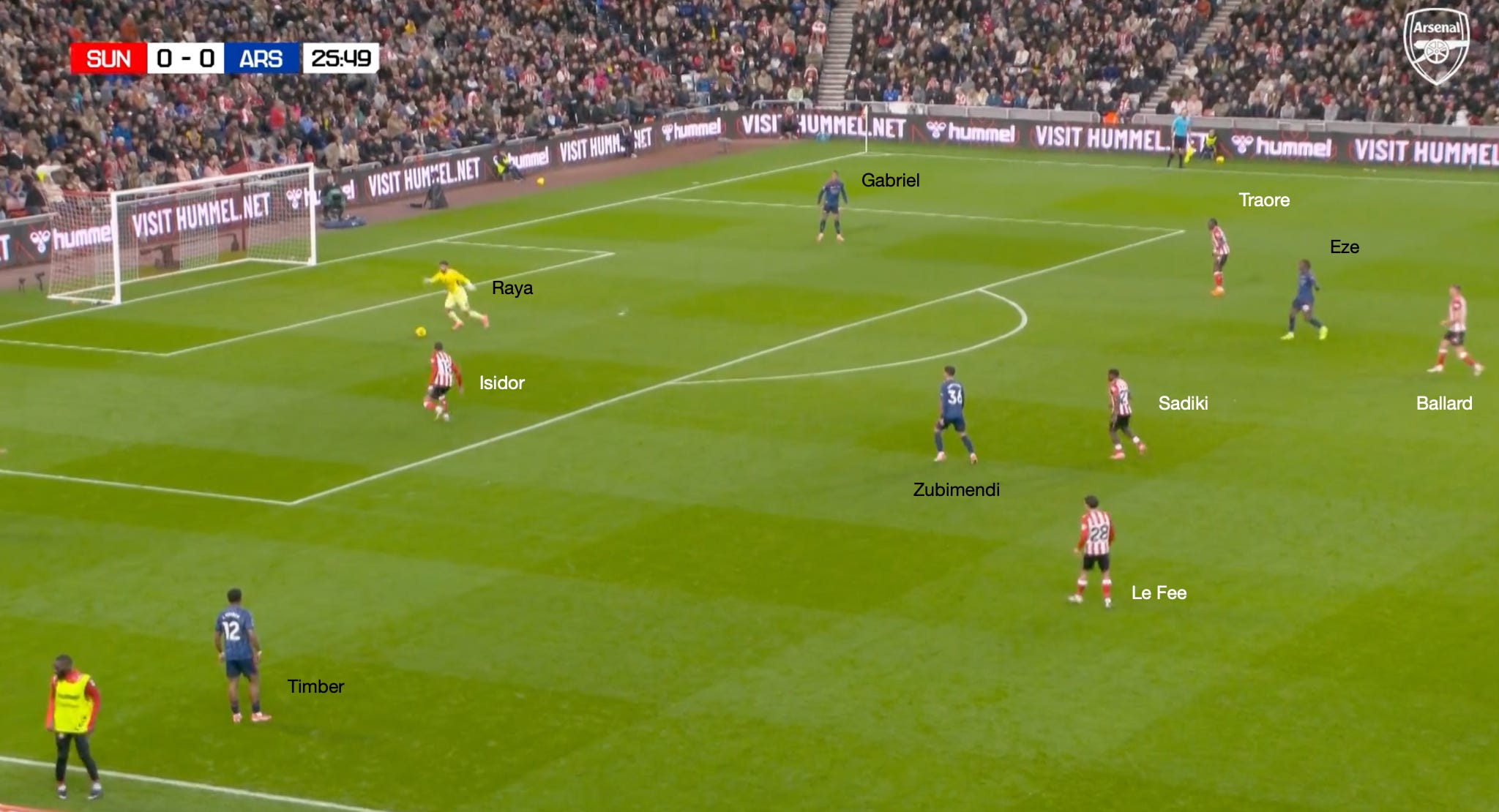
Back passes, overhit passes, players receiving the ball square on and poor touches were all triggers for Sunderland to lock on.
Long balls from us due to the nature of their press generated physical exchanges in advanced areas, with the favour then returned by Sunderland whenever they won the loose ball game.
A game of this nature often leads to numerous stop-starts, injuries, throw-ins, and set pieces, with the clear intention of disrupting the in-game flow. This was Sunderland’s aim, and it worked in the opening 45 minutes as Arsenal struggled to sustain substantial, threatening pressure.
In layman’s terms, Sunderland were better in the loose ball game in the first half, which prevented Arsenal from establishing sufficient control. The Black Cats’ endeavours were rewarded with a goal by Ballard, courtesy of a long ball via an indirect set piece from their goalkeeper, with Sunderland winning the physical exchanges in the box before Arsenal’s former academy graduate netted the opener.
We did, however, witness a noteworthy change after the break. Massive periods of pressure, which saw us create numerous chances and a complete contrast to the first half.
Naturally, you feel that the manager has clearly made significant tweaks because how on earth can a team produce a performance of that level when, before the interval, it was a serious struggle? There was a specific tweak I observed, which I’ll cover later, but that’s not the salient factor.
What really happened was that we won many more ‘loose ball game’ situations.
That is literally it. Have a look at what Riccardo Calafiori had to say after the game, when asked about the changes Mikel Arteta made at halftime.
“[Arteta] just said that we needed to basically win our duels and then from there we could start to play our game, so that’s what we did.”
Do you now see where I’m coming from?
If you win your duels, which are referred to as ‘exchanges’ in this piece, you can then reset and play your game. On many occasions, we won the loose ball game near the middle third after half-time, and the moment you win duels within this area of the pitch, you can pin teams back, as it’s much harder to press the opponent aggressively in these spaces because the team without the ball is closer to their own goal. Pressing becomes easier when the opposition is within their own third or at goal kicks, whereas it’s much more difficult to implement when the game is near the centre of the pitch.
Essentially, we won many more loose-ball game situations and latched onto the ball far more cleanly, which allowed us to pin Sunderland deep inside their own half, which is where they adopted a nominal 5-4-1 shape. Winning the physical battle then enabled us to implement our ‘on the ball’ principles.
I know this has been a lengthy discussion on the loose ball game, but I don’t believe the nuances involved, which have been discussed in this piece, are fully recognised and just how vital this part of the game is in the modern era.
Newcastle at St James’ Park was a very similar type of contest, as they also adopted an approach not too dissimilar to Sunderland.
Why did we perform brilliantly on the day, in what I would say was our best performance against Eddie Howe’s men in their backyard under Arteta? It’s because we were superior in the loose ball game, which allowed us to then play our football for the majority of the 90 minutes!
Right, casting our attention back to yesterday’s second half, and why I’ve labelled this piece as ‘Arsenal optimism’.
That was one of the best performances I’ve seen under Arteta in a situation where we come back out of the dressing room a goal behind. For me, it’s up there with the likes of Newcastle away from this season, Liverpool at Anfield from last season, Bournemouth at the Emirates in 2022/2023, Aston Villa at their ground in 2022/2023 and West Ham at home in 2022/2023.
We created chances at will, placed the Sunderland block under severe stress and earned the right to three points, whilst conceding virtually nothing.
I’ve highlighted in my ‘Crystal clear intentions’ and ‘Principles’ articles how we look to create chances against back give systems, which place profound emphasis on managing the wide central defenders, either pinning them or provoking them to step out.
We haven’t, however, focused much on final third sequences against these structures in the past.
Essentially, we have specific patterns that are staples. The Bukayo Saka back post cross, where an overload is naturally present at the far stick, since the full back (wingback in the context of a back five) is sandwiched in between two players. We saw this yesterday in the dying embers with Calafiori forcing the save from Robin Roefs, before Balard denied Mikel Merino’s point-blank shot on the line.
Furthermore, the trajectory of this cross drags the opposing defenders and midfielders closer to the goalkeeper, which opens up space just outside the box or in the box for a shot on goal, which we saw with Martin Zubimendi’s strike that rattled the bar.
Equally, we deliver these types of crosses down the opposite flank, although what’s more prevalent, certainly when Leandro Trossard is in the side, is his left-footed cross after driving down the byline.
There are other chance creation mechanisms we use, but what I want to focus on now is the tweak utilised after the interval, which I alluded to earlier, and what Arteta perhaps referred to post-match, where he explicitly stated that ‘we (Arsenal) had to adjust certain things.’
Now, our left-hand side has seen notable improvements this season, compared to the previous two campaigns, although I will caveat that the sample size is not currently large.
Greater chemistry between players and balance has been on show, especially with the way Declan Rice has been used this season (we will cover this in the future), which has been facilitated by Zubimendi’s lack of angle bias and Calafiori’s capricious presence, with the latter striking an ever-growing partnership with Trossard.
However, I felt that in the first half, when we did have the ball inside the final third, there was an emphasis on excessive pinning, which was repetitive alongside a conspicuous lack of movement when we funnelled play down our left-hand side.
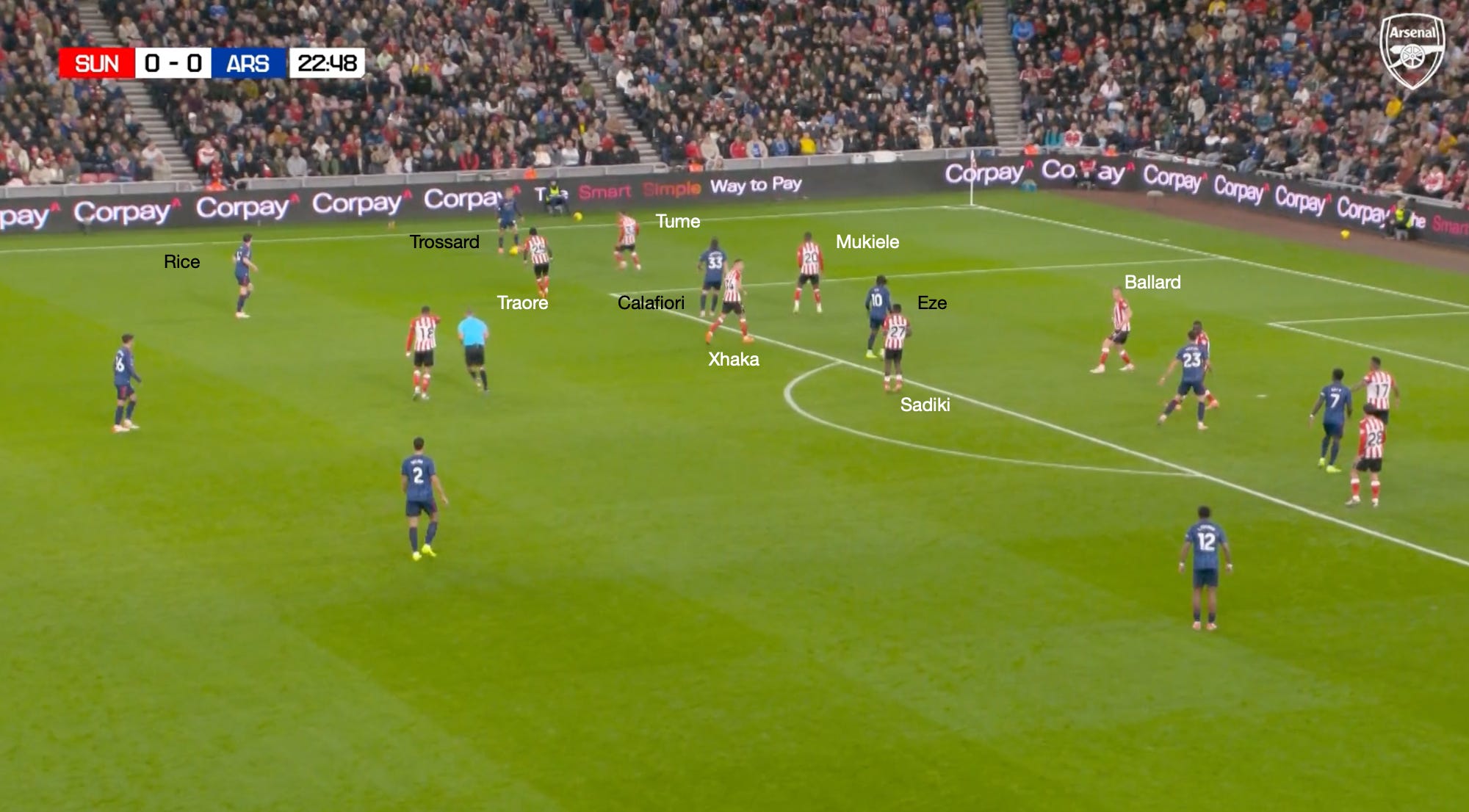
Take a look below to see an example of this, where you can see Trossard 1v1 against the right wingback Trai Hume, before drawing a double team as right winger Bertrand Traoré comes across to create a 2v1.
Have a look at what’s happening in the box, which is what’s interesting. You can see Calafiori pinning the wide right centre back, Nordi Mukiele and Eze on the last line, occupying the central centre back, Ballard. You also have Merino and Saka attacking the far side, ready for the back-post cross, which I’ve spoken about earlier.
Trossard’s gravity attracts Hume and Traoré, which opens space for Rice in the half space to whip a cross in towards the back post, which Sunderland comfortably defends.
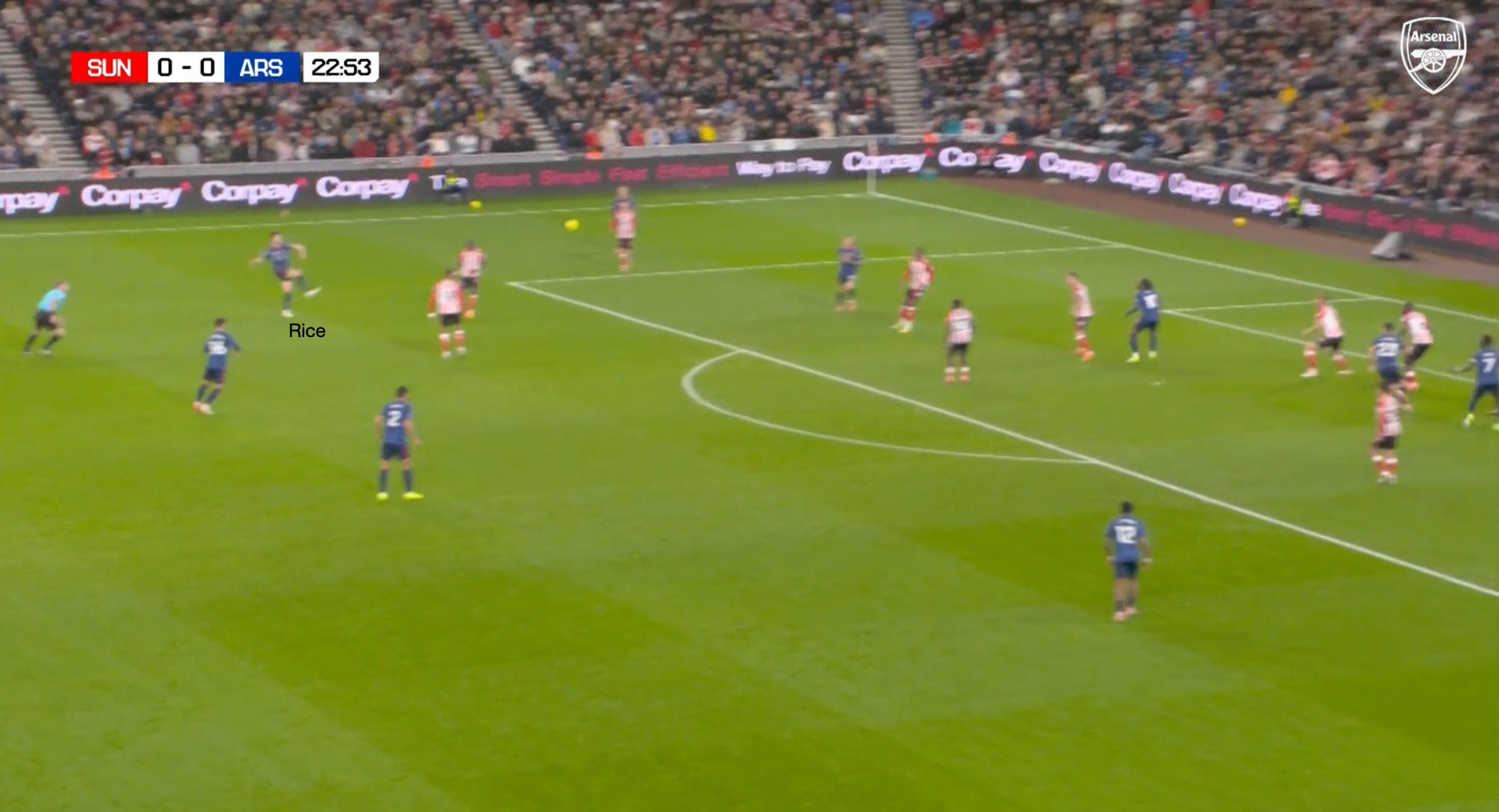
Take a look at another example from the first half, where you see similar principles on display; however, different players are occupying certain roles, and instead of delivering a back-post cross, Zubimendi, after receiving the ball, circulates it to the opposite side.
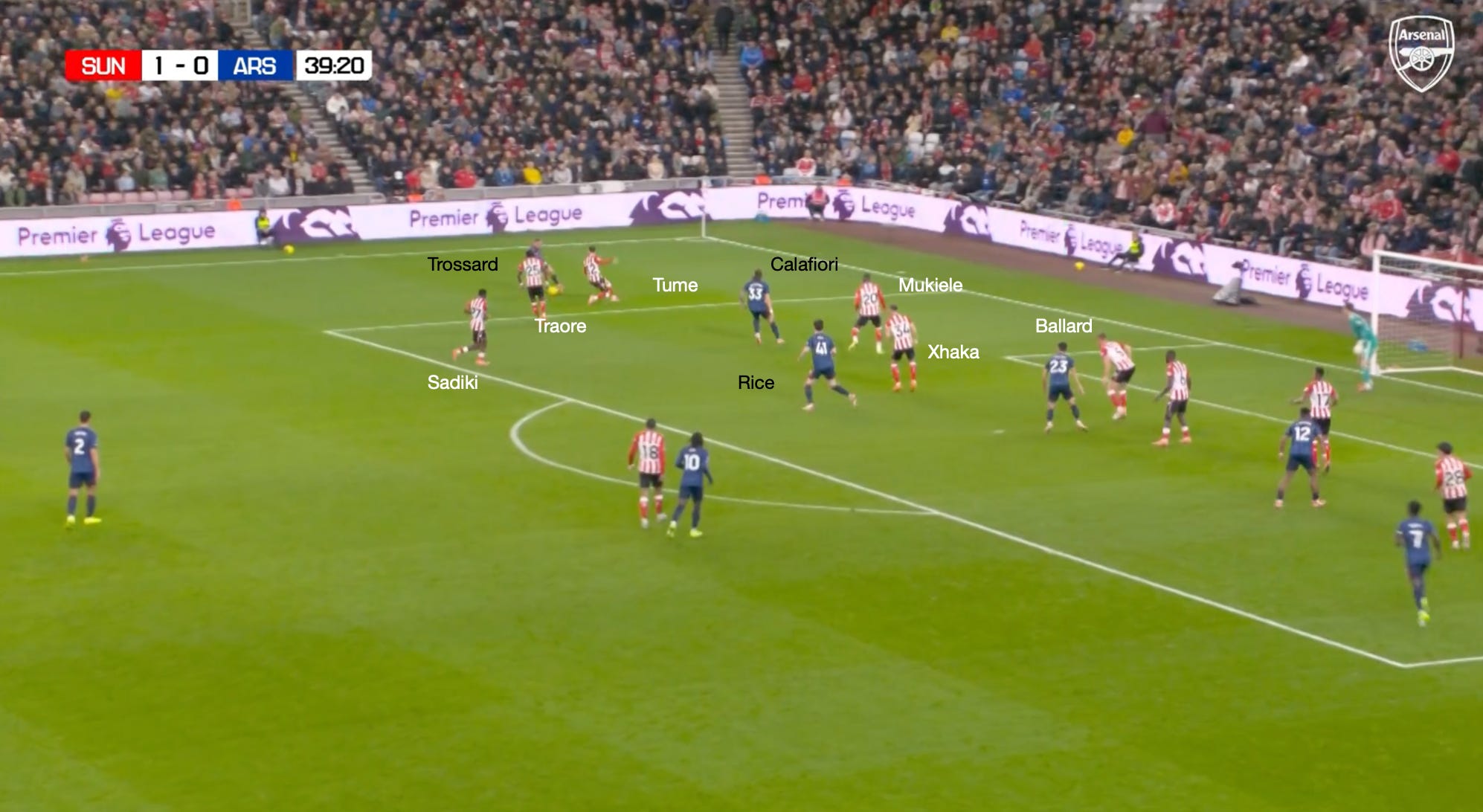
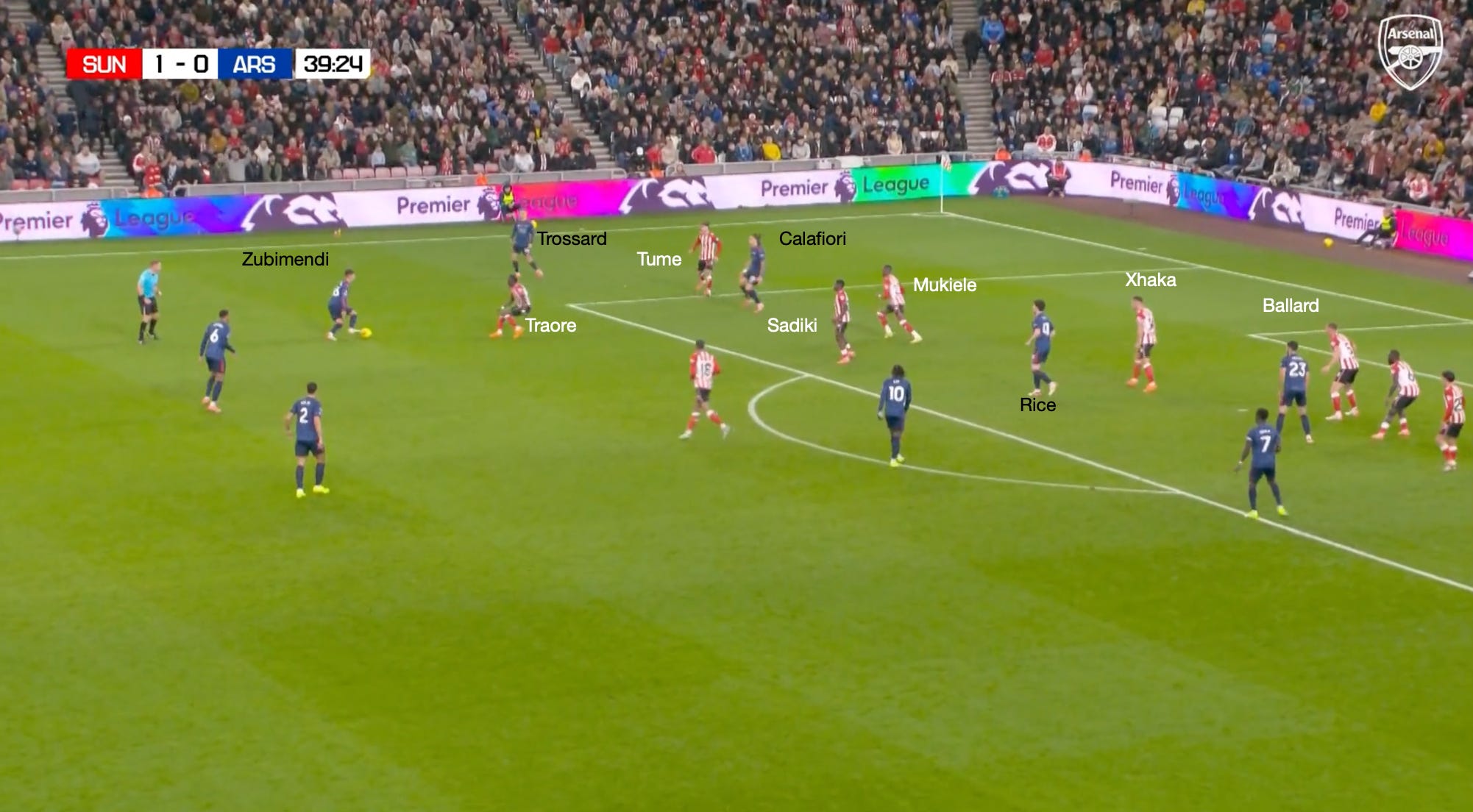
The reason why I’ve said it’s over-excessive and repetitive pinning was that it became very predictable. We had too many players stationed on the last line and a lack of dynamism, which prevented us from finding potential gaps within Sunderland’s block. It’s much easier to defend as the movement is static.
I’ve previously discussed ‘too much pinning’ on Twitter and The Cannon Podcast, where a better balance between players moving freely and pinning could be struck, which I felt we saw after half-time.
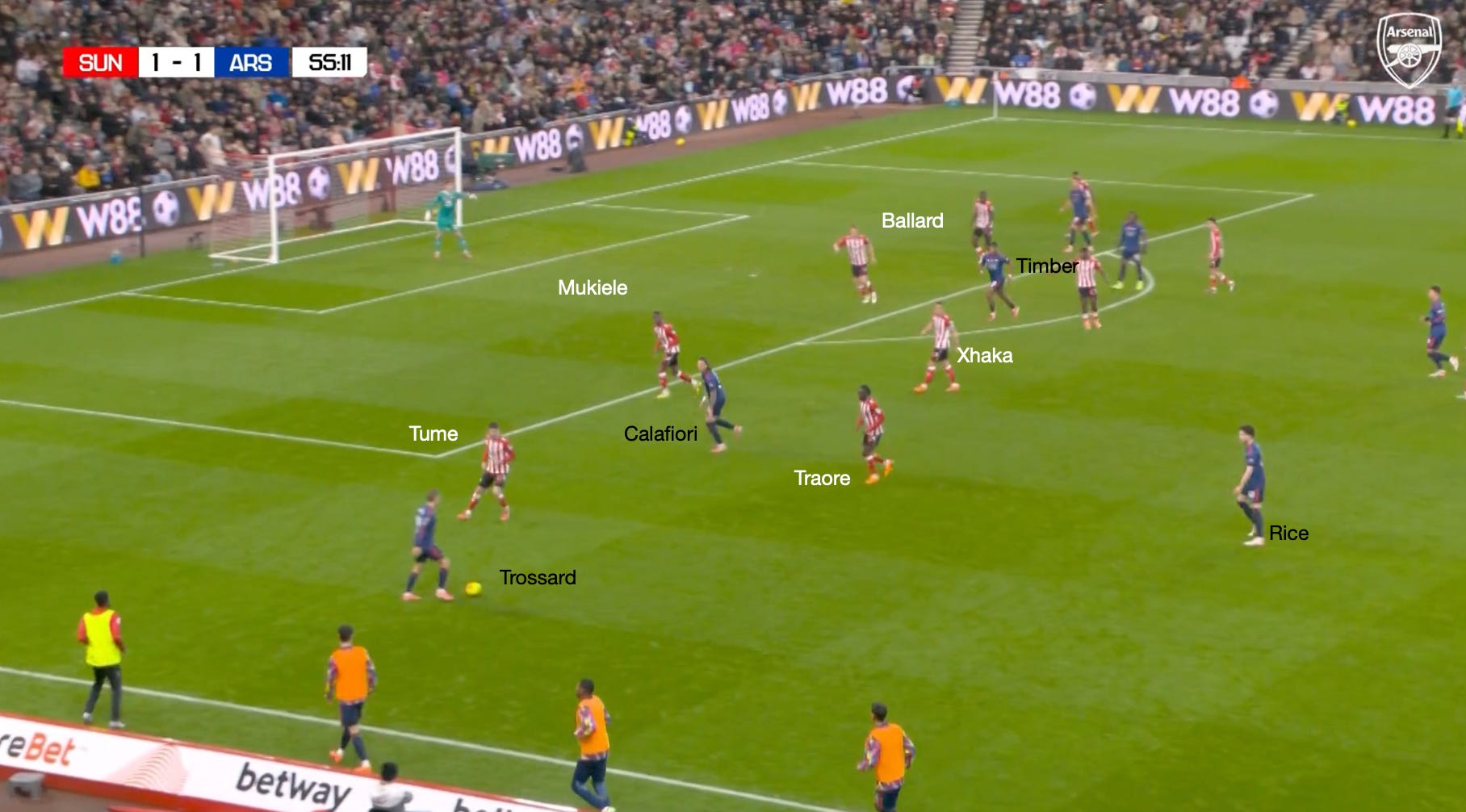
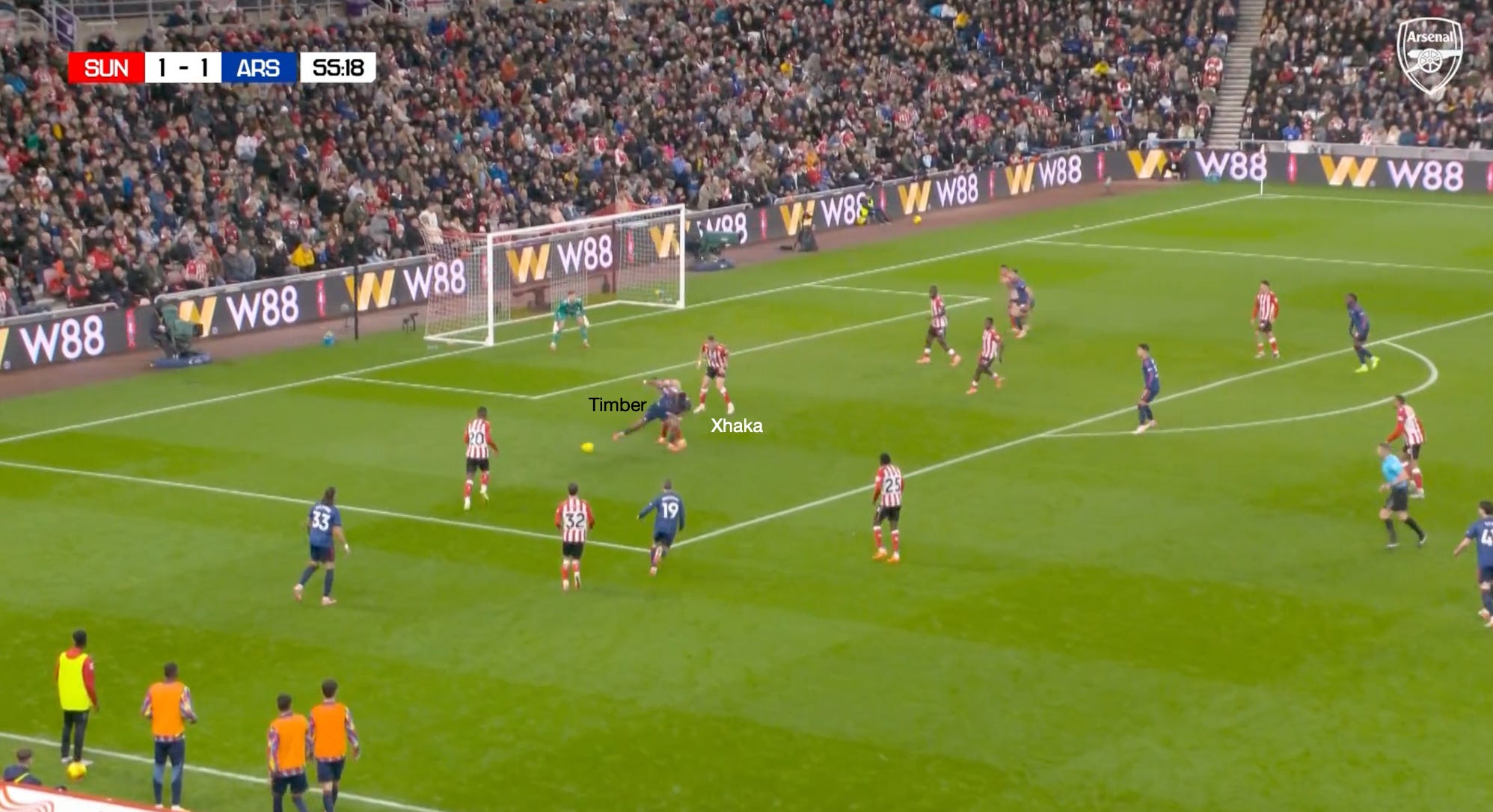
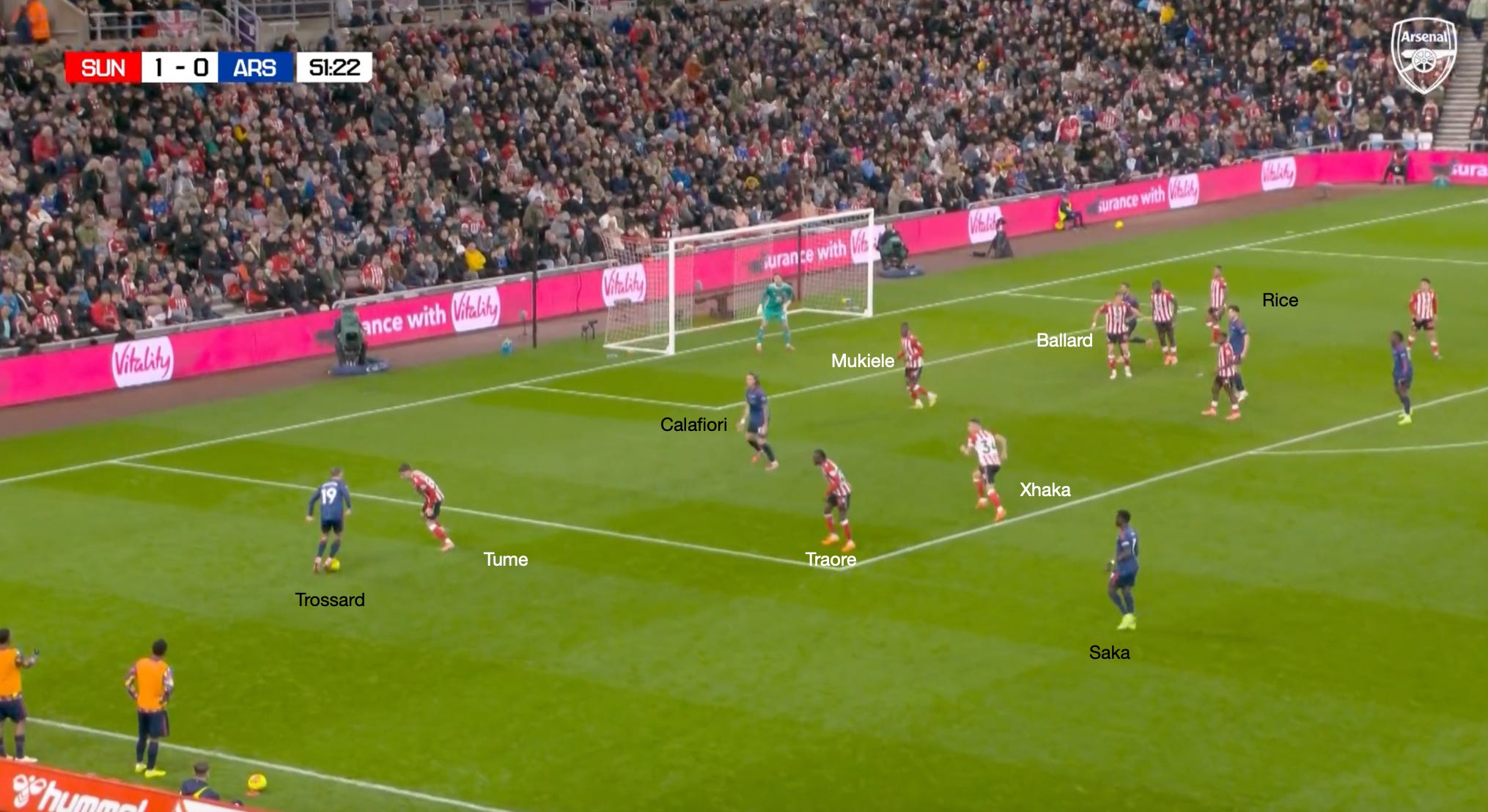
The example below showcases this in action, where you can see Trossard 1v1 vs Hume, with Traoré ready to come across and create the double team. But notice what’s happening around Trossard. Calafiori can be seen in the inside channel yet again, pinning the wide centre back Mukiele.
Remember, as mentioned in my previous articles, pinning the central defenders on the outside is imperative. What’s key is that the space between Mukilele and his partner, Ballard, is left free, ready for someone to arrive dynamically, as opposed to someone already stationed there to pin Ballard. The trigger to find the onrushing runner, in this scenario, Jurrien Timber, is when the wide central defender (Mukiele) is either dragged away from the compact back five or jumps forward. Whilst Trossard doesn’t initially deliver the pass to Timber, he does find the right back after Calafiori pulls Mukiele wide. Granit Xhaka, however, manages to deal with the situation.
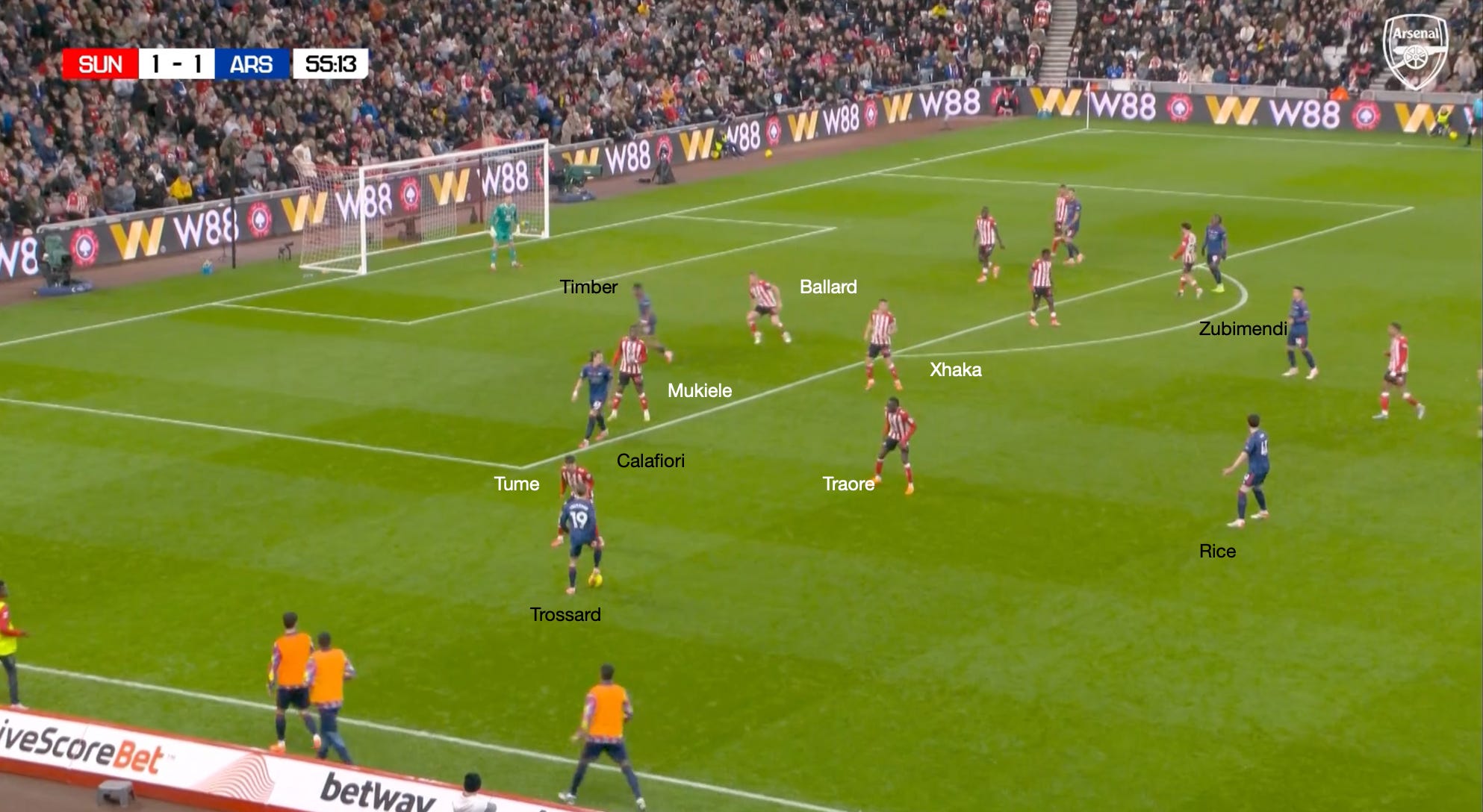
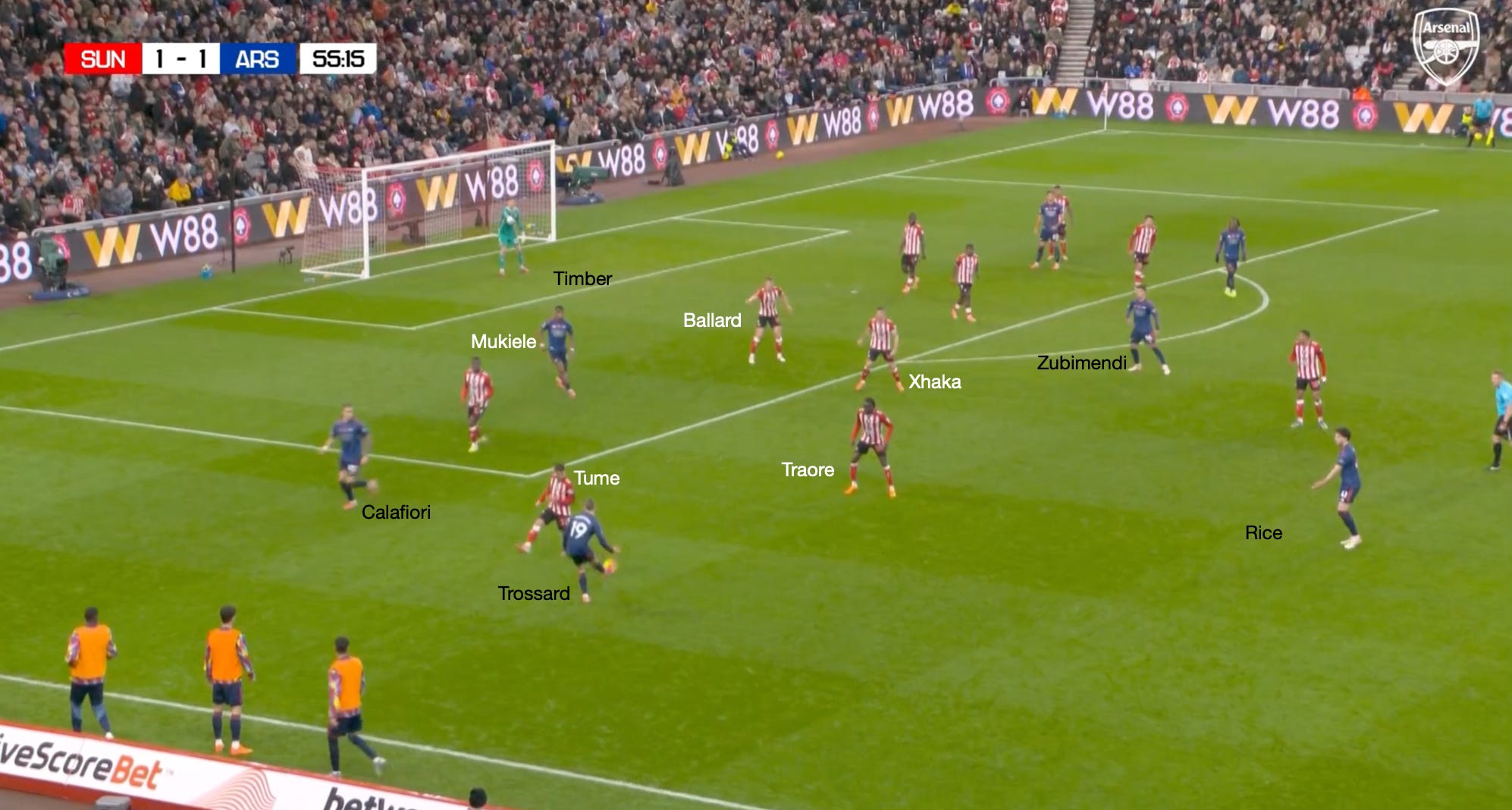
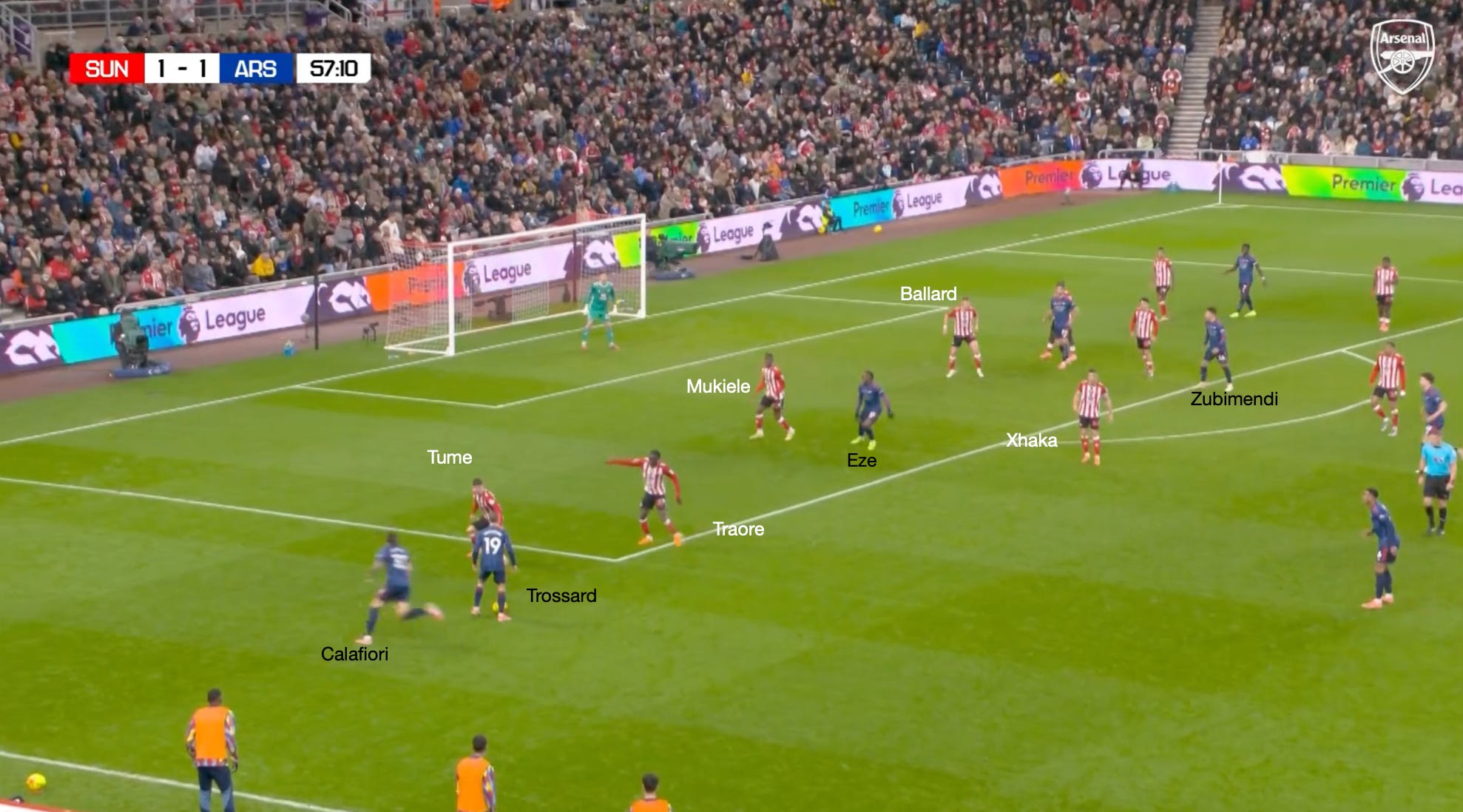
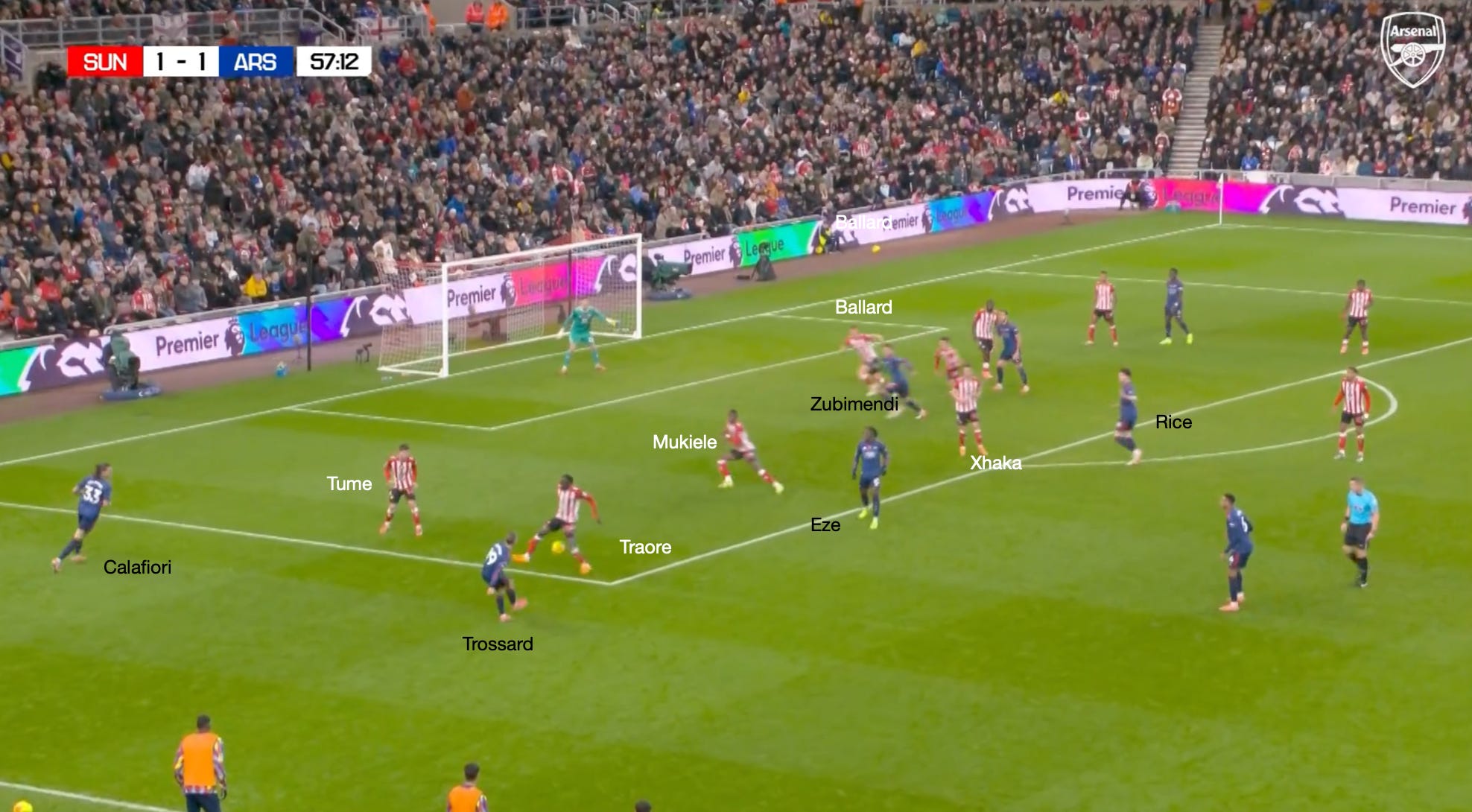
You can see another example below where similar principles are applied. Trossard fixes Tume, with Calafiori overlapping this time to create an advantage out wide (double width); notice Eze pinning Mukiele, with nobody positioned between Mukiele and Ballard. Zubimendi recognises the opportunity to attack the space and receives a beautiful pass inside from Trossard, but can’t convert the chance.
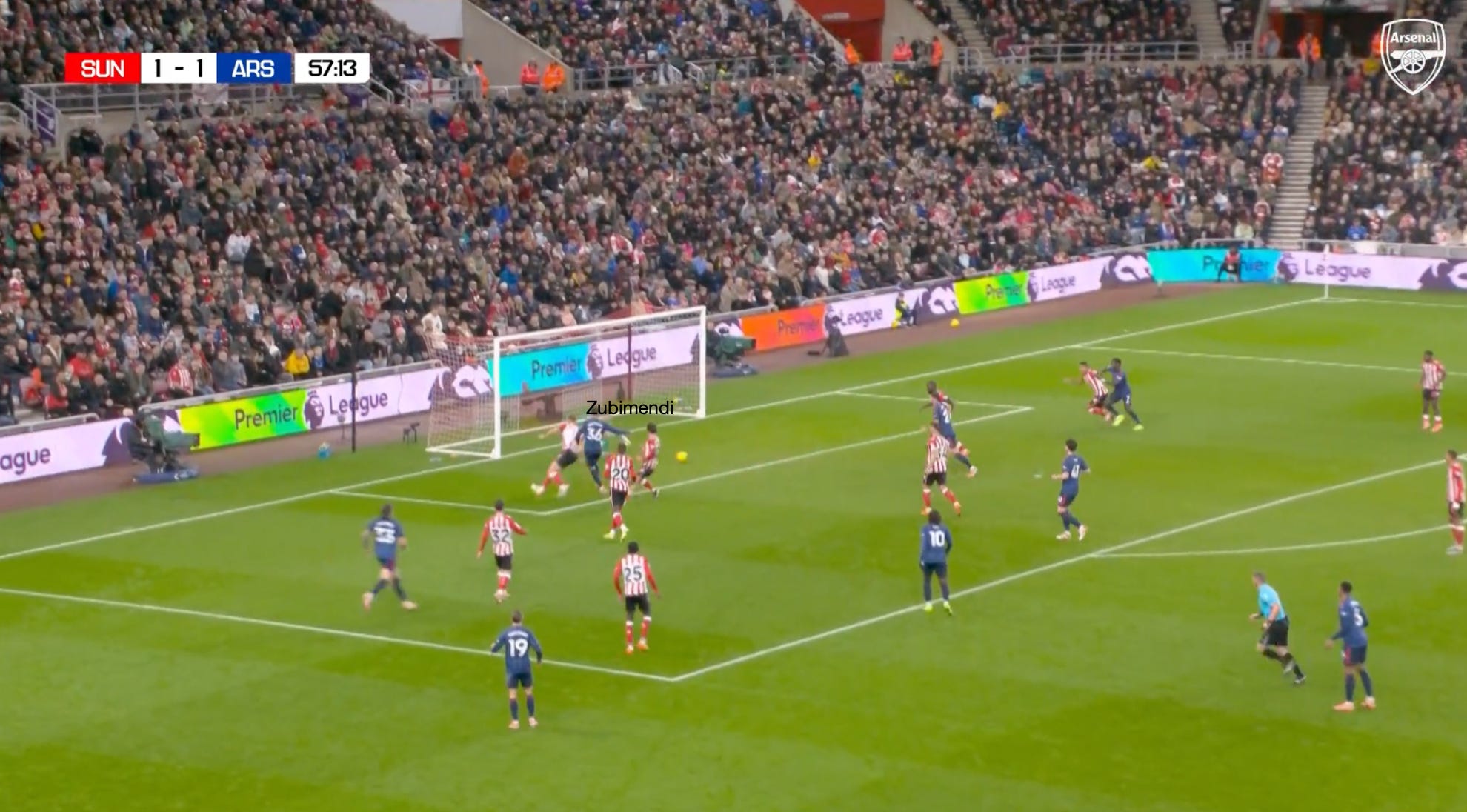
Zubimendi is phenomenal at attacking spaces further forward, to keep the game flowing. Rice previously gave an interview back in 2024 with The Athletic, where he provided insight into the tactical demands Arteta puts on his players.
One of the key quotes from the article emphasises Arteta’s focus on maintaining ‘good height’, which implies that one must always position themselves in a zone that ensures forward progression is possible. Zubimendi is brilliant at this, as shown above and in many other scenarios we have seen already in an Arsenal shirt.
However, going back to the Sunderland game and these dynamic arrivals through the left-hand side, you can see another situation where the principles already described are illustrated. The only difference is that Mukiele and Tume have situationally swapped roles, with Saka drawing Tume wide, which allows Calafiori to attack the space, and he almost latches onto the pass by Trossard.
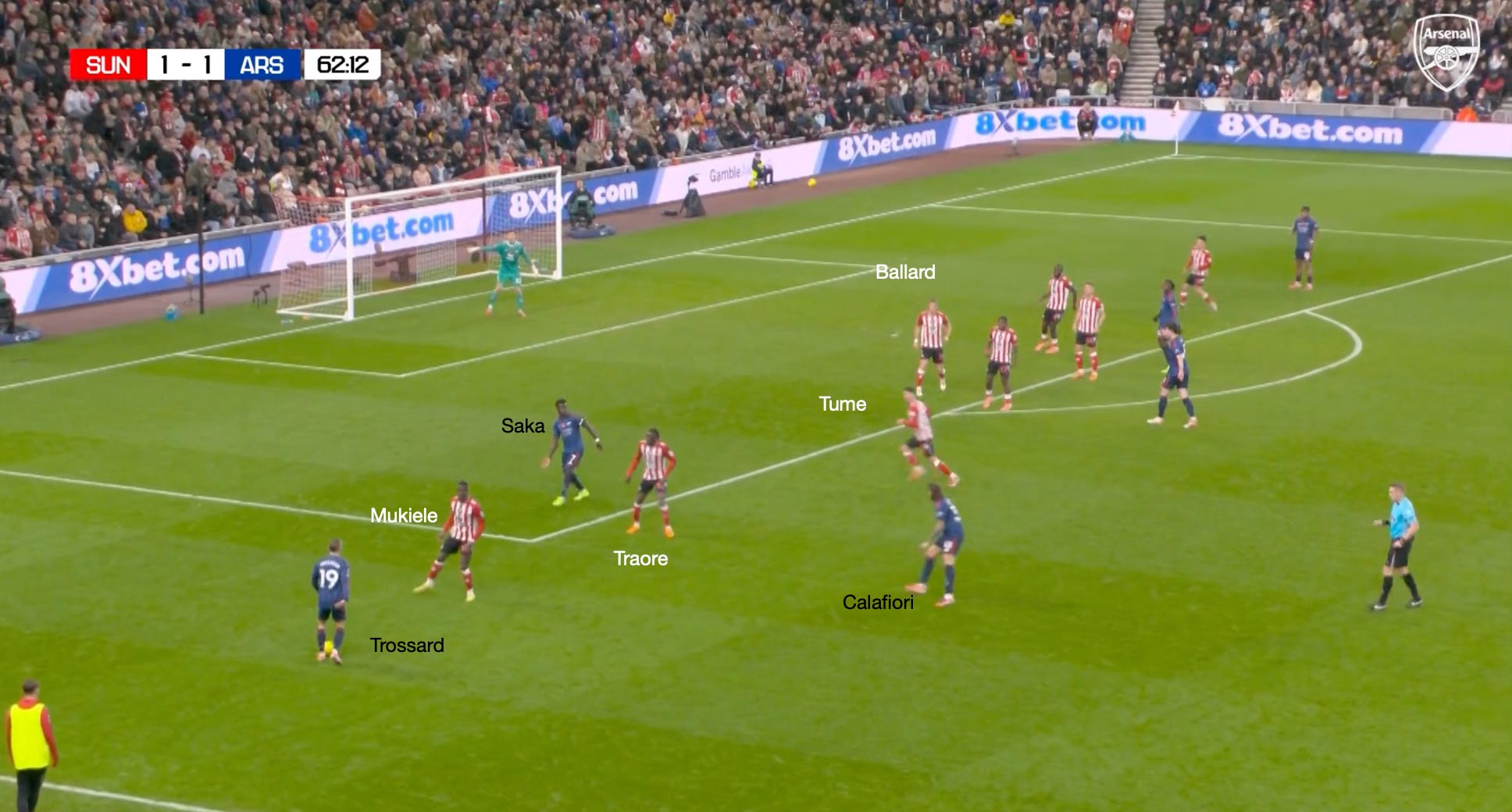
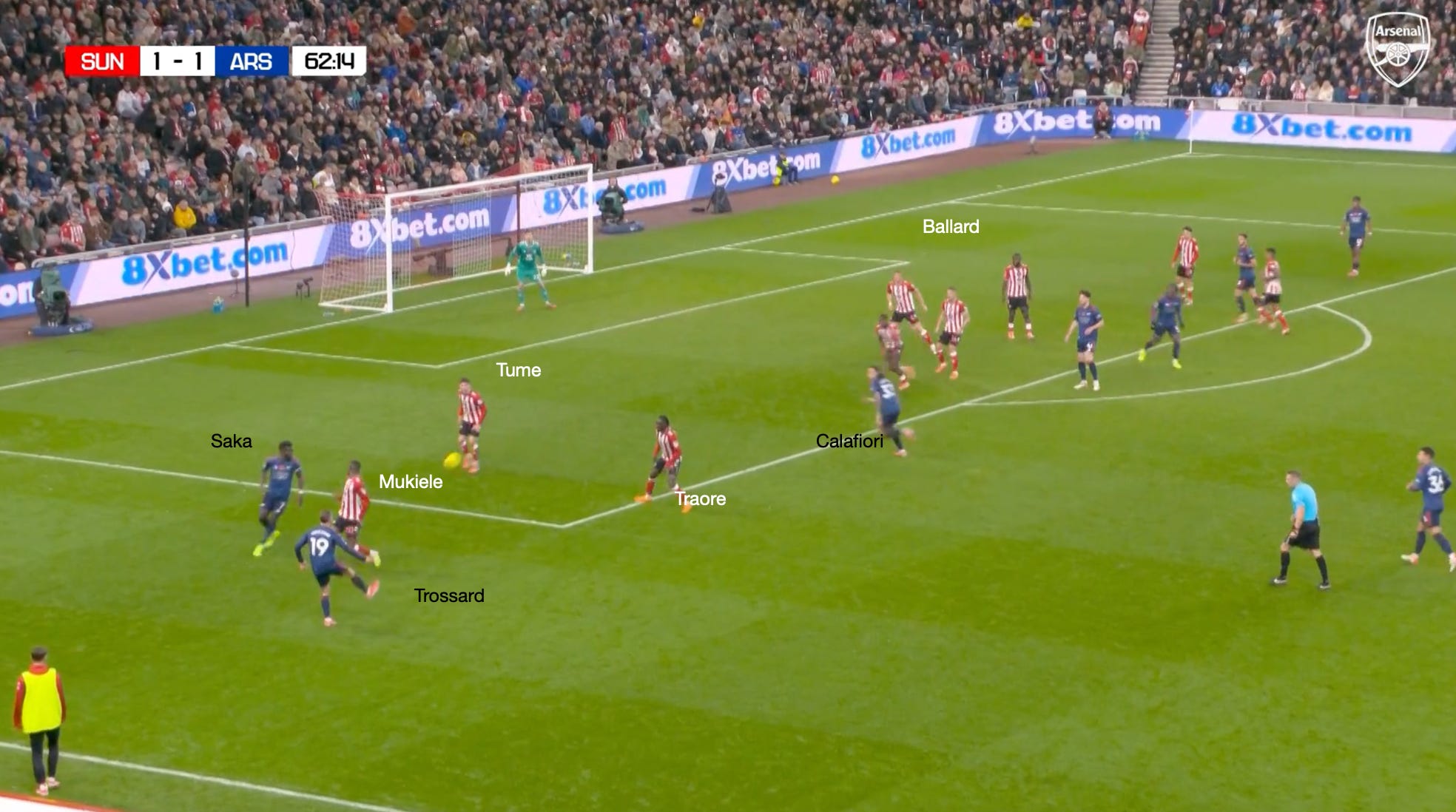
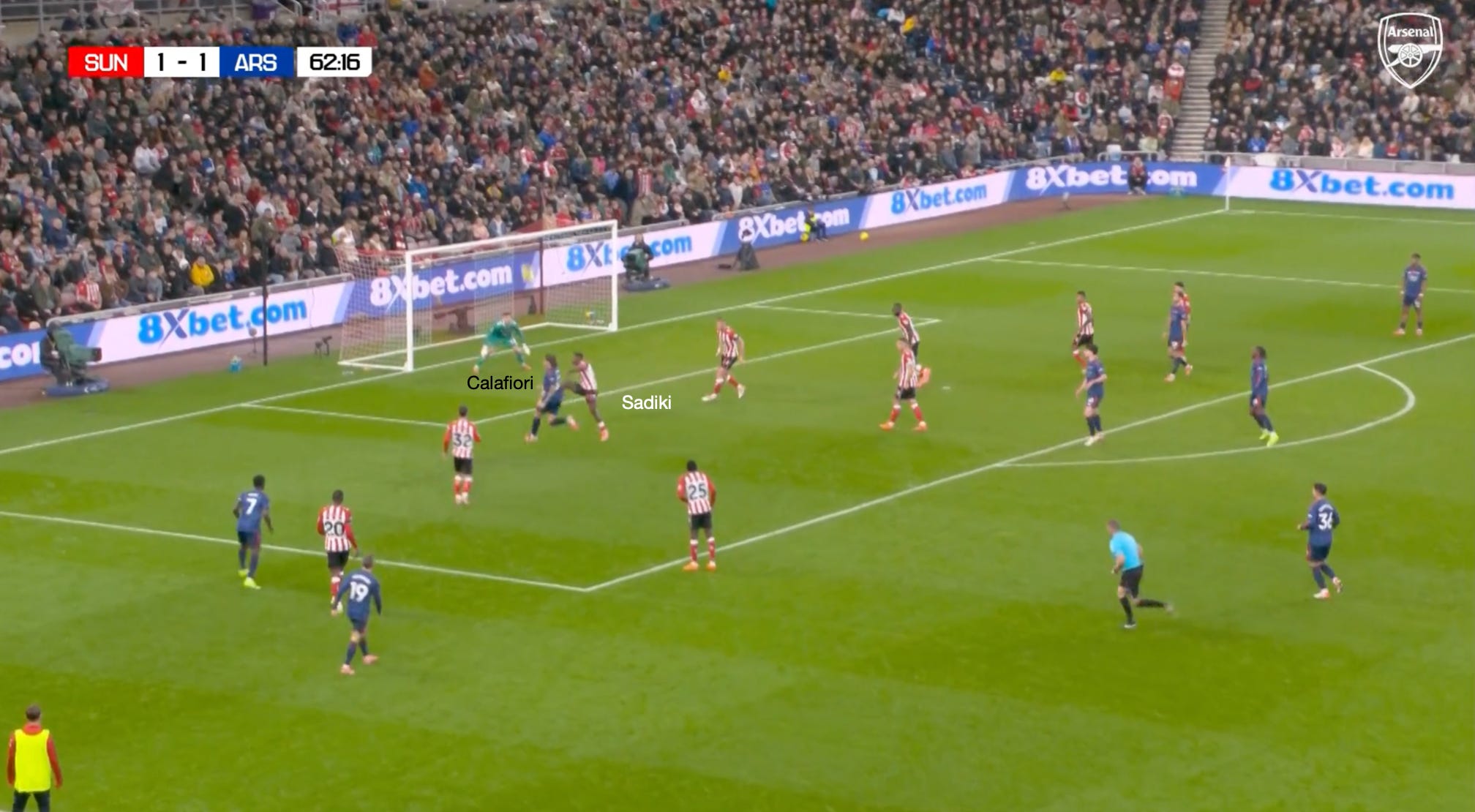
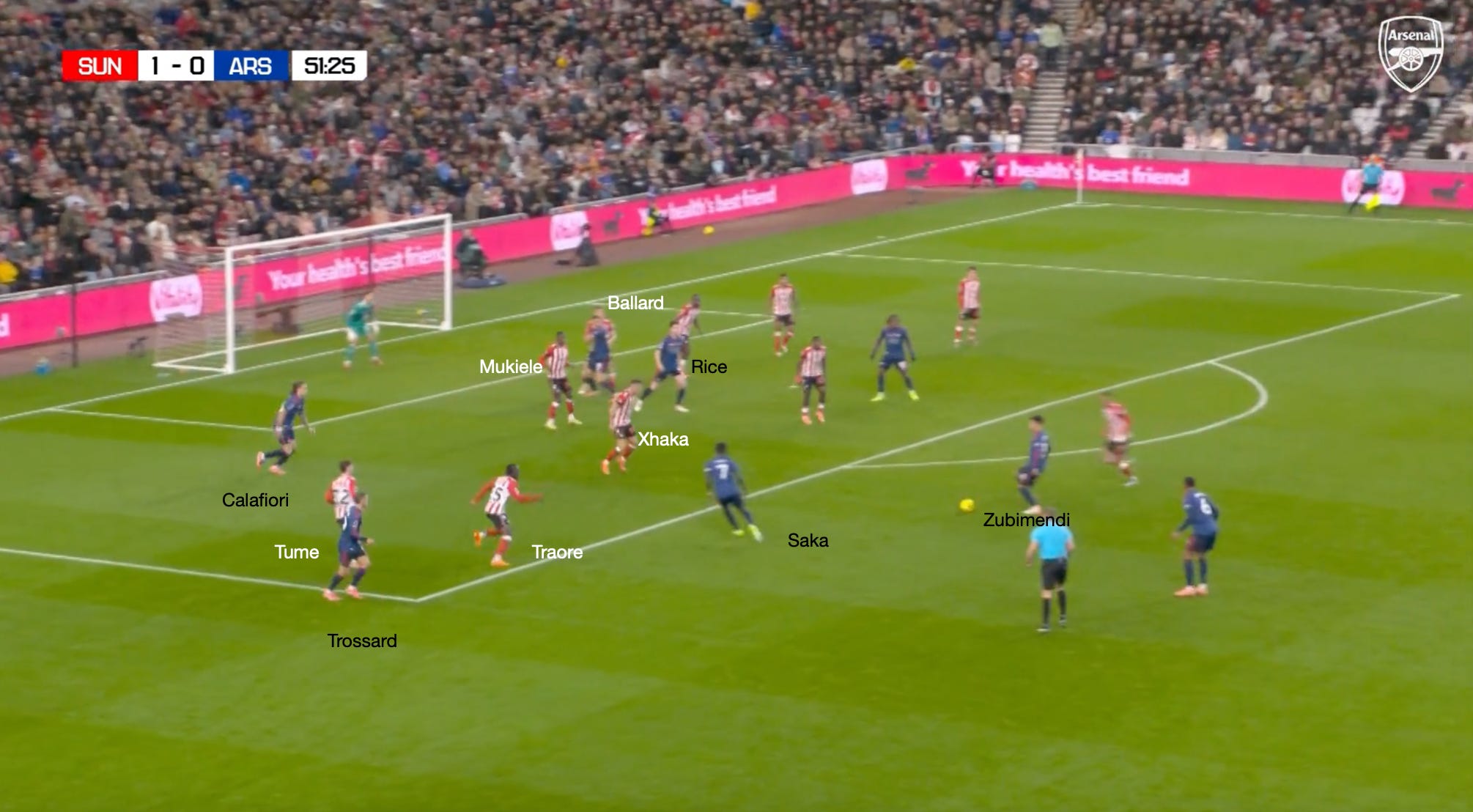
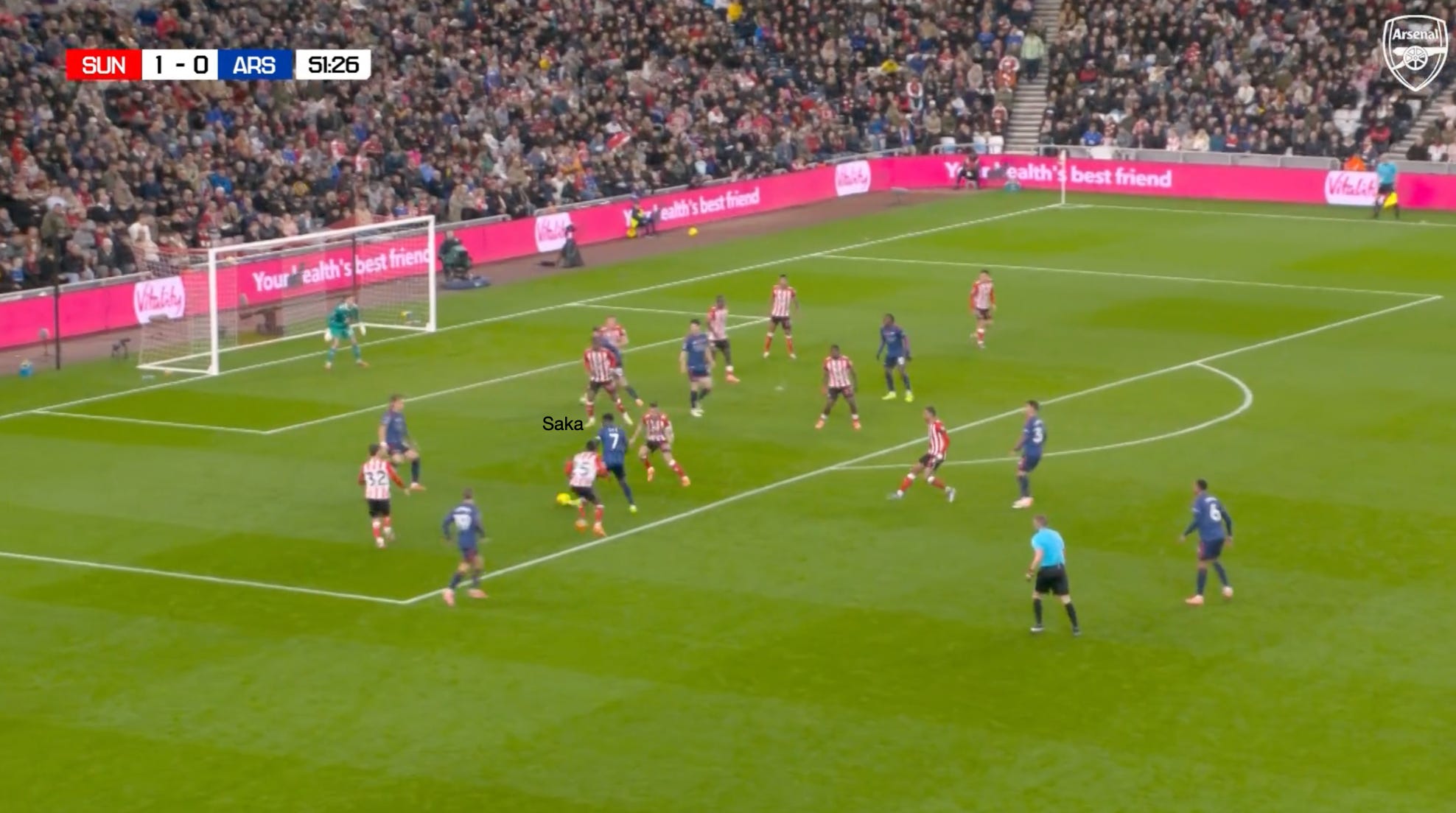
And finally, take a look at this sequence, which isn’t identical to the above examples, but again shows the importance of arriving dynamically and attacking the spaces in between the lines of the back five, as opposed to being stationed on the last line.
Calafiori pinning the wide right centre back Mukiele again, Trossard draws the double team (Tume and Traoré), before passing to Zubimendi, with the Spaniard then executing a precise, first-time left-footed pass for Saka, who has abandoned the right-hand side, to attack, in between the wingback and wide centre back channel. Saka, unfortunately, drags his shot wide.
We caused all sorts of problems via these patterns, and it’s something we should utilise more in the final third against settled defensive structures, irrespective of whether it’s a back five or four.
To close this post, I want to stress that we were on the receiving end of…
‘It’s football, sh*t happens’
We conceded two goals that were very much goals you wouldn’t associate us conceding under Arteta, which is why I view it more as an anomaly. Credit to Sunderland, though, as we mustn’t forget that the opposition is allowed to employ tactics too. They had greater joy with the loose ball game in the first half, but we responded brilliantly after the break.
The discourse I’ve seen on social media is that Arsenal went too defensive towards the end of the game, and Arteta should have responded with more substitutions.
The biggest issue we had yesterday was a lack of pace across the frontline. Injuries are hurting us here. An emergency Merino centre forward shift requires speed in behind to stretch the opposition backline. Furthermore, pace across forward areas was solely missed to help alleviate pressure at the death; we lacked release valves. You then factor the lack of energy left in the tank among certain players, such as Merino, thereby amplifying the issue even more. However, you need a Merino in that game state, especially with no other strikers on the bench, as he has the capacity to hold the ball up.
I agree that changes at full back could have helped, especially with a Piero Hincapié switch for Calafiori, but would that have prevented the equaliser? I’m not sure.
Ultimately, it’s a goal allowed that very rarely happens, and that’s it, hence the ‘it’s football, sh*t happens’ phrase. That’s the Premier League for you.
What I would rather focus on are the positives, and there were a plethora of them, especially with the frequency of chances created in open play after the interval, utilising ideas that I’ve not seen us use much of in the past.
another great piece rohan, really enjoyed this one, the way you explain football is sooo good
Sunderland vs Arsenal felt like a lesson in variance and a quiet reminder of what football can be sometimes.
🔗 https://gooneradi.substack.com/p/hello-variance-my-old-friend