

The international break is a period of Arsenal reflection. A stoppage in time that allows us to evaluate where we are, assessing both the positives and negatives. Sticking to the former, as naturally I am a glass-half-full type person and rightfully so, given how the season has currently transpired.
So, I started thinking about the areas of our game model that we should be encouraged by, as we sit top of the tree at this moment of writing, four points ahead of Manchester City, with eleven Premier League games played.
Honestly, there were many things I could have chosen to write about, but I couldn’t look any further past our engine room and, in particular, Declan Rice and Martin Zubimendi.
This piece will delve into their ever-growing partnership from predominantly an ‘in-possession’ standpoint, and the associated ripple effects involved. I will cover the defensive side and other aspects in a later article.
Firstly, let’s discuss Zubimendi and begin by showing you specific passing metrics from his Fbref chart.
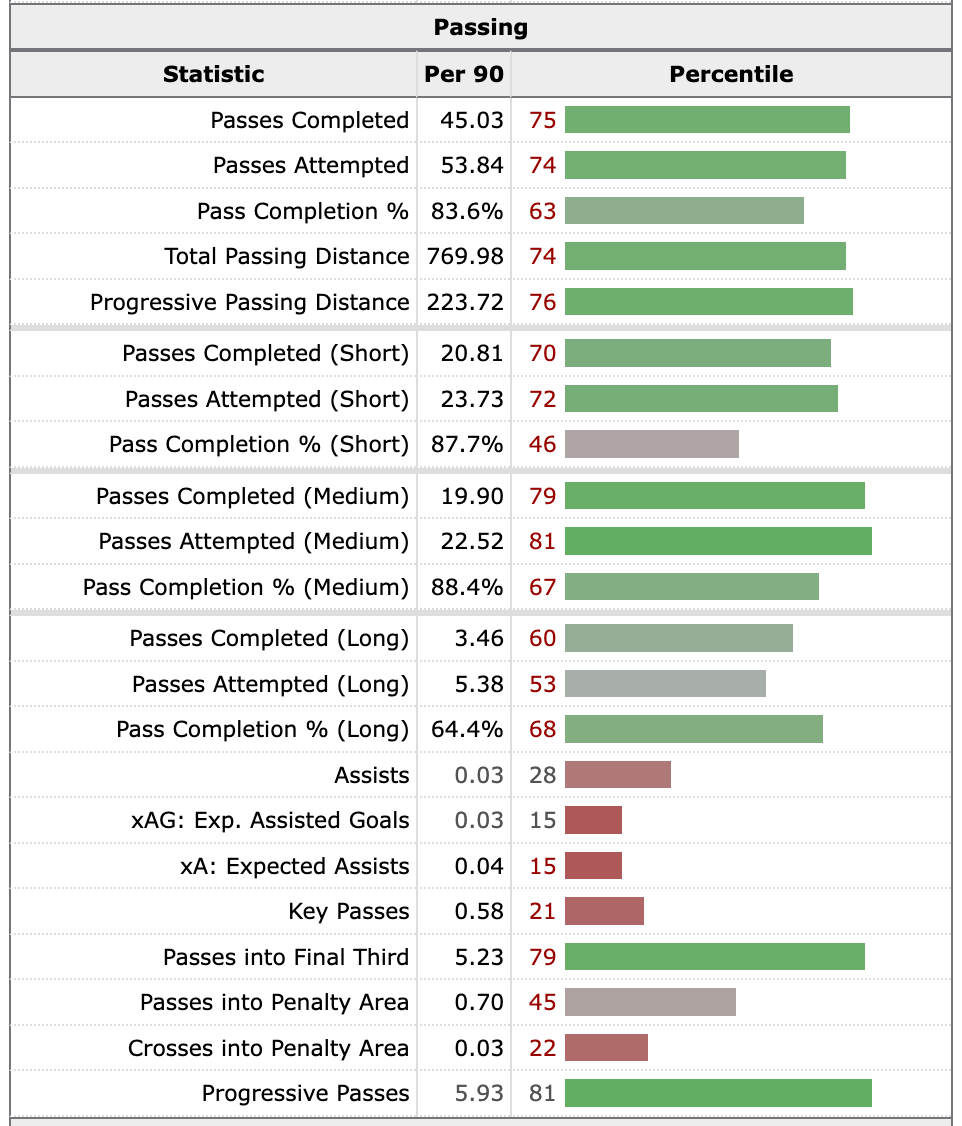
Nothing shown above screams excitement, right? It’s all very steady and paints a picture that suggests a player who won’t set the world alight with the ball at his feet. That’s certainly the impression I got when reading the timeline on X or from opinions posted in the comments section on The Cannon Podcast. Simply using data in isolation, however, isn’t wise.
Naturally, we all do it right; I certainly do! We examine Fbref charts before attempting to compile a narrative that seems rational. This is the anchoring effect in full flow. If you have read Thinking, Fast and Slow by Daniel Kahneman, you may be familiar with this concept.
The anchoring effect is essentially making a judgment from the first piece of information you see, which can generate a bias. This acts as an anchor which influences further judgment.
So, if an Fbref chart was the pre-eminent driver of your feelings on Zubimendi’s ability on the ball, then you have experienced the anchoring effect. Now and then, the Fbref chart of ‘A’, without even watching ‘A’, will provide a strong understanding of the type of player ‘A’ is. However, it’s always essential to do your own due diligence and watch the tapes! The eye test and the numbers as a collective offer balance; it’s never strictly about just one or the other.
Using the eye test in Zubimendi’s case provided clarity to the numbers presented in the above data.
The environment capped Zubimendi’s potential. You can have all the qualities in the world, but if the tools around you are not the best, then you can’t showcase your very best version. Real Sociedad finished eleventh in La Liga last season, with just six points between them and relegated Leganés. This is what he was working with, which impeded his individual numbers.
A better way to understand Zubimendi was by analysing his performances for the Spanish national team. Everybody is aware of his impact in the UEFA 2024 Euro final, where he was tasked with coming on for the injured Rodri and boy did he deliver.
A more recent example, which is what really got Arsenal fans excited, me included, was his UEFA 2025 Nations League final display, where Zubimendi was nothing short of sensational and didn’t deserve to be on the losing side.
All of a sudden, excitement started to creep in when one doesn’t just confine themselves to his Real Sociedad numbers, and his impact since arriving in north London has been brilliant, for many different reasons.
Let’s begin by reviewing his Fbref chart! Take a look below at his passing numbers in the Premier League.
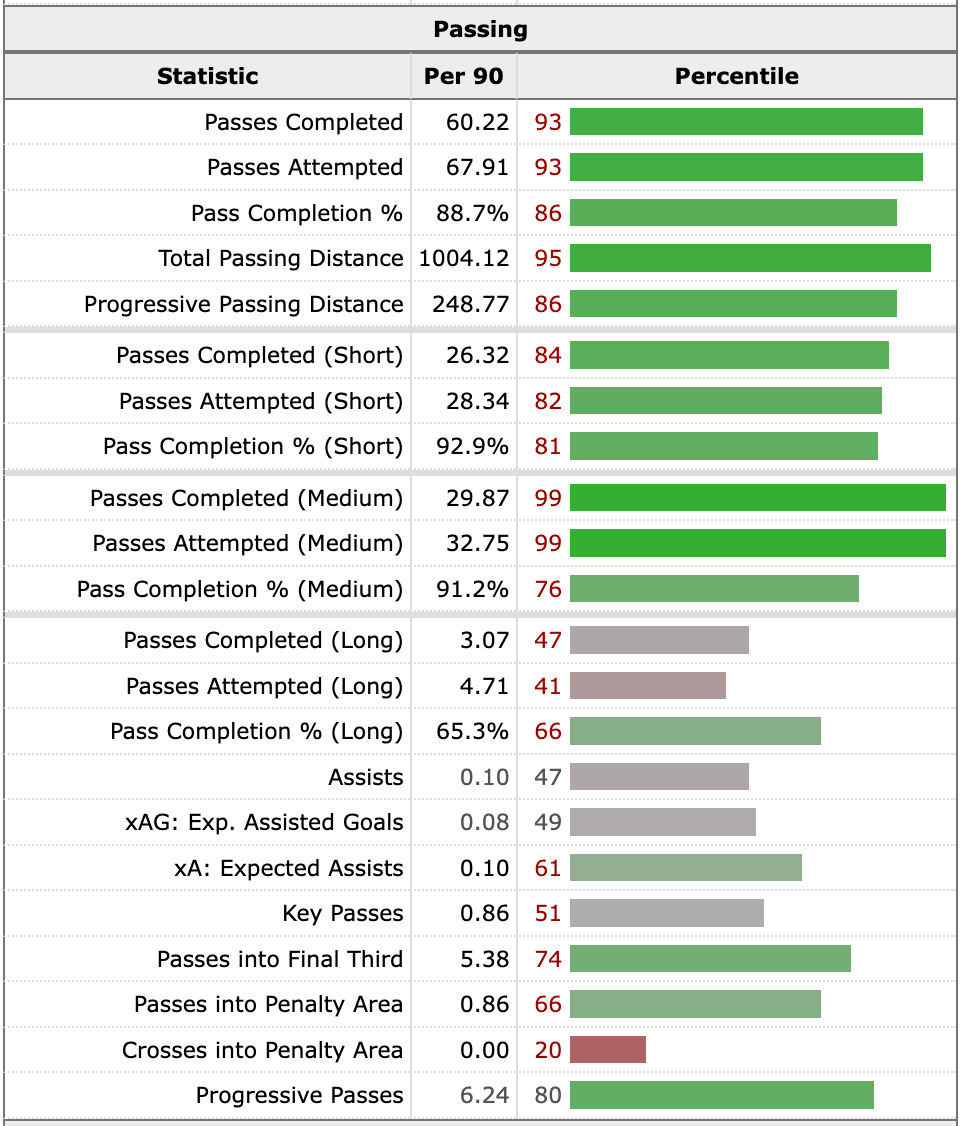
Now we are talking! More passes attempted, more passes completed, better overall pass completion rate, better short-range passing and better medium-range passing compared to his La Liga chart. And it doesn’t just stop there. He’s simply producing far better numbers in other departments as well, which you can see for yourself by accessing the Fbref links that have been embedded.
The caveat is that we are currently dealing with the law of small numbers. Still, I’m confident that Zubimendi will continue to impress here because he’s surrounded by a healthier environment, filled with an abundance of top-percentile talent, whilst being coached by an elite tactician in Mikel Arteta.
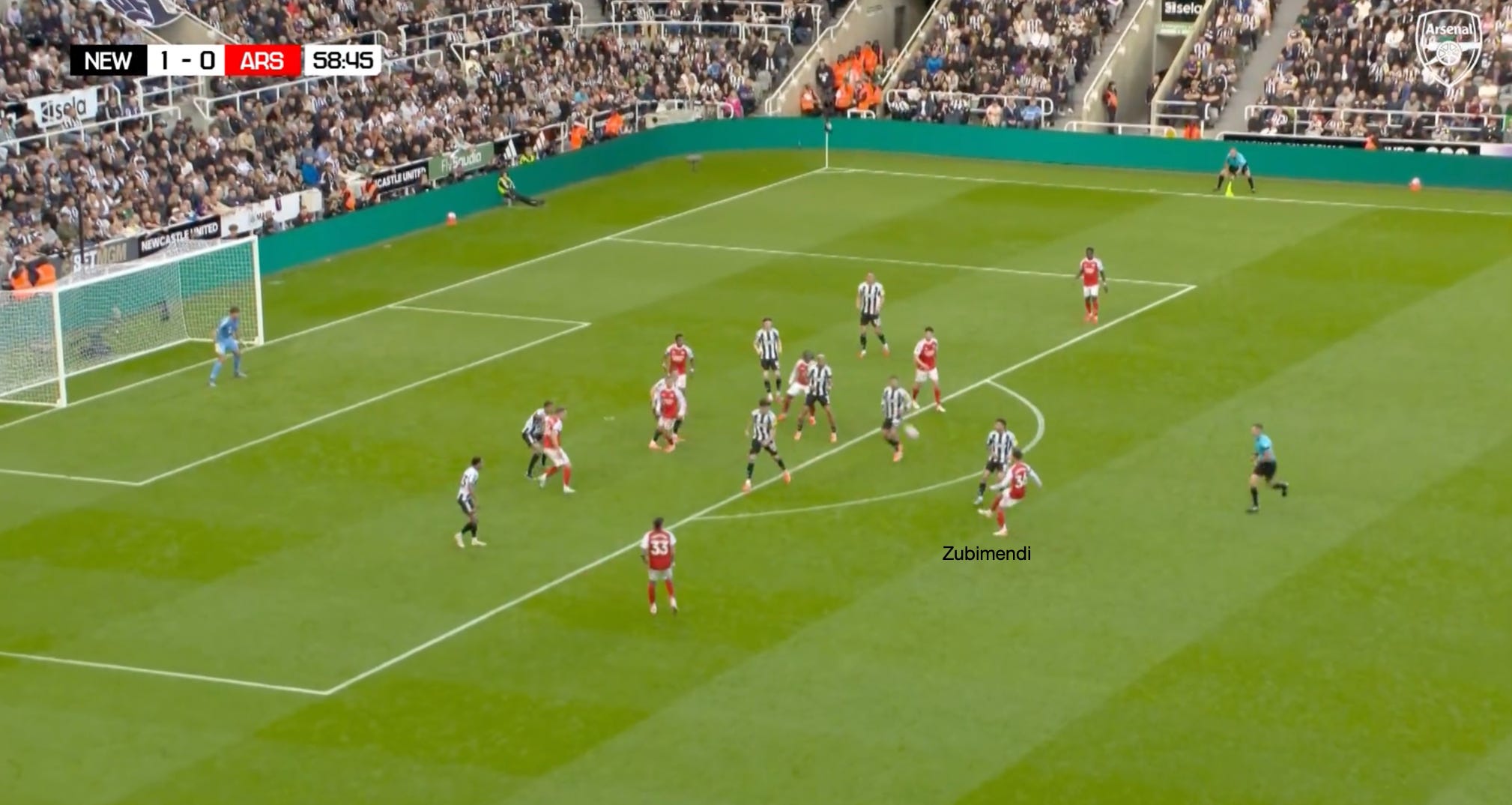
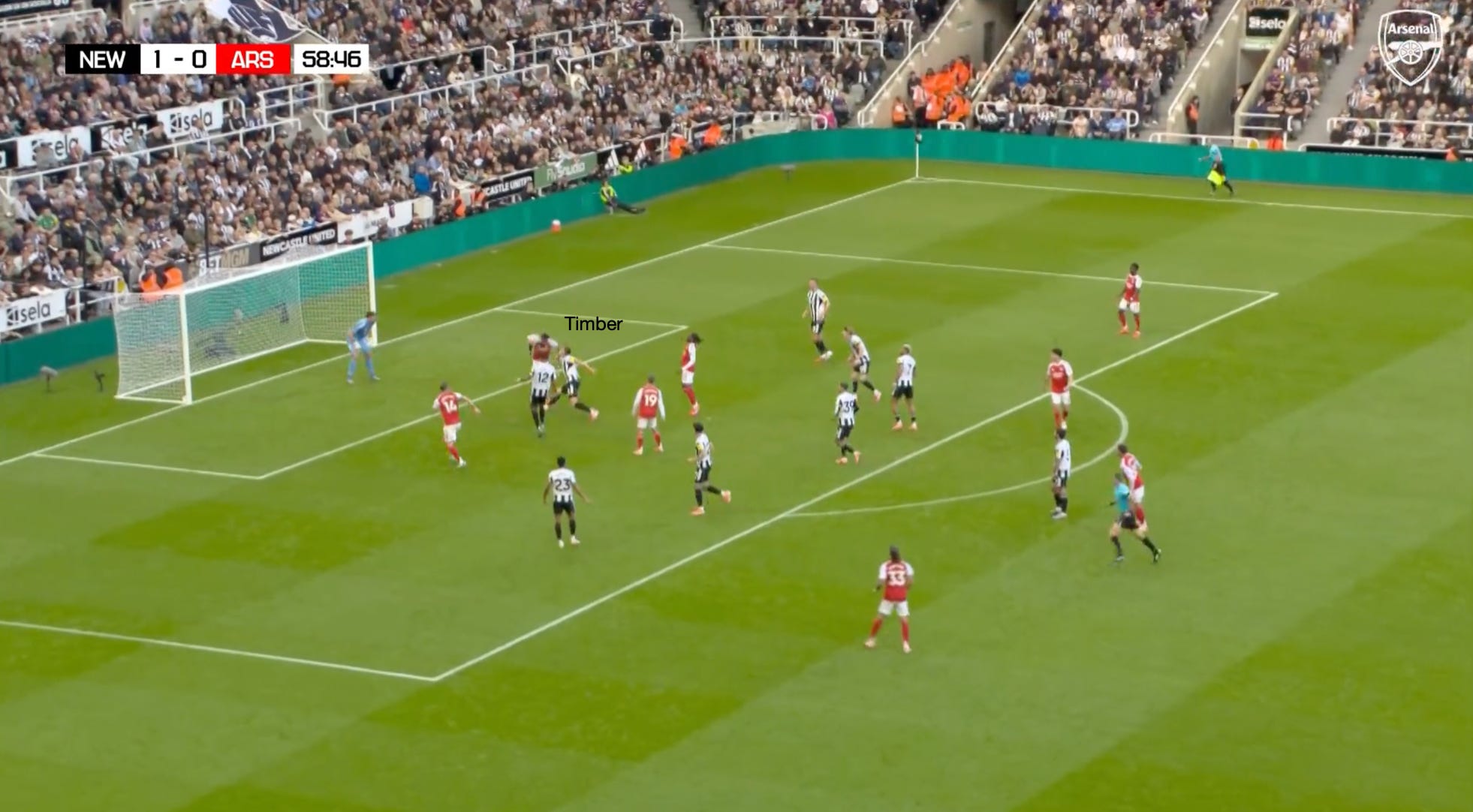
So what specifically has Zubimendi provided us with? Let’s focus solely on the salient factors and look at through balls to begin with, which are passes that are played into space, either on the ground or over the top. Zubimendi absolutely thrives here, with notable examples being against Newcastle and Atletico Madrid, with the former seeing him deliver an inch-perfect ball for Jurrien Timber to latch onto, forcing Nick Pope into action, whilst the latter is a delightful lofted pass in behind for Gabriel Martinelli to meet in the build-up to Viktor Gyökeres’ opening goal against Atletico Madrid.
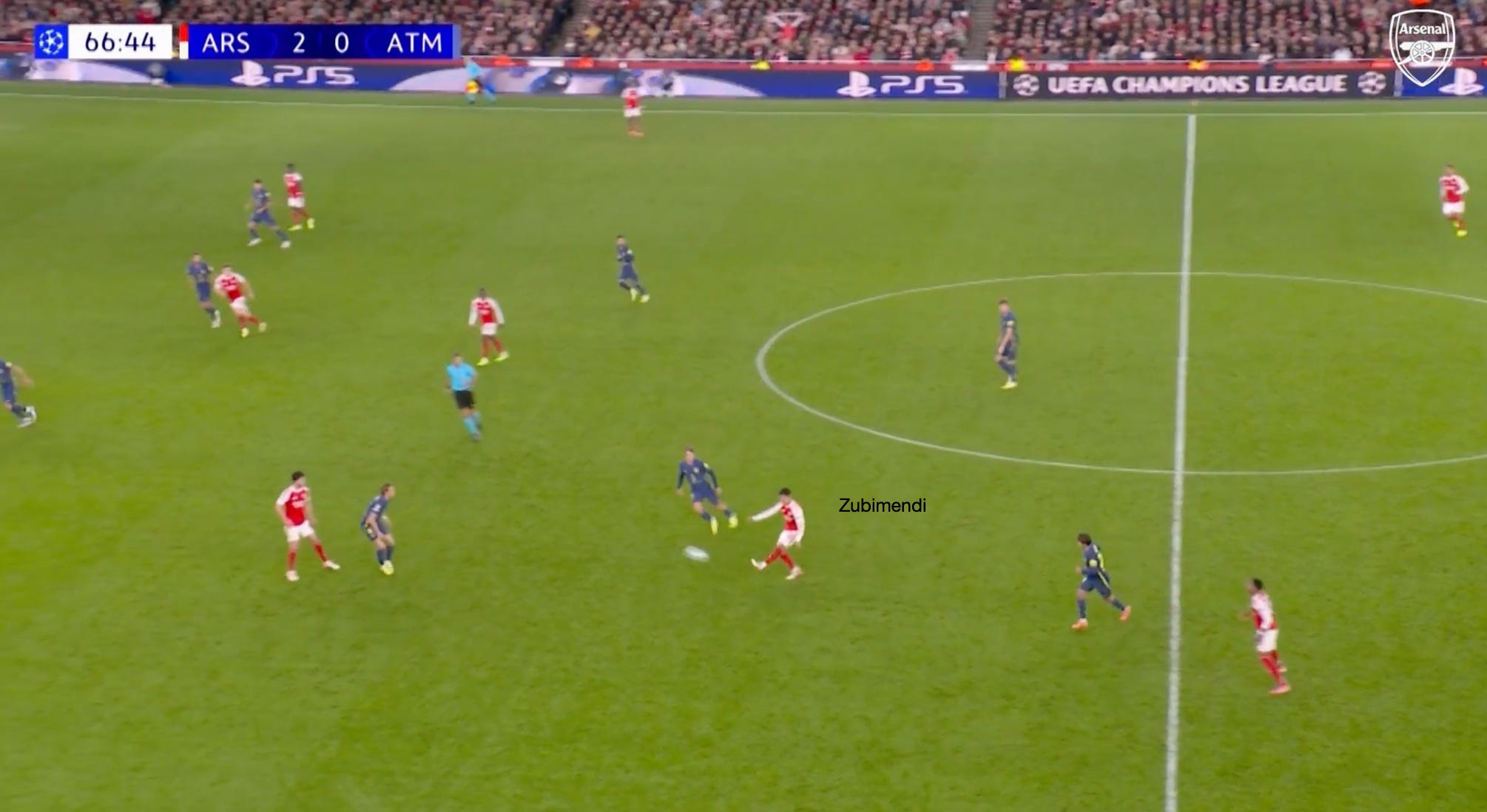
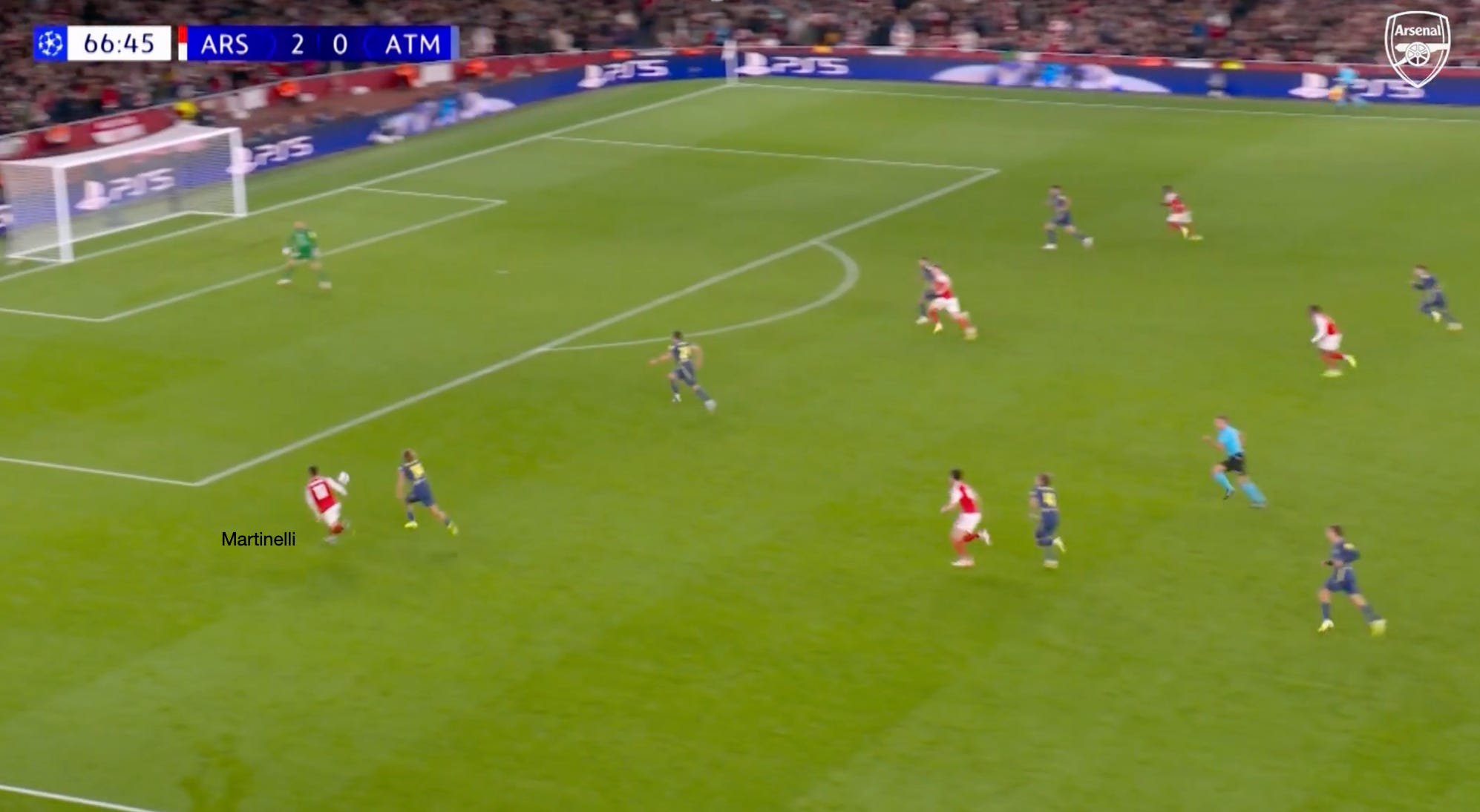
It’s also worth mentioning his exquisite pass in behind for Eberechi Eze that puts him through against West Ham, in the lead-up to Rice’s goal.
Statistically, as per Fbref, Zubimendi ranks in the 91st percentile for through balls per 90. My intuitive feeling is that his presence has made this pass more prevalent across the entire team. Although quantifying Zubimendi as the catalyst isn’t easy, what is discernible is that Arsenal are leading the way, courtesy of The Athletic, for delivering the most through balls (40) in the Premier League so far; no other team has executed more of these types of passes. A combination of Zubimendi’s presence, our wingers abandoning width by making diagonal out-to-in runs to a greater degree (see ‘Variation’), Gyökeres’ incessant runs in behind, and Riccardo Calafiori’s capricious nature in the final third is what I believe has led to the high volume nature of these passes being on show.
Let’s also remember that we are yet to see our skipper, Martin Ødegaard, have a regular run in the team. Through balls are a staple of his game, where he ranked top in Europe for this metric during the 2023/2024 campaign (Credit: Squawka).
To add more meat to the ‘on the ball’ Zubimendi discourse, it’s perhaps best to assess what’s different in how he’s interpreted the nominal six role and its benefits, compared to his predecessors. I would say one aspect is his influence in the pockets upfield, regardless of whether it’s in the left or right half-space, which has enhanced our play in the final third. The ability to receive inside the block, under pressure and remain comfortable whilst delivering the necessary precision is one of Zubimendi’s most underrated qualities as a player. One of the most recent examples was against Sunderland, where the Spaniard almost converted a chance via a quick shift, turn and shot following an excellent line breaker from Rice.
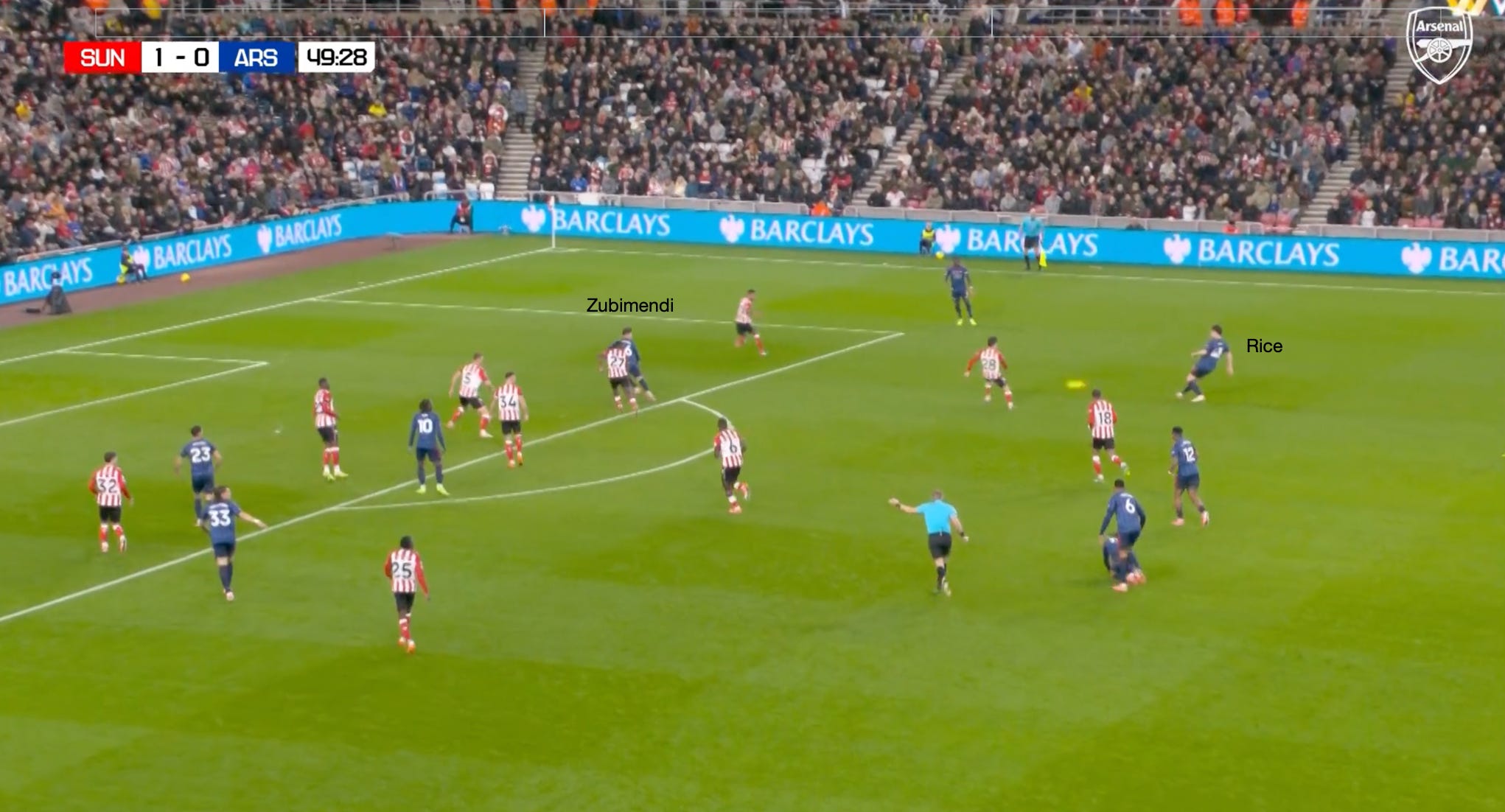
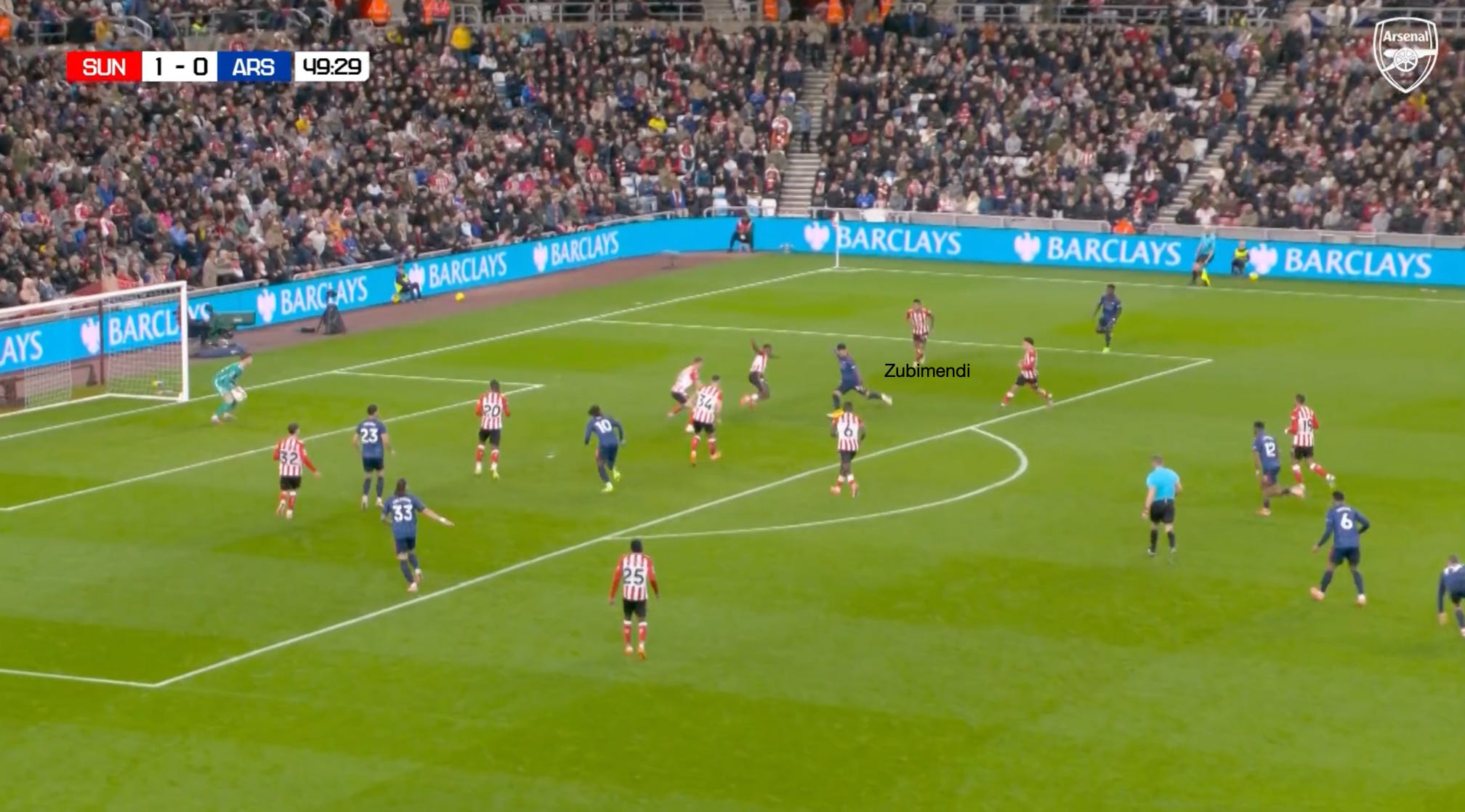
There were more situations showcasing Zubimendi’s prowess and intelligence in the final third at the Stadium of Light, which you can observe in my previous ‘Arsenal optimism’ piece, one of which sees him attack the vacated space in between the wide right centre back and central centre back, before almost finishing that sequence. This point about attacking ‘vacated space’ is vital, which we will discuss next.
You may recall an interview Rice did with The Athletic in 2024. One of the key points raised in that conversation is the emphasis Arteta placed on maintaining ‘good height’. In layman’s terms, all this means is positioning yourself accordingly to ensure that the ball carrier has enough options to play the ball forward. The off-ball players within proximity to the ball carrier must be in a zone that opens up the opportunity to keep the game flowing.
This was an area in which Rice required coaching. Zubimendi, however, has been educated within positional setups throughout his career, and it’s evident how smart he is when you watch him move through the thirds.
One of my favourite examples was in the game against Nottingham Forest at the Emirates, and you can see the sequence below.
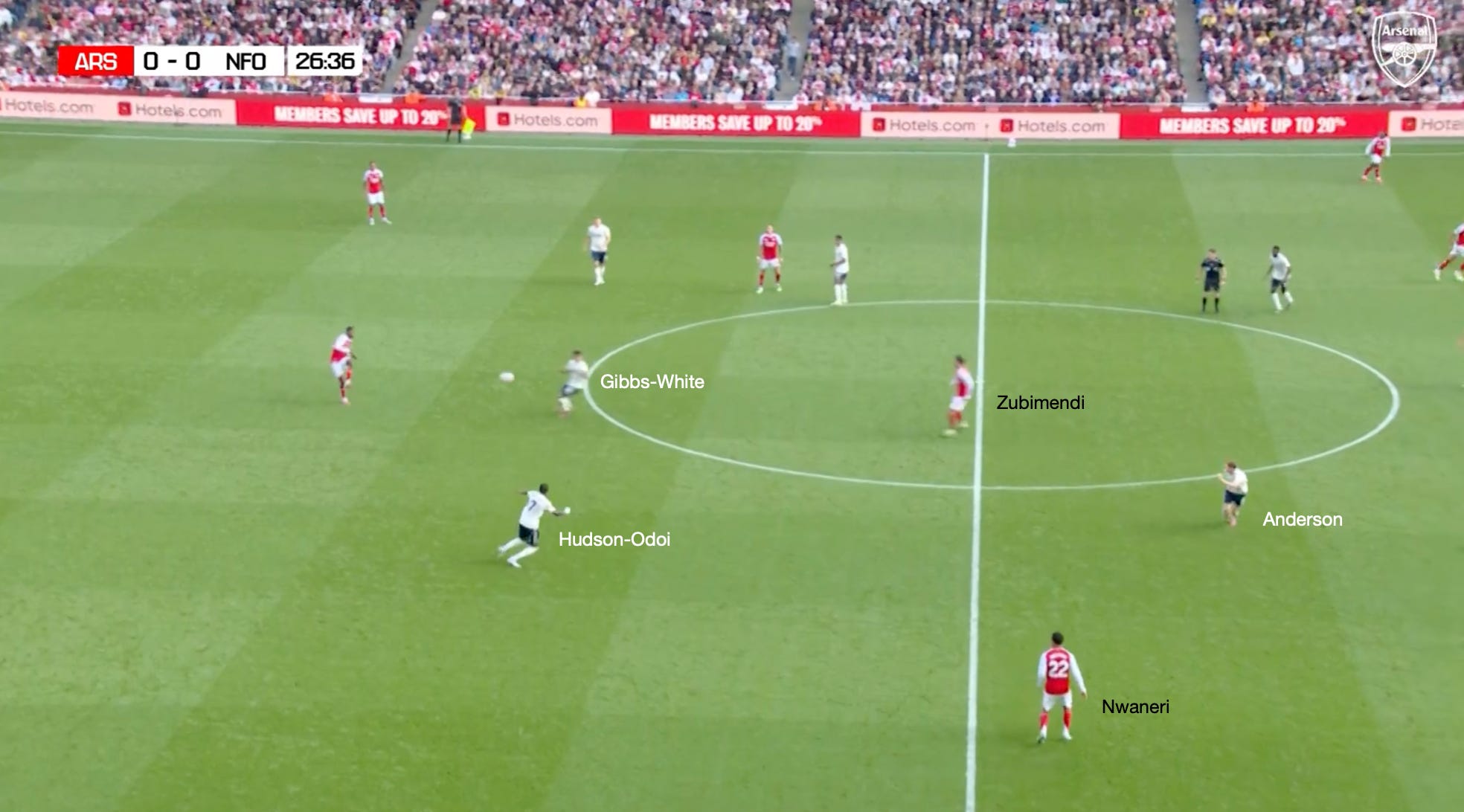
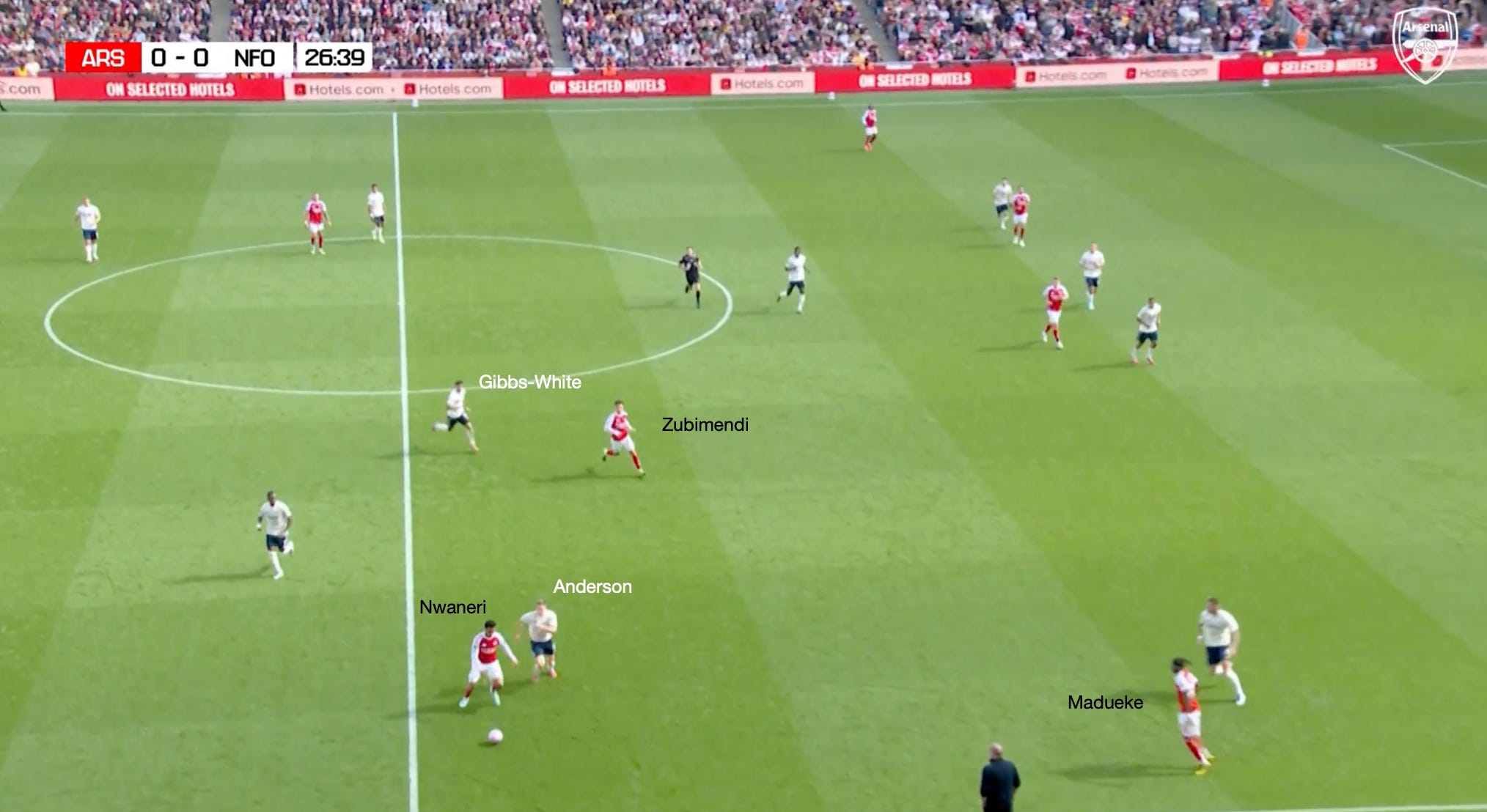
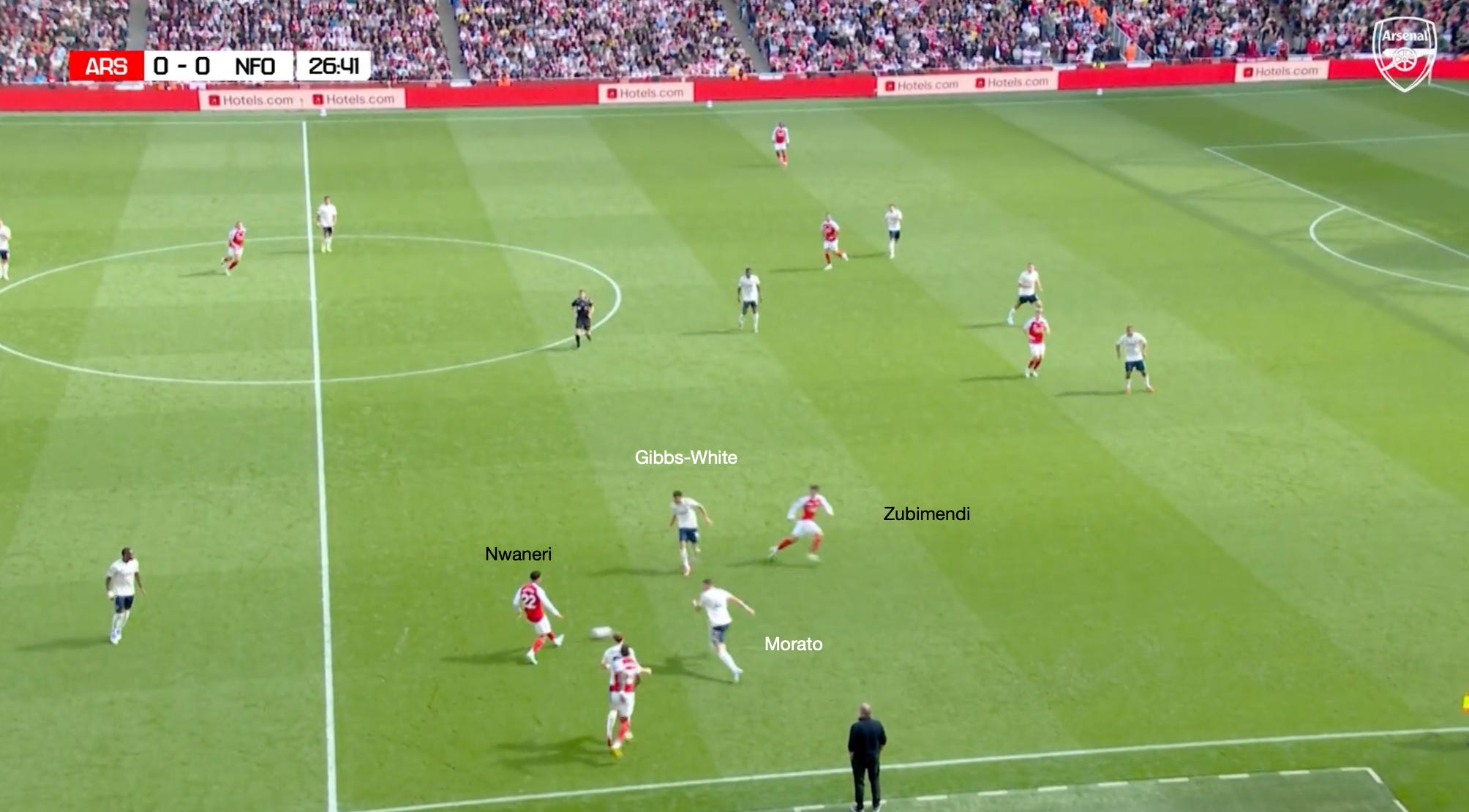
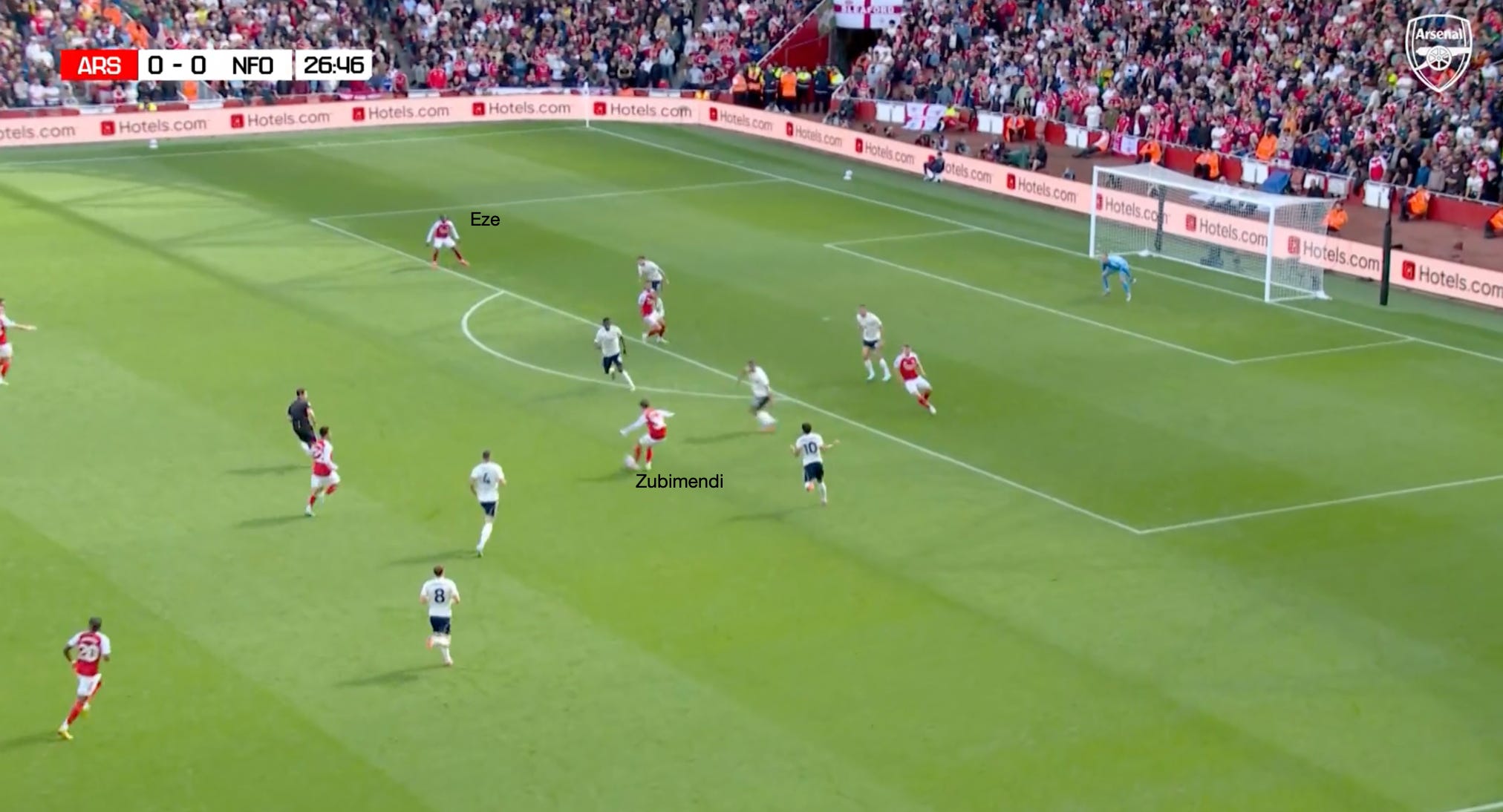
What I’m about to explain is, in Miguel Molina’s words, who is one of Arsenal’s assistant coaches, the principle of ‘three heights’.
‘Three heights’ is a structure we must adhere to when the opposition winger presses the wide centre back. You can see Callum Hudson-Odoi, the Forest left winger, high and ready to press our wide right centre-back, Timber, who is not shown in the initial picture. That is the trigger for someone to step outside of the block, which is Ethan Nwaneri in this scenario. Morgan Gibbs-White, the Forest number ten, initially marks Zubimendi but then proceeds to jump high as Cristhian Mosquera brings the ball forward, who delivers a wonderful pass into Nwaneri.
Now you may ask, why is there a trigger for someone to step outside of the block when the winger (Hudson-Odoi) jumps forward? Essentially, it’s to attack the press of the winger (again, this is in Molina’s own words) and to create a dilemma for the ball side midfielder, which is Eliot Anderson in this situation.
Does he stay and maintain central compactness? This would give Nwaneri the freedom to move forward as Noni Madueke has pinned the full back, and Gyökeres is stationed on the last line in between the two central defenders, which keeps them at bay.
Or does Anderson abandon the centre and pressure Nwaneri? He does the latter, which opens up other potential advantages that Zubimendi can exploit. After Nwaneri receives and is pressured by Anderson, passes are exchanged between him and Madueke, who is marked by the full back (Morato), before Nwaneri finds Zubiemndi, who attacks the vacated right half space and drives forward unmarked because Gyökeres has pinned the centre backs, before finding Eze on the ‘weak side’ (isolated flank), whose shot is eventually blocked.
Let me provide some further reasoning for the above paragraphs.
The concept of ‘three heights’ after Hudson-Odoi’s high positioning enables this move to occur. The three heights consist of Timber, Nwaneri and Madueke. These three players form the lines. Timber (height one), part of the back three, is pressed by Hudson-Odoi, which triggers the construction of the second height (Nwaneri), who is potentially the free man. Anderson, however, decides to jump wide and lock on to deny this superiority, and lastly Madueke (height three) pins the full back to open space between the opposition's defensive and midfield line. This structure gives us the platform to flow through the pitch.
Then it’s all about how players interpret space, and as we’ve already gathered, Zubimendi is excellent at judging the situation. He recognises that Nwaneri’s movements leave the right half-space further ahead empty, and attacks this zone to give either Madueke or Nwaneri an option ahead of play.
This, my friends, is a long-winded way of Zubimendi playing with ‘good height’ and there are plenty of examples available throughout the season already that demonstrate just how astute he is in this regard.
Let’s now bring our attention to Rice and start by looking at recent comments he made on the previous international break.
“The manager has adjusted my position at Arsenal a bit this year to give me a bit more freedom to drop deeper, but to also get in the box when I can.”
Interestingly, Arteta disagreed with Rice’s interpretations, emphasising that it’s less about the role and more about how the former West Ham skipper has ‘evolved’, which I will touch on later. Ultimately, what really matters is that change is conspicuous, which has taken Rice to a new level.
And that’s crazy to say, really, given how he has personified consistency under Arteta and was voted Arsenal’s 2024/2025 player of the year. The fact that his £105 million price tag isn’t questioned should speak volumes.
Rice’s ability, out of possession, isn’t bettered by any other midfielder in Europe, in my opinion. The way he’s able to turn 50:50 duels into 80:20s in his favour is truly remarkable, regularly using his frame and physical advantages to full effect. It’s also no surprise to see Arsenal’s press hit new heights since Rice’s arrival, and opposing teams recognise how much of a cheat code he is in turning over possession.
During the 2023/2024 season, a Premier League coach highlighted just how effective Rice is at dominating his space.
“We showed the players their [Arsenal] pressing, the intelligence of Declan Rice. The amount they ask Rice to do without the ball - jumping up to the press, being in between two players, constantly filling the right gaps -he’s been great.”
It’s his off-the-ball work that has been the biggest positive. But as stated at the beginning of the piece, I’m focusing on the ‘on the ball’ aspect of the game, and my overarching feeling is that we’ve yet to see the best version of Rice here.
Predominantly in possession, we’ve seen Rice play further forward and inside the left half-space, operating between the defensive and midfield lines, surrounded by bodies and with a focus on crashing the box.
But is that really maximising Rice’s ability in possession? I don’t think so.
Rice has so much more to give. He’s not a pocket or small space player. This is a player who requires the freedom to roam and face the play; utilising Rice in a back-to-goal manner is limiting.
If we look at his passing Fbref chart from last season, you will see a player who is under-utilised as a passer. Not ranking high in passes attempted, passes completed, etc. He was also averaging 62 touches per 90, which puts him in the 67th percentile when compared to midfielders across Europe.
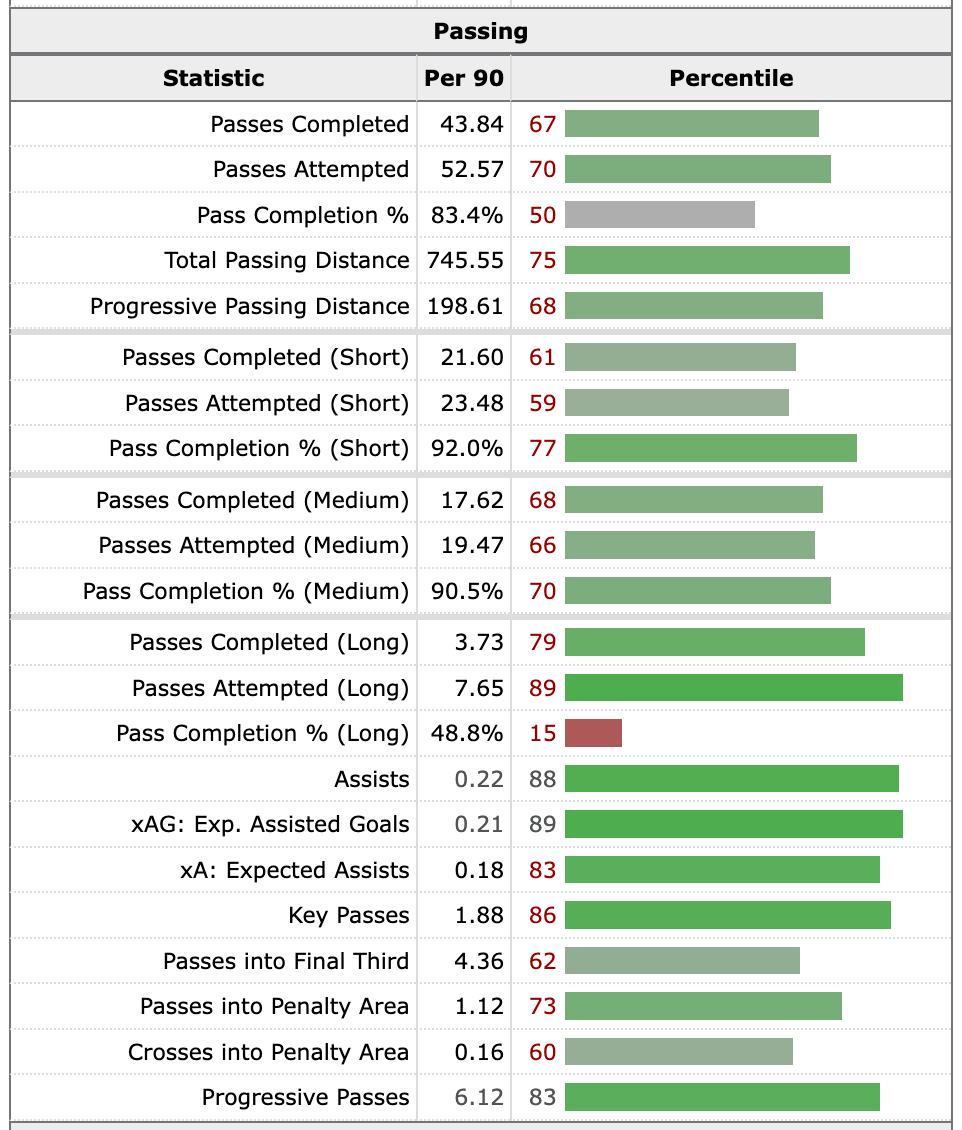
Fast forward to this season, and you will notice a significant difference. Take a look at the Fbref chart below. The law of small numbers applies once again, but this chart certainly signals change.
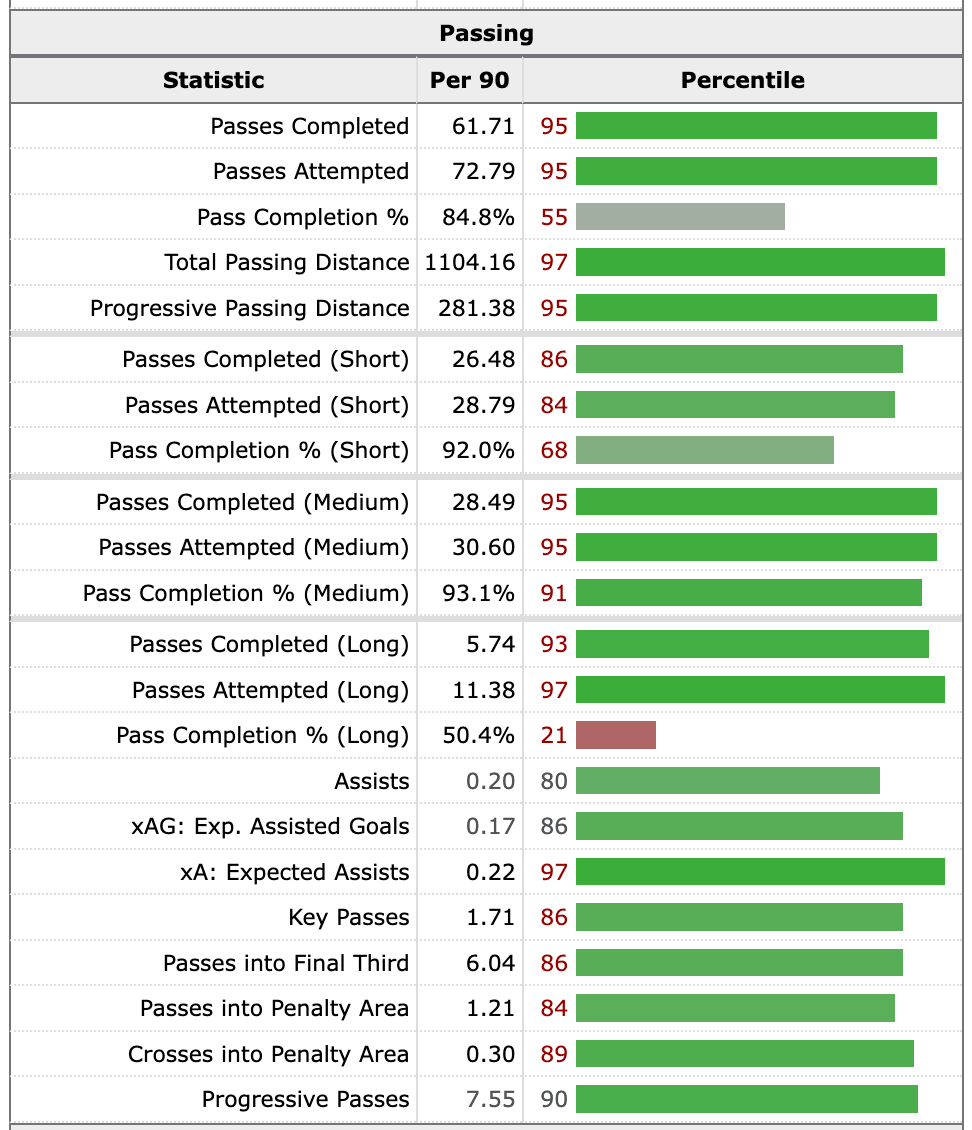
A sea of ‘above 90th’ percentile, and it’s also worth noting that Rice is racking up 20 more touches per game this season. I will discuss the benefits this has had later, but let’s focus on what’s driven this change. Two players are key in facilitating this ‘high-touch Rice’.
The first is Zubimendi. We have seen Rice and Zubimendi operate nominally as a double pivot, primarily. It’s a double pivot that staggers in various ways depending on how the opposition sets up and the challenges presented. There are further nuances to document, but the important point for now is that Zubimendi and Rice are working in tandem, which makes perfect sense.
For all of Zubimendi’s immense qualities, I would say his faults lie when the game becomes stretched and the distances between teammates lengthen. These flaws, however, are mitigated by Rice’s presence, who is immense at eliminating transitions. A high-touch Rice means a Rice who is deeper, which means a Rice who is frequently part of the rest defence structure, which means a Rice in more optimum spaces to offer stability.
Equally, a deeper and high-touch Rice also needs to be accommodated, as he isn’t without his own faults, one of which is his weaknesses in build-up against high-pressing systems and most notably man-to-man schematics. Rice isn’t someone who will receive the ball back to goal, turn and evade a press. He’s very much more comfortable playing the wall pass, thereby handing over responsibilities to others. And this is where Zubimendi mitigates this issue, as he is extremely confident under pressure in deeper areas of the pitch, acting as the conductor. This is the beauty of Rice and Zubimendi as a partnership.
The other crucial factor is Zubimendi’s lack of angle bias, which basically means that he is comfortable on both sides of the pitch, thereby enhancing fluidity. We’ve all seen just how adept Zubimendi is in drifting laterally towards the left-hand side, using his strong weak foot and speeding up the tempo of our play. Rice is equally strong on either side, which has allowed these smart diagonal movements across the pitch to occur between the two, making it much harder for the opposition to mark.
The second player, crucial to Rice operating deeper, is Calafiori, whom I labelled as capricious earlier in the piece because of his unpredictable nature, which Arteta views as a dangerous quality to have in advanced areas. At left back, Calafiori has a great feel for the game in the final third, combining with the left winger through rotations on both the inside and outside, as well as making powerful marauding runs through the inside channel, between the centre-back and full-back. You don’t constrain a player like Calafiori because he can make things happen through many zones across the pitch.
By having Calafiori higher up the pitch, this naturally forces Rice to play deeper, and the signs were there last season. In games against West Ham at the Olympic Stadium, Leicester City at the Emirates, and Nottingham Forest at the City Ground, Rice wasn’t primarily in the pockets and threatening the last line. Instead, he was playing deeper. Calafiori started in all of these games. Injuries, however, denied us the opportunity to see the Italian international over a large stretch of games, which opened the door for Myles Lewis-Skelly, who was used much more like a midfielder, predominantly inverting alongside Thomas Partey, which pushed Rice into the left pocket in between the lines.
Do I believe Lewis-Skelly could have been switched with Rice, where the latter is in the pivot and the former is in the left half-space, further ahead? Absolutely. However, we didn’t see this, but I do hope that in the not-so-distant future, we see our academy Hale End star notch nominal midfield minutes.
But anyway, Calafiori at left back has aided the presence of a ‘high touch Rice’, and it’s no surprise to see our left-hand side dynamics begin to blossom. Rice deeper, with Calafiori and Leandro Trossard forming the triangle, has produced a better balance. My ‘Arsenal optimism’ piece last week discussed just how threatening we were down this flank via some key dynamic patterns. I will once again caveat the ‘small sample size’ logic, but it’s certainly encouraging, and I’m keen to see how Eze performs on the left wing in this setting.
Another benefit of a ‘high-touch Rice’ is the fact that he’s been able to showcase his passing ability on a higher volume scale. He’s got a range of different types of passes in his locker, both on the ground and over the top, with one of his favourites being that line breaker from left to right, allowing the player on the opposite side to receive the ball on the diagonal. His pass to Ødegaard against Olympiacos is a great example of this in action.
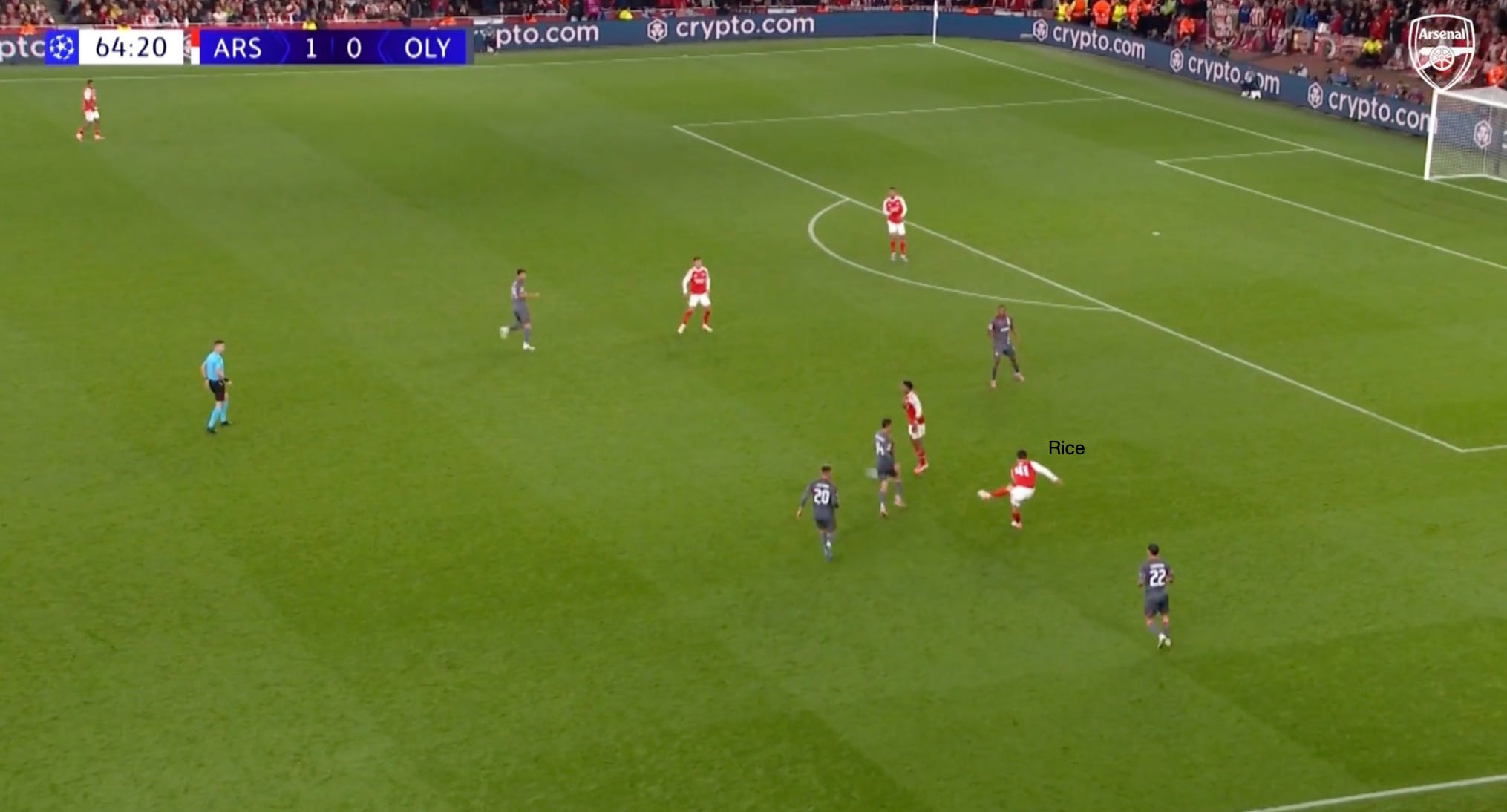
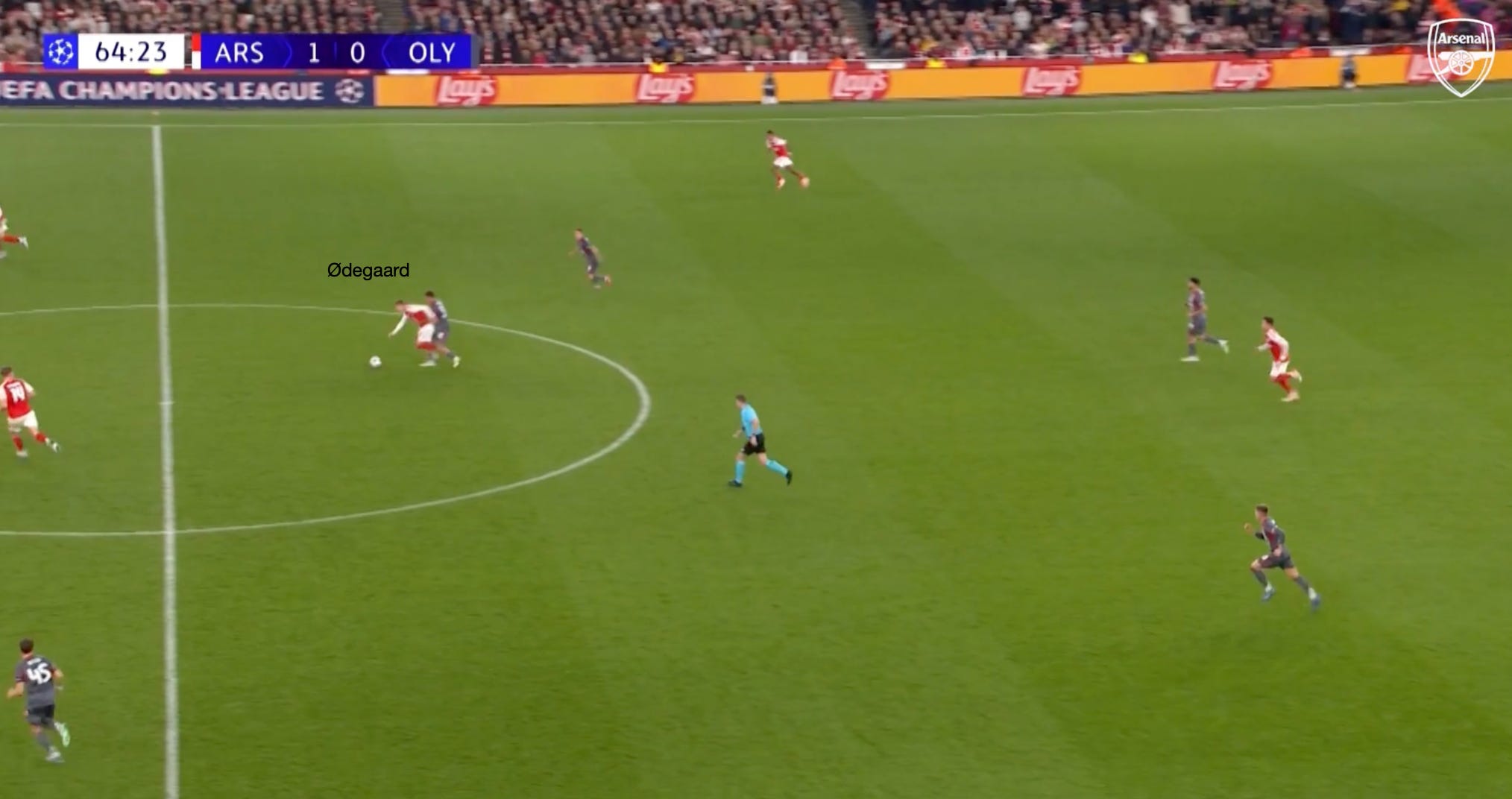
However, perhaps the most noteworthy pass Rice possesses is the long diagonal ball, which is a great weapon for isolating wingers in 1v1 scenarios. Statistically, as per Fbref, he ranks in the 93rd percentile for switches this season. We have seen this many times already, most notably perhaps against Fulham at Craven Cottage in the second half, which I discussed in length in my ‘Combating tactical homogeneity’ piece.
Before the current season, the only occasions on which we saw Rice’s passing abilities displayed over a lengthy sample size was during the second half of the 2023/2024 campaign, when he was playing nominally alongside Jorginho.
That, for me, is the most complete version we have seen of Arsenal under Arteta so far, and it’s no surprise to see why fans were becoming increasingly optimistic about a Zubimendi and Rice combination as time passed by, as comparisons, in theory, were made to the popular Rice and Jorginho pairing.
What’s also been great to see is the more box-to-box tendencies of Rice this season. I want to stress that Rice playing deeper doesn’t restrict him from making runs into the box, whether that’s against settled defences or in transition, which we’ve gathered from the comments he made that were shown earlier in this post.
If there is an opportunity to seek an advantage and that advantage comes from attacking the box, then one must do it! That is how Arteta football works; it’s all about provoking the opposition into performing certain behaviours and responding with superiority in mind. However, the difference in using Rice in this fashion is that he arrives from deep more often and in open spaces, as we saw with his goal against Burnley at Turf Moor.
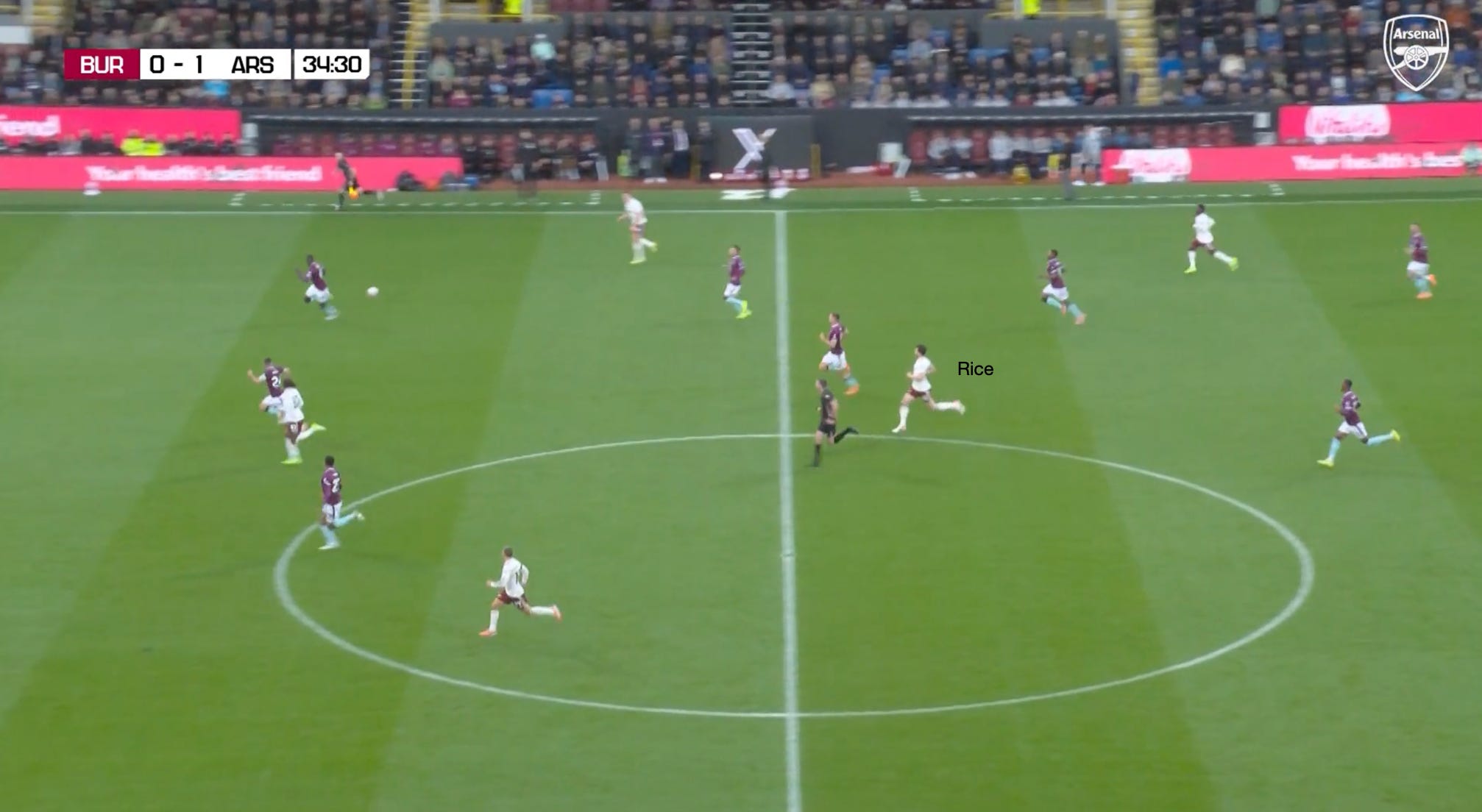
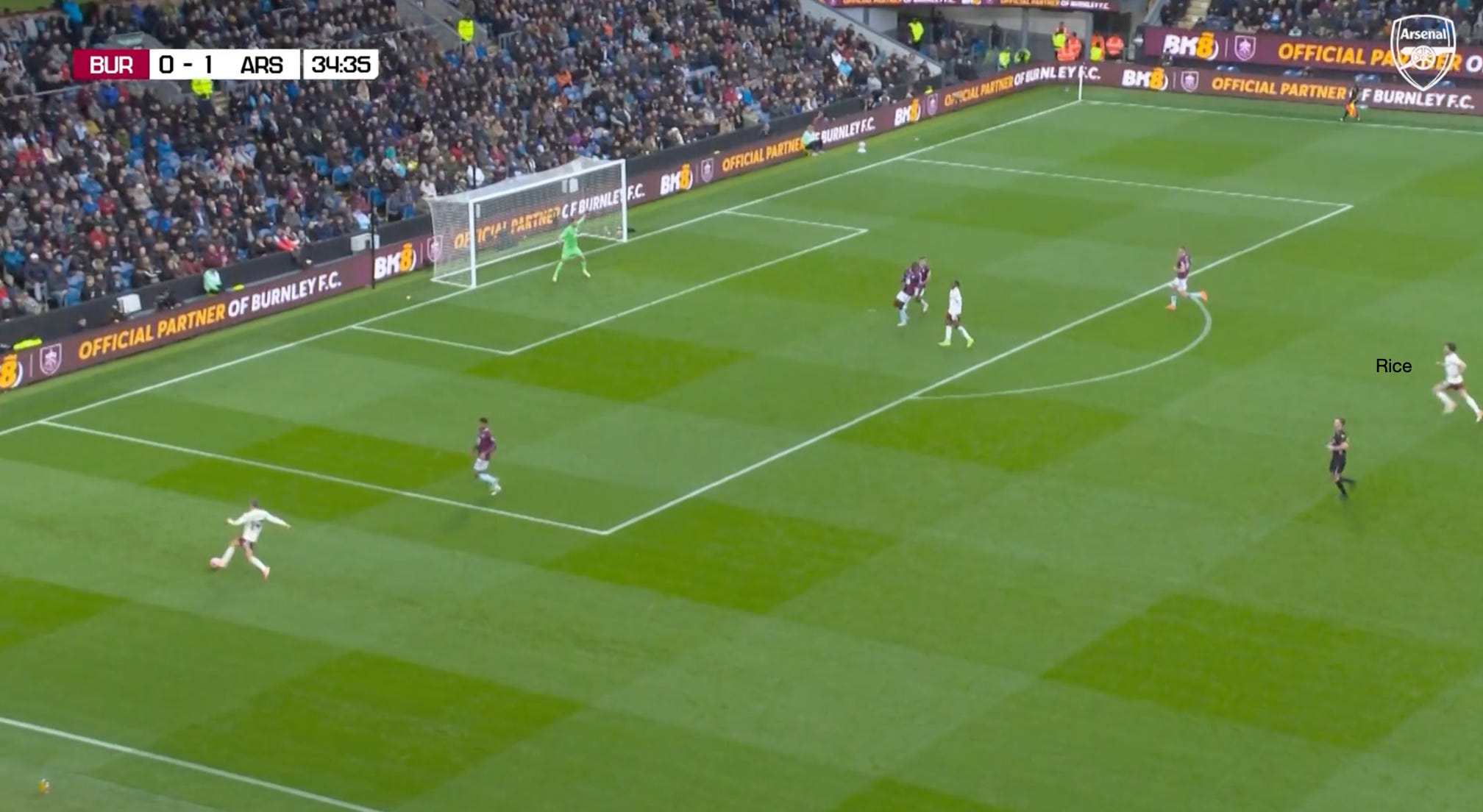
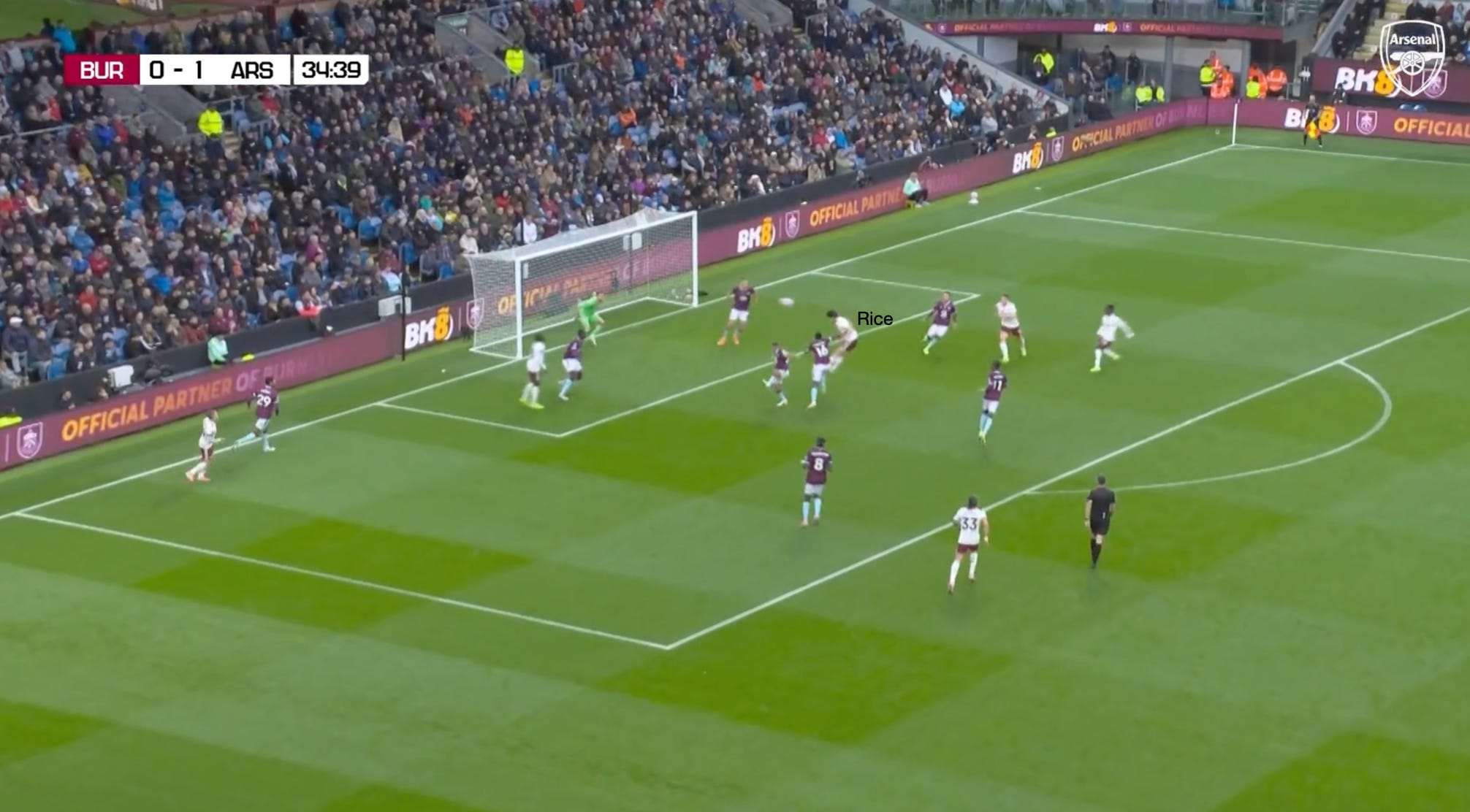
Rice has highlighted in the past how he loves to ‘drive forward with the ball’ when the game is open and he’s given the license to continue impacting proceedings with goals when the opportunity arises, despite his deeper role.
So what have we learnt? We are aware of just how positive the Rice and Zubimendi pairing has been, both in terms of what they’ve provided individually, how they complement each other's assets and the other associated ripple effects involved, especially with Rice, who still is given the freedom to join the attack and threaten the box, but is now having more touches on the ball. I see this as a win-win.
I think this is why Arteta emphasised how he has evolved this season. We are seeing a lot more of what Rice has to offer in all phases.
Against Fulham, his switch to wide left centre back and essentially the ‘false full back role’ for a midfielder after the interval was key in unlocking the right-hand side in multiple ways, as mentioned in my ‘Combating tactical homogeneity’ piece.
Against Newcastle, we saw him more in the single pivot with Zubimendi stepping into the backline on the right. Against Slavia Prague, due to the absence of runners across the frontline, such as Gyökeres, Kai Havertz, Martinelli, and Madueke, with Mikel Merino as the centre forward, Rice was used as one of the stretchers to add depth and verticality to our attacks. I could go on and on. He has already been tasked with various responsibilities throughout the season.
And a lot of this doesn’t happen without Zubimendi. He and Rice provide a plethora of ways in which we can attack the opponent. And I haven’t even discussed in length the defensive or pressing side of the game, Zubimendi’s ball striking capabilities in situations we have manufactured, where he can shoot on sight near or inside the box, and of course, Rice’s elite set-piece delivery. I can cover all of this and more in a later piece.
My final point is that we are yet to see a Zubimendi/Rice/Ødegaard trio over a run of games. What do all three have in common?
They are all capable of playing ahead of the ball, behind the ball and through either side of the pitch.
Granted, each of these players has their preferred areas they would like to occupy the most, but the fact that they can all move comfortably in and out of different zones is exciting.
Great post, man. Made me even more excited to see ode, zubi and dec (and a fully firing eze on the wing). Honestly, Rice is a player who I can still barely believe plays for us, absolutely crazy talent. Watching him for Ingerland this international break just exemplified it further.
That Athletic article with prem managers/analysts providing their views on Arsenal that you alluded to was also a good read, hadn't seen that before. Keep it up!
Great read, and you should consider writing bigger pieces where you incoporate all the things as one, instead of breaking them down into smaller pieces. I assume we all would have the time to read 10,000+ words on Zubimendi and Rice's burgeoning partnership.